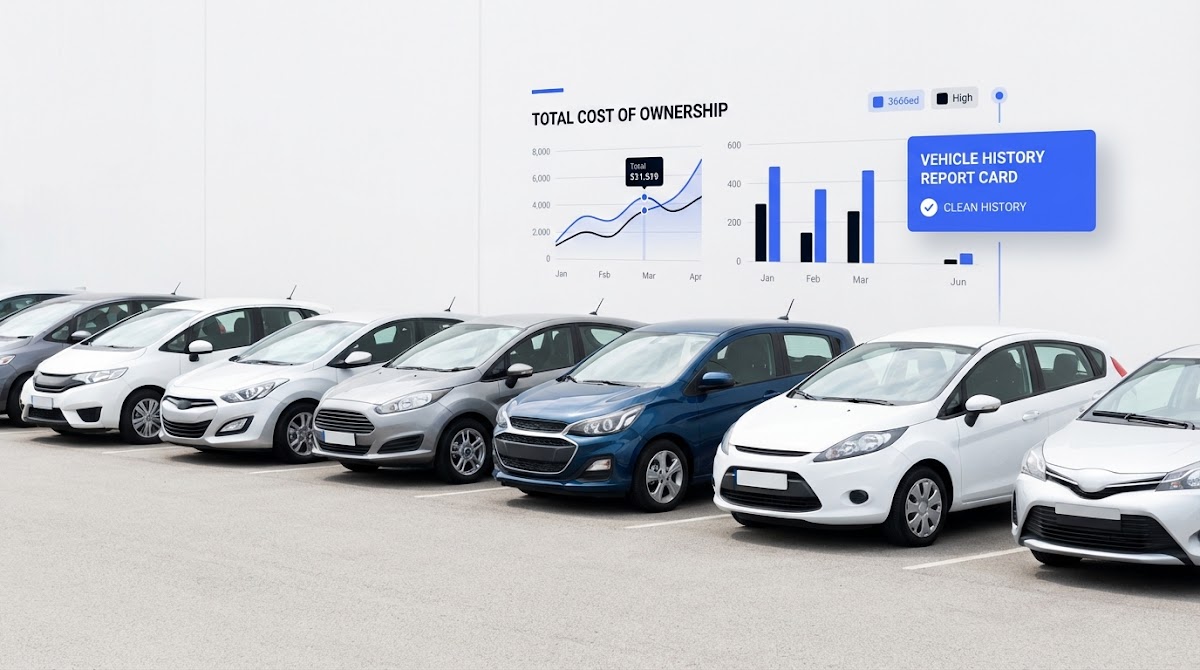
Which small car is best value for money? Practical guide to affordable cars for sale
This guide shows how to evaluate affordable cars for sale by looking beyond sticker price to total cost to own, reliability, fuel use and safety. It explains how to use model-level 5-year TCO tools, EPA fuel data and vehicle history reports to compare small cars, and gives checklists and scenarios for common buyer profiles.
This guide helps research-focused buyers decide which used Honda Fit years to approach with caution and what checks to run before contacting a dealer. It explains why mid-2010s Fits often show more transmission and engine complaints, why VIN-level recall checks matter, and how to use a vehicle history report and pricing context to reduce risk.
This guide explains current new and used pricing for buyers searching for tesla 3 for sale, and shows the VIN-level checks that matter most. It summarizes 2026 new Model 3 starting points and used value bands, then gives a step-by-step checklist to verify any listing with a vehicle history report and battery warranty checks.
This article explains the most common problem buyers encounter when looking at used tundras for sale, focusing on evidence from government complaints and owner-aggregator reports. It outlines practical inspection steps, how to check VIN-specific recalls and TSBs, and what to prioritize in a vehicle history report to reduce risk.
Searching for affordable cars for sale often starts with a low sticker price. This guide reframes that search so you compare small cars on total cost to own and risk. It shows how to use five year TCO tools, EPA fuel data and vehicle history reports to make clearer, evidence-based choices.
Compare five year total cost to own, not just the asking price, to find true value among small cars.
Use EPA combined MPG and model-level TCO tools to see how fuel and depreciation change ownership cost.
Run a vehicle history report and verify title and service history before contacting the dealer.
What "affordable cars for sale" really means: price versus value
When shoppers search for affordable cars for sale they often mean models with a low asking price. That is only part of the picture. Value for money depends on how much the car will cost to own over time, including depreciation, fuel, maintenance, insurance and fees.
Standardized five year total cost to own tools let you compare models using the same assumptions so you see ownership impact rather than only the purchase price. A widely used baseline for model-level 5-year ownership estimates is Edmunds' True Cost to Own, which many shoppers use to convert a listing price into long run cost expectations Edmunds True Cost to Own, or the Department of Energy Vehicle Cost Calculator AFDC Vehicle Cost Calculator.
Fuel costs matter more for buyers who drive a lot or consider higher mileage trims. The EPA fuel economy data and the fueleconomy.gov calculators provide the standardized miles per gallon and fuel cost inputs you can paste into a TCO tool to compare trims and powertrains.
Local variables change the final math. Regional fuel prices, local insurance premiums and dealer pricing all affect the total cost to own, so treat any model-level comparison as a starting point you must adjust to your ZIP code and expected mileage.
In used listings, the phrase affordable cars for sale should therefore be read as affordable after reasonable ownership costs are considered, not merely affordable at purchase.
Where to start: searching listings and filtering for affordable cars for sale
Set a realistic budget that includes expected five year ownership costs, not only the price tag. Start by estimating a target total cost to own from a TCO tool, then work backward to a maximum purchase price that keeps the five year total within your budget constraints. Use a model-level TCO baseline to see how different asking prices change the five year outcome Edmunds True Cost to Own, and try calculators such as State Farm's new vs used car tool New vs. Used Car Calculator. For step by step help, see our how-to guide.
Once you have a purchase range, use listing filters to reduce risk before you visit. Prioritize listings with a clean title, single owner history, no reported accidents when applicable, clear mileage checks and evidence of regular maintenance. These filters tend to reduce the chance of surprise repair costs and make the TCO estimate more reliable.
Price analysis labels on some marketplaces help triage listings. Labels such as Great Deal or Good Deal provide local pricing context and let you focus first on candidates that are priced competitively. Treat labels as a prioritization cue and verify each candidate with a vehicle history report and a local TCO check before you commit.
Concrete example, step by step: set your five year ownership target, run a model-level TCO for your ZIP code and expected miles, then add a filter stack: clean title, single owner, maintenance records, mileage check. This workflow helps narrow the field to listings that are both affordable and lower risk.
How to compare affordable cars for sale using a 5-year TCO framework
A five year TCO tool breaks ownership into core components: depreciation, fuel, maintenance and repairs, insurance, taxes and fees. Use the tool to translate a listing price and your personal inputs into an apples-to-apples cost projection. A common industry baseline for model-level data is Edmunds' True Cost to Own, which provides the structured inputs many shoppers rely on when ranking models by expected ownership cost Edmunds True Cost to Own. The AAA Your Driving Costs calculator also gives a breakdown of typical annual driving costs AAA Your Driving Costs.
Depreciation is often the largest single ownership cost for mainstream small cars. Kelley Blue Book highlights depreciation as a primary driver of five year totals, so make sure your comparison accounts for how different models and trims hold value over time rather than focusing only on initial price Kelley Blue Book 5-Year Cost to Own.
Fuel inputs matter by trim and powertrain. Use EPA MPG figures and the fueleconomy.gov find a car tools to copy the combined MPG and typical fuel cost into your TCO calculator so the fuel line reflects the trim you are actually considering fueleconomy.gov Find a Car.
The best value depends on your priorities and local costs; use a five year TCO for exact trims, factor in reliability and safety ratings, and verify each listing with a vehicle history report before you contact a dealer.
Practical steps to run a comparison.
1. Enter the model, year and trim into the TCO tool. 2. Set your ZIP code so local tax and insurance estimates are applied. 3. Input expected annual mileage and select the fuel type or powertrain. 4. Paste the EPA combined MPG for that trim to get a consistent fuel cost estimate. 5. Compare the five year totals across candidates and sort by the metric that matters most to you, such as lowest five year cost or best balance of cost and reliability.
Keep these adjustments in mind when comparing two similar models. Small differences in depreciation curves or MPG can shift the ranking when totals are close, so always run the numbers for the exact year and trim listed rather than assuming all versions of a model cost the same to own.
Key decision criteria to rank the best value small cars
When you rank models for value, focus on a short list of criteria that drive long run cost and ownership experience. Start with depreciation, reliability, fuel economy and safety, then apply local context such as insurance costs and resale trends.
Depreciation and expected resale
Depreciation is a major ownership cost. Use model-level outputs from tools that estimate five year declines so you understand how much of the purchase price is likely to be lost to depreciation. Kelley Blue Book's guidance makes depreciation a central part of the ownership equation, and comparing KBB or TCO outputs across models helps you see which ones hold value better Kelley Blue Book 5-Year Cost to Own.
Reliability and likely maintenance spend
Reliability ratings from long run studies tend to correlate with lower expected maintenance and repair costs. Where ratings differ between candidates, favor the model with stronger reliability indications because that can lower unplanned costs over the ownership period Consumer Reports car reliability.
Fuel economy and powertrain choices
Fuel economy varies by engine, hybrid option and transmission. Copy the EPA combined MPG for the exact trim into your TCO inputs and evaluate how much fuel cost changes the five year total. For drivers with high annual miles, fuel differences can shift the ranking substantially fueleconomy.gov Find a Car.
Safety ratings and insurance impacts
Safety ratings matter for more than occupant protection. Better crash test performance can reduce insurance premiums and support stronger resale values in some markets. Include IIHS ratings as a factor when two models are otherwise similar, and adjust your ownership score accordingly IIHS vehicle ratings.
Each of these criteria can be weighted to match your priorities. For a commuter, fuel economy and insurance impact may weigh more. For a family, safety and interior space may be higher priorities. Use the TCO outputs as the numerical backbone, then factor in reliability and safety as multipliers on expected maintenance and insurance lines.
How to check a used listing: vehicle history reports, pricing insights and red flags
Before you move a listing into the serious consideration set, run a vehicle history report and compare it to the listing details. A report can reveal ownership history, accident history, service records, title status and odometer checks that materially affect your risk profile.
When you read a vehicle history report, confirm the VIN, ownership history and title status first. Check for any reported accidents and review service history entries for evidence of regular maintenance. These pieces of information help you decide whether the model-level TCO is likely to hold or whether hidden issues could raise future costs Consumer Reports car reliability.
Use fueleconomy.gov to copy combined MPG for TCO inputs
Copy the combined MPG into your TCO tool
Price analysis labels give local pricing context but should not replace a report check. Labels like Great Deal or Good Deal compare the asking price to local market activity and can help prioritize listings, but always reconcile a label with the vehicle history report and a model-specific TCO estimate.
Common red flags include salvage or rebuilt title status, large gaps in service history, odometer rollback indicators and a history of multiple owners in a short period. If a report shows these signals, consider walking away or booking a pre-purchase inspection because future costs can increase dramatically.
When a listing looks good on paper, confirm the VIN with the dealer and run a fresh vehicle history report before any deposit or payment. If the report contains questions, get clearer documentation from the dealer and, where reasonable, schedule an independent inspection.
Common mistakes buyers make when chasing the cheapest small car
Focusing only on the sticker price is the most common error. A low asking price can mask higher depreciation, poor reliability or missing maintenance history, which raises total ownership cost. Kelley Blue Book emphasizes depreciation as a top ownership cost, illustrating why sticker price alone can be misleading Kelley Blue Book 5-Year Cost to Own.
Skipping reliability and safety checks is another frequent mistake. Reliability studies offer predictive insight on maintenance and repair spend, so skipping that step can leave you exposed to higher than expected bills. Use long run reliability ratings to prioritize candidates that tend to incur lower repair costs Consumer Reports car reliability.
Ignoring regional variables such as local fuel prices or insurance premiums also undermines a good comparison. EPA fuel numbers are a consistent input, but you must apply local fuel prices and insurance estimates to get realistic ownership totals fueleconomy.gov Find a Car.
Instead of only chasing the cheapest sticker, build a small checklist: run a TCO comparison for the exact trim, run a vehicle history report, confirm maintenance records, and weigh reliability and safety before you call the dealer.
Practical scenarios: choosing an affordable car for sale for three buyer profiles
Below are three compact scenarios that show how to apply the decision framework. Each includes the top priorities, key TCO components and a short pre-call checklist.
Urban commuter focused on fuel and parking costs
Top priorities: fuel economy, small footprint for parking, predictable maintenance costs. For this buyer, the fuel and depreciation lines in a five year TCO matter most. Use EPA combined MPG for the specific trim and set expected annual mileage high enough to reflect commuting patterns. If fuel is the largest recurring expense, choose the trim or powertrain with the best MPG after you confirm reliability indications.
Checklist: confirm combined MPG for the trim, run the TCO with your ZIP code, check the vehicle history report for service entries, verify parking size and security at your destination.
Small family prioritizing safety and space
Top priorities: safety ratings, interior room and reliability. For families, insurance and resale implications of safety ratings can be significant. Include IIHS ratings in your decision and favor models with good occupant protection and child seat compatibility. Reliability ratings matter because unexpected repairs interfere with family routines and increase out-of-pocket costs.
Checklist: verify IIHS ratings for the model year, run a TCO with a moderate mileage estimate, confirm ownership history and service records in the report, check for child seat anchors and interior space in the listing photos.
First-time buyer who wants low TCO and reliability
Top priorities: low total cost to own, predictable maintenance and easy insurance. This buyer should weight depreciation and reliability most heavily. Use a five year TCO to set maximum purchase price and prefer candidates with stronger reliability signals from long run studies. A vehicle history report adds another layer of verification to reduce the chance of surprise expenses.
Checklist: run TCO for the exact year and trim, review Consumer Reports reliability guidance, run a vehicle history report and confirm clean title and regular service entries.
Run a Vehicle History Report to verify the listing
Before you call dealers, run one TCO comparison and a vehicle history report to confirm the listing matches your budget and risk tolerance.
These scenarios show how different priorities change the way you interpret the same set of facts. Across profiles, the shared steps are the same: use a TCO baseline, copy the exact trim's EPA MPG, check reliability signals and run a vehicle history report before you visit the dealer Edmunds True Cost to Own. Read more on our blog.
Next steps: a checklist before you contact the dealer
Use this compact pre-call checklist to prepare. Confirm the VIN and run a vehicle history report. Verify the title status and the ownership history. Compare the asking price against the five year TCO outputs and any platform price analysis labels. Confirm the exact model year, trim and powertrain so your comparisons are accurate.
Bring these items to the call: the VIN, a note of your TCO comparison totals, questions about recent maintenance and any service receipts the dealer can provide. Ask clearly about warranty transfers and any dealer disclosures about prior damage or title issues.
Frame CarFax Deals as a verification and pricing-insight layer that may help surface risk signals and pricing context when you are comparing multiple listings. Use vehicle history reports and price analysis labels as inputs to your decision, not as a single determining factor.
Finally, plan to book an independent pre-purchase inspection for any used car that remains a finalist. The inspection can confirm mechanical condition and catch items not visible in a history report.
Use a five year TCO tool, enter the exact model, year and trim, set your ZIP code and annual mileage, paste the EPA combined MPG for that trim, and compare totals including depreciation, fuel, maintenance, insurance and fees.
Confirm the VIN, ownership history, title status, reported accidents, service records and mileage checks; any inconsistencies or salvage indications are red flags worth deeper inspection.
Yes, for high mileage drivers differences in fuel economy can materially change five year ownership totals, so use EPA MPG for the exact trim in your TCO comparison.
When comparing affordable cars for sale, a short workflow will reduce risk: run a TCO for the exact trim, copy the EPA combined MPG, run a vehicle history report and verify title and maintenance records. Layer these checks with safety and reliability signals to choose the car that is most likely to stay affordable over time.

 Blog
Blog