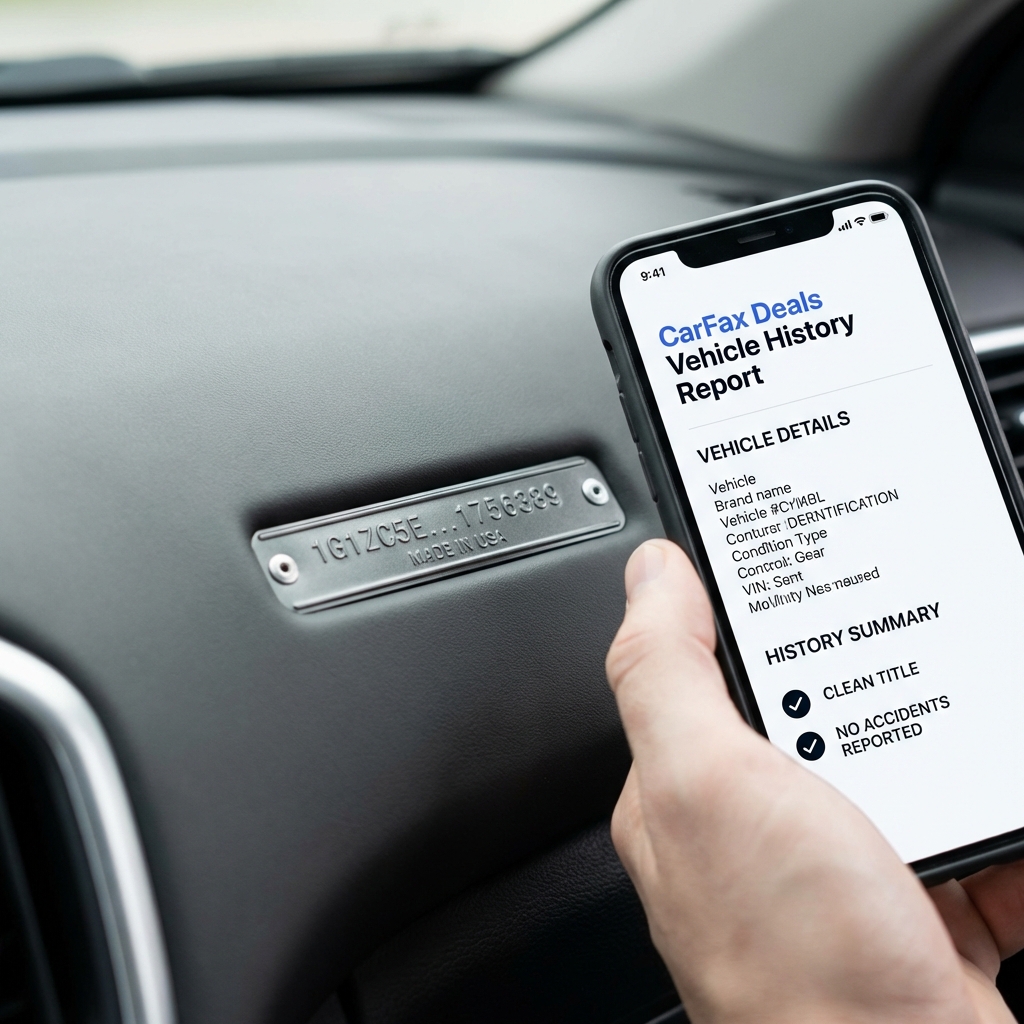
Car buyers often ask whether a $5,000 asking price is reasonable. This guide shows how to judge car prices by using local comparables, vehicle history reports, and inspection-led cost estimates. It offers checklists, a step-by-step framework, and decision rules to help research-oriented buyers decide whether a $5,000 listing fits their needs.
Carfax coupon codes rarely work, and the codes listed on coupon sites are usually expired. The discounts that do exist are bundles (three reports for $64.99, five for $99.99), AAA member pricing, and free reports from dealers and listings. The simplest guaranteed discount is CarfaxDeals at $7.99 per report versus $44.99 at Carfax.com.
A Carfax VIN lookup takes the 17-character vehicle identification number and returns the car's recorded history: accidents, title brands, odometer readings, owners, and service records. Free VIN tools only decode specs or check recalls and theft. The full Carfax report costs $44.99 on Carfax.com and $7.99 at CarfaxDeals.
You can get a free Carfax report from the Carfax.com used car listings, a dealer website, the seller, Carfax Car Care (for a car you already own), or listing sites that include one. There is no free report for any VIN you type in. When no free report exists, a paid one costs $44.99 at Carfax or $7.99 at CarfaxDeals.
If you are wondering whether $5,000 is a good price for a used car, the short answer is: it depends. The listing price tells part of the story, but local market comparables, the vehicle's condition, and verified history are the factors that decide whether that number makes sense for you.
This guide walks through practical checks and a repeatable framework for turning a $5,000 sticker into a reasoned offer target. It covers immediate triage steps, how to read a vehicle history report, inspection priorities, and clear decision criteria for buyers with different ownership horizons.
Local comparables and a VIN vehicle history report matter more than national sticker averages when judging a $5,000 listing.
A paid pre-purchase inspection often changes the fair value of a low-priced car by hundreds to thousands of dollars.
Set an offer by subtracting likely repair costs from the asking price and comparing the result to local comparables.
What $5,000 typically means in today’s used-car market
Why price bands matter more than sticker numbers for car prices
When you see a listing priced at $5,000, treat that figure as a price band rather than a final verdict. In many markets, cars at this level are usually older or have higher mileage, which tends to raise the chance of near-term repairs and ongoing ownership costs; national valuation guides are a starting point, but recent local listings give a clearer sense of what similar cars actually sell for in your area Kelley Blue Book guidance on comparables.
Price bands matter because local demand, regional vehicle availability, and seasonal factors shift what counts as a fair price. A $5,000 SUV in one city may be a common listing price, while in another market the same model and condition could trade several hundred dollars higher or lower. Use local comparables rather than national averages to anchor your expectations Edmunds market and valuation guidance.
Cars listed near $5,000 also often show common disclosure issues that can change value quickly, such as title brands, inconsistent mileage, or incomplete service records. Before you assume the sticker reflects actual value, check title status and ownership records, because these entries can shift a reasonable offer by hundreds or more FTC guidance on title and disclosure.
Check comparables and run a VIN report before you view
Consider pulling local comparables and a vehicle history report before you set up a viewing; these steps help you triage listings and avoid wasting time on high-risk cars.
Age and mileage are the main drivers at this price point. A five-thousand-dollar car is often older by model year or has higher total miles, and those factors correlate with likely short-term maintenance. That makes a pre-purchase inspection and a careful test drive especially valuable for deciding if the listing price makes sense Consumer Reports on inspections and test drives.
Compare at least three recent local comparable listings or recent sales to see whether $5,000 is within the local market range. Look for the same model year, trim, and similar mileage when possible, and note differences that deserve a price adjustment Kelley Blue Book on building comparables.
Check seller and dealer transparency signals and any price analysis labels offered by listing tools. Prioritize listings that show clear ownership records, service history, and seller contact information, since those signals tend to lower purchase risk CARFAX on history and transparency.
Look for obvious physical red flags in photos: mismatched paint panels, gaps in body panels, or poor tire condition. If you see these, plan a more cautious approach and budget for a paid inspection.
Estimate a short-term repair reserve for likely items on older vehicles such as brakes, tires, battery, and common wear components. Even a conservative reserve of several hundred dollars can change whether $5,000 is acceptable for you.
Use filters to speed triage: clean title, single owner, no accident reported, and recent service records cut down the list quickly. These filters help you focus limited viewing time on listings that offer clearer risk profiles.
A step-by-step framework to judge if $5,000 is fair
Step 1: Build local comparables
Start by collecting at least three recent local listings or sale records for the same model year, trim, and similar mileage. Local comparables matter because regional demand and supply shifts can move effective value away from national guides; use local listings to form an initial market range and treat the $5,000 price as a candidate within that range Kelley Blue Book on local comparables. You can also use valuation tools when available Edmunds appraisal.
Record the differences you find: trim level, powertrain, known options, and visible condition. For each difference, note whether it should raise or lower the price and by roughly how much in your market. These adjustments keep you from comparing sticker to sticker and help translate listing prices into apples-to-apples estimates Edmunds on condition and valuation.
It depends on local comparables, the vehicle history report, and inspection findings; use those inputs to calculate an adjusted value before making an offer.
Step 2: Adjust for condition, mileage, and ownership risk
After building comparables, adjust for condition and mileage. Higher mileage usually reduces value because it raises the probability of near-term component failures; older powertrains or vehicles with poorly documented service history deserve larger downward adjustments. If the vehicle has a well-documented service history and single owner, that typically narrows the adjustment range.
Use the vehicle history report to resolve ownership and title questions. A clean title and consistent mileage checks keep more of the comparables' value valid, while branded titles or inconsistent mileage entries usually require steep discounts or a walk-away approach CARFAX on title brands and mileage checks.
Step 3: Factor in total cost to own
Estimate likely short-term repairs from condition and inspection notes, plus routine ownership costs like insurance, fuel, and maintenance. Folding those into a simple three-year ownership projection helps you see whether buying at $5,000 will be cost-effective or if a slightly higher purchase price for a lower-risk car is justified Edmunds on total cost to own considerations.
Translate repair risk into dollars by getting inspection quotes or using typical repair ranges for components commonly replaced on older cars. Subtract your repair reserve from the asking price to produce an adjusted fair value; if that adjusted number sits comfortably within your local comparables, the listing is more credible.
What a vehicle history report should tell you
Key fields to check in the VIN vehicle history report
A thorough vehicle history report highlights title status, reported accidents, ownership history, service records, and mileage checks. These fields help you identify risk that is invisible in photos or a short description and should be part of your first screening step CARFAX on what a vehicle history report shows. For additional context on what a report includes, see this overview Car and Driver on vehicle history reports.
Title status is critical. A branded or salvage title often requires a deep discount because rebuilding and resale can be costly and unpredictable. If title entries are unclear, ask the seller for supporting documents or walk away if you cannot verify status FTC on title issues and buyer protections.
Ownership history and mileage checks reveal whether a car has had multiple owners in a short time or inconsistent odometer readings. Those patterns often explain low asking prices and increase the chance of hidden problems. When service records are available, they reduce uncertainty; when absent, plan a larger repair reserve.
How a paid pre-purchase inspection and test drive change the math
What inspectors typically find on older or high-mileage cars
A paid mechanical inspection commonly uncovers issues that photos and a brief listing description do not show, such as suspension wear, oil leaks, transmission roughness, or starter and alternator wear. These findings often convert directly into dollar estimates that change an asking price's attractiveness AAA on inspection findings and common issues.
Use inspection results to adjust your offer. If a shop estimates $1,200 in needed repairs, subtract that amount from the asking price to see an adjusted fair value. That adjusted value is what you should compare to your local comparables and your ownership-cost estimate.
CarFax Deals pairs listing context with vehicle history reports and pricing insights to help you check title status and pricing context before you contact the seller. Run CarFax Report
For the test drive, focus on drivability, transmission behavior, brake feel, and unusual noises. Problems that appear only under load or during longer drives may be costly to fix. Note anything the inspector flags and use it to refine your repair reserve before making an offer Consumer Reports on test drive and inspection priorities.
Decision criteria: when $5,000 can make sense for you
Ownership horizon and usage patterns
Decide how long you expect to keep the car. Short-term needs such as a temporary commuter vehicle change your tolerance for likely repairs. If you plan to own the car for several years, weigh potential repair frequency and resale prospects more heavily when judging $5,000 as acceptable Edmunds on ownership horizon and value.
Set clear mileage and repair-risk thresholds. For many buyers, proceeding at $5,000 is reasonable when a car shows a clean title, single-owner history, and evidence of routine maintenance. Conversely, a branded title, inconsistent mileage, or documented major accidents usually merits a lower target price or declining to buy CARFAX on risk signals to prioritize.
Use price analysis labels and dealer transparency signals to prioritize listings that reduce uncertainty. Labels like Good Deal or Fair Deal should be one of several filters, not the sole reason to proceed.
Common mistakes buyers make with low-priced cars and how to avoid them
Over-relying on sticker price
Relying on national averages rather than local comparables can mislead buyers about what $5,000 will actually buy in their neighborhood. Local recent sales and listings often tell a different story than broad national indices, so make local data your primary reference when judging value Kelley Blue Book on local versus national valuation.
Skipping the VIN report or an inspection is another frequent mistake. Forgoing these steps increases the chance that an apparently cheap car becomes expensive after repairs. If budget is tight, at minimum run a VIN vehicle history report to check title and reported accidents before an in-person visit CARFAX on why a VIN report matters.
A quick VIN-focused checklist to run before viewing a listing
Use this before scheduling a viewing
Watch for deceptive listing signals such as mismatched descriptions, vague service claims, or frequent price reductions with no explanation. These patterns can indicate unresolved problems or an attempt to avoid full disclosure.
If you cannot afford both a history report and a paid inspection, prioritize the VIN report first and use a focused test drive checklist to surface the most likely defects during an in-person check.
Examples and short scenarios: how the framework plays out
Scenario A: lower-mileage older SUV listed at $5,000
Imagine a late-2000s SUV with moderate miles listed at $5,000. Local comparables show similar SUVs selling between $4,800 and $5,500. A clean title, single-owner history, and recent service records make the listing plausible. A paid inspection finds brakes and tires need replacement estimated at $600. Subtracting that reserve from the asking price produces an adjusted value that still sits within local comparables, so proceeding with a careful offer may be reasonable Kelley Blue Book on adjusting for repairs.
Scenario B: high-mileage sedan with a clean title at $5,000
A high-mileage sedan with a clean title can still be a risky buy. Local comps might be lower due to mileage. An inspection that flags a transmission concern with a shop estimate of $1,500 pushes the adjusted value well below comparable sale prices. In this case, walking away or making a low offer that accounts for the likely repair cost is usually the safer choice AAA on inspection and repair estimates.
These scenarios show how inspection and history findings change the math. The same $5,000 sticker can be acceptable in one case and impractical in another once you apply repair reserves and ownership-cost adjustments Edmunds on folding inspection into value.
Next steps and a concise takeaway checklist
Run a vehicle history report, get a paid inspection or a focused test drive, and compare local comparables. These three actions together give you the information needed to turn a $5,000 figure into a reasoned offer target rather than a guess CARFAX on essential pre-purchase steps.
Set an offer target by subtracting your repair reserve from the asking price and comparing that adjusted number to local comparables and your expected total cost to own. Prioritize listings with clean title, single owner, and clear service history; these signals tend to lower risk and improve predictability.
Yes. A vehicle history report helps confirm title status, reported accidents, and mileage checks, which often change how you value a low-priced listing.
Skipping a paid inspection increases risk; if you must skip it, at minimum do a focused test drive and budget a repair reserve based on age and mileage.
Subtract the inspection repair estimate from the asking price to get an adjusted value, then compare that number against local comparables to set a reasonable offer.
A $5,000 listing can be a sensible buy when local comparables, a clean vehicle history report, and inspection findings align in your favor. Conversely, title branding or costly inspection repairs can turn the same sticker into an unacceptable risk.
Use local data, a VIN report, and inspection-led adjustments to set a fair offer. That method reduces surprise costs and helps you prioritize listings that match your needs.


 Blog
Blog