Is now a good time to buy a car?, Practical guide for used buyers
This article looks at whether now is a good time to buy cheap cars for sale, with a conditional conclusion. Market indices show moderation from pandemic peaks but prices remain above pre-2019 levels, and elevated financing costs and local inventory differences mean timing depends on your financing and market. The guide offers a practical checklist, a stepwise evaluation framework, and short buyer scenarios to help research oriented shoppers compare listings and reduce risk.
A step-by-step workflow for estimating a truck's market value that centers on comparing consumer valuation tools, adjusting for mileage and condition, and checking wholesale market signals. The guide explains private-party, trade-in and dealer retail values and shows how a vehicle history report and pricing insights can change an asking price.
This guide helps research oriented buyers evaluate suv used cars for sale under $25,000 by combining safety ratings, reliability data, local pricing context, and vehicle history checks. It outlines a simple framework, a pre visit checklist, and a decision scoring worksheet so you can compare finalists before contacting a dealer. Use the steps here to narrow candidates and confirm risk signals with a vehicle history report and a pre purchase inspection.
When searching suv used cars for sale, prioritize model year, trim and powertrain before choosing a make or model. This guide explains how safety ratings, dependability studies and local pricing insights combine to produce a short list you can verify with a vehicle history report. It also provides a stepwise checklist you can use before contacting a dealer.
This article helps research oriented buyers decide whether now is a good time to buy cheap cars for sale. It combines recent market context with practical steps you can use to compare listings, check financing and reduce uncertainty before contacting a dealer.
You will find a short conditional answer, a market snapshot, a financing primer, channel and seasonal timing guidance, a stepwise evaluation framework, and a compact checklist you can use immediately. The aim is to make the decision process clearer, not to promise outcomes.
Wholesale used-vehicle values have moderated since the pandemic peaks, but retail prices are often higher than pre-2019 levels.
Elevated financing costs in 2024 and 2025 make monthly payment comparisons central to timing decisions.
Use vehicle history reports and local pricing insights to narrow options and reduce inspection risk.
Quick answer and what this guide covers
Short answer: for many buyers, now can be a reasonable time to look for cheap cars for sale, but the decision is conditional. Wholesale used-vehicle values moderated through 2024 and 2025 compared with the pandemic peaks, yet retail list prices are still elevated versus pre-2019 levels, so what looks cheap in one region may be normal elsewhere. Manheim Used Vehicle Value Index
This guide covers the facts you need to weigh, including market context, how financing changes the calculation, where to look for price softness, a repeatable evaluation framework and a compact buyer checklist. It explains how vehicle history reports and pricing insights can reduce uncertainty when comparing listings.
It can be, but the right choice depends on local inventory, your financing costs and the specific vehicle history; use pricing insights and vehicle history reports to compare options before deciding.
How to use this article: start with the quick checklist, then follow the evaluation framework to narrow options, and finish by checking financing and scheduling inspections before you commit.
Where used-car prices stand now: market snapshot
Wholesale indices and retail trends tell different but related stories. Wholesale used-vehicle values moderated through 2024 and 2025 after the pandemic era peaks, which reduced some of the acute upward price pressure dealers faced earlier. That moderation helps explain why more listings labeled as lower priced appear in some markets. Used Vehicle Market Report 2025
Even with moderation, many retail list prices remain higher than they were before 2019. In practice, that means the phrase cheap cars for sale should be read against local and recent history: a low list price today may still be above comparable pre-2019 prices in the same zip code. Use local pricing context to decide if a listing is truly economical relative to recent sales.
Inventory improved in 2025 as off-lease and fleet vehicles returned, which eased some upward pricing pressure, but that effect varies by region and model. Markets with larger lease returns saw faster rebalancing in late 2025, while other areas still face tighter supply. Manheim Used Vehicle Value Index See the Cox Automotive inventory update.
How financing and interest rates affect timing
Auto financing costs stayed elevated in 2024 and 2025, and that changes the math for buyers. Higher interest rates increase monthly payments and the total cost of a financed purchase, so a low list price does not automatically mean a low monthly payment. Compare likely loan rates to paying more cash or increasing a down payment when timing matters. Federal Reserve consumer credit releases
Practical approach: estimate a target monthly payment first, then test sample loan rates to see whether a listing fits. Use simple monthly payment comparisons rather than only looking at sticker price to decide if a deal actually meets your budget.
estimate monthly payment for a used vehicle loan
Use interest rate as annual percent
Check prevailing loan spreads and consumer credit trends before you commit. Lenders vary by credit profile and region, and small changes in rate have noticeable effects on monthly cost, especially for longer terms or smaller down payments. Federal Reserve consumer credit releases
Inventory, channels, and seasonal timing to find lower prices
Local inventory differences matter. Where off-lease returns and fleet vehicles came back into the market in 2025, buyers often saw more choices and softer asking prices. In areas with shallow supply, prices can stay elevated even as national indices moderate. Compare local listings to recent sales in your area to see whether supply has loosened. Used Vehicle Market Report 2025
Seasonal patterns remain useful. Late-year and end-of-quarter periods often produce softer pricing, while spring and summer usually bring stronger demand and higher prices. If timing is flexible, watching these windows can help you find lower list prices or better dealer incentives. Edmunds guidance on timing and Edmunds 2026 trends
Channel tradeoffs matter for risk. Auctions and private sales sometimes show lower list prices, but they carry higher inspection and disclosure risk compared with dealer listings where disclosure and some protections are more common. If you consider non-dealer channels, build in a professional inspection and stronger title checks. Kelley Blue Book on channels and timing
An evaluation framework: how to compare listings fast
Step 1: Set a clear budget and a target monthly payment range. Work backward from what you can comfortably pay each month, including insurance and likely maintenance. This makes it easier to compare listings without being swayed by sticker price alone.
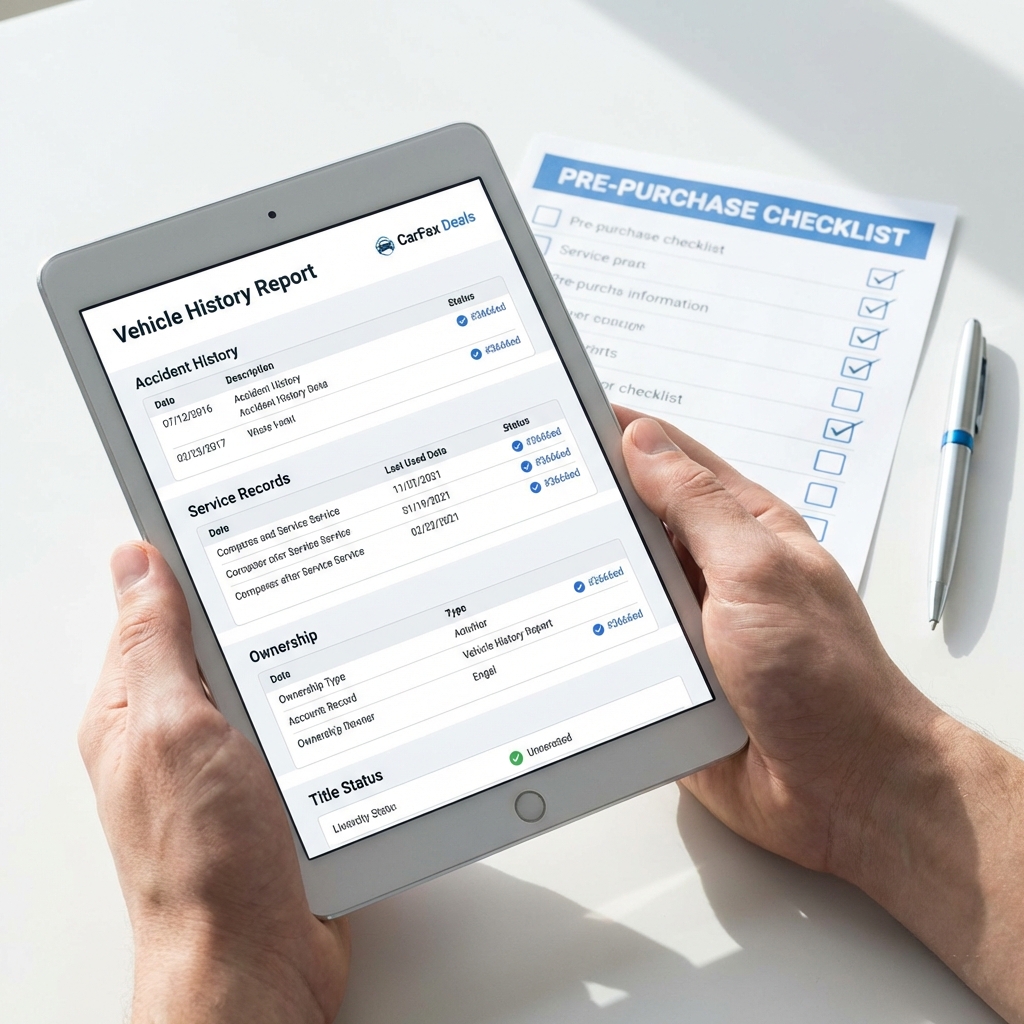
Step 2: Run vehicle history reports and compare pricing insights for comparable local listings. A vehicle history report helps confirm title status, ownership history, service history and reported incidents, while pricing insights show where a listing stands relative to recent local sales. Use both to prioritize which cars to inspect in person. CPI used cars and trucks context
Run a vehicle history report to compare listings
To reduce uncertainty before you visit a dealer, run a vehicle history report and compare price analysis labels for similar local listings.
Step 3: Apply quick filters for priority risk signals. Favor cars with a clean title, single owner history, no accident reported, and consistent service history when available. That narrows your shortlist and focuses inspections on vehicles with lower documented risk.
Step 4: Organize comparisons in a simple table: monthly estimated payment, price analysis label if available, title and ownership notes, recent service entries, and inspection checklist. That quick matrix helps rank finalists and decide whether to negotiate, accept a listing, or wait for better options.
Decision criteria: what to prioritize when choosing a cheap used car
Condition and maintenance history usually dominate the near-term ownership experience. Check service history and odometer consistency in the vehicle history report, and use inspection findings to confirm the car does not need immediate, costly repairs. When service records are sparse, factor that uncertainty into your price tolerance. CPI used cars and trucks context
Total cost to own and resale considerations for cheap cars for sale
Total cost to own includes likely financing costs, insurance, fuel, and expected maintenance. For buyers sensitive to monthly payment, a slightly higher priced but well maintained unit can be cheaper over a year than a lower priced vehicle that needs repairs. Consider model year, trim and powertrain when estimating routine costs.
Resale prospects are model specific. Use published reliability summaries and local resale behavior as inputs, and remember that higher mileage and a checkered ownership history lower expected resale value. Factor resale into a short list ranking rather than as a single deciding factor. Used Vehicle Market Report 2025
Dealer transparency signals help compare sellers. Dealer reviews, ratings and profile information, along with price analysis labels where available, can indicate which listings are easier to verify and which dealers consistently disclose history. Use those signals as one input among several, not the only one.
Common mistakes and where buyers lose value
Skipping a vehicle history report before a test drive is a common oversight that increases the chance of surprise issues later. A history report often reveals title status, ownership records and reported service events that a casual inspection might miss. Check reports early in the process to decide whether a listing is worth pursuing. Edmunds timing and checks
Underestimating inspection and disclosure risk in non-dealer channels can erase apparent savings. Private sales or auction purchases sometimes present lower list prices, but buyers often face higher uncertainty about maintenance history and title clarity. Add a professional inspection to reduce this risk.
Focusing only on the lowest sticker price misses financing, inspection costs and likely near-term repairs. Compare total ownership cost rather than headline price when ranking finalists, and use financing comparisons to see how list price translates to monthly payment under realistic loan offers. Kelley Blue Book on value traps and see KBB guide
Practical scenarios: three buyer examples and recommended approach
Budget commuter buyer looking for under-market price: set a firm maximum monthly payment and a minimum acceptable condition threshold. Filter listings for clean title and single owner, run vehicle history reports to confirm no reported incidents, and prioritize dealer listings with clear pricing context to reduce disclosure risk. If financing rates push monthly cost above your target, wait or expand search radius.
Family buyer prioritizing reliability: prioritize well maintained cars with documented service history, slightly higher list price and lower likelihood of immediate repairs. For this buyer, paying a premium for documented maintenance and a clean ownership record often lowers short-term hassle and unexpected costs. Used Vehicle Market Report 2025
Buyer sensitive to monthly payment and financing: when monthly cost is the constraint, compute sample payments for comparable listings under likely loan rates and terms, and weigh increasing the down payment to reduce monthly burden. If local loan rates are elevated, waiting for rate movements or improving your credit profile may be worth considering.
A short buyer checklist and next steps
Immediate actions before contacting a dealer: 1) assess finances and set a target monthly payment; 2) compare loan offers and test cash versus financed scenarios; 3) run vehicle history reports and compare pricing insights for local comps; 4) schedule a professional inspection for shortlisted vehicles. These steps help you prioritize which listings to inspect in person. Federal Reserve consumer credit releases
When to wait: signals that justify delaying a purchase include materially higher local prices than recent comps, financing rates that push monthly payments above your target, or a shortage of comparable inventory in your area. If multiple signals point to downside risk, waiting until inventory or rates change can improve outcomes.
Before you finalize, confirm title status and ownership history in the vehicle history report and verify dealer transparency signals such as ratings and reviews to reduce post-purchase surprises. Combining these checks often speeds comparison shopping and lowers the risk of a costly mistake. Manheim Used Vehicle Value Index
Conclusion: a balanced take on buying cheap cars for sale now
Final considerations: wholesale values have moderated from pandemic peaks but retail prices remain elevated relative to pre-2019, and elevated financing costs through 2024 and 2025 mean monthly payments deserve close attention. Inventory improvement in 2025 helped in some markets, but local variation persists, so timing depends on your financing and local supply. Used Vehicle Market Report 2025
Where to find more timely data: watch wholesale indices, Federal Reserve consumer credit data and local pricing insights to revisit timing. For research oriented buyers, combining vehicle history reports and local pricing context before contacting a dealer tends to reduce uncertainty and speed decision making. Federal Reserve consumer credit releases
It depends on your local market and financing. Wholesale values moderated through 2024 and 2025, but retail prices remain elevated versus pre-2019. Compare local pricing, likely loan rates and vehicle history reports to decide.
Very important. A vehicle history report helps confirm title status, ownership history and reported service or incident records, reducing the risk of hidden problems before you inspect the car.
Sometimes auctions or private sales have lower list prices, but they usually carry higher inspection and disclosure risk. Factor in inspection costs and potential title uncertainty before assuming a net saving.
If you have shortlisted vehicles, start by running vehicle history reports, comparing local pricing insights and checking likely loan rates. Use a short inspection checklist and dealer transparency signals to finalize which cars are worth an in-person visit.
For ongoing market updates, watch wholesale indices, Federal Reserve credit releases and local pricing trends, and re-run your comparisons as conditions change.


 Blog
Blog