What are the common Corvette problems? – A buyer's guide
This guide summarizes commonly reported Corvette problems and gives a clear, prioritized inspection workflow for used buyers. It shows how to combine a VIN-level vehicle history report, focused mechanical checks, and pricing context so you can judge listings with less uncertainty. The guide also explains generation-specific patterns and common inspection priorities.
A step-by-step workflow for estimating a truck's market value that centers on comparing consumer valuation tools, adjusting for mileage and condition, and checking wholesale market signals. The guide explains private-party, trade-in and dealer retail values and shows how a vehicle history report and pricing insights can change an asking price.
This guide helps research oriented buyers evaluate suv used cars for sale under $25,000 by combining safety ratings, reliability data, local pricing context, and vehicle history checks. It outlines a simple framework, a pre visit checklist, and a decision scoring worksheet so you can compare finalists before contacting a dealer. Use the steps here to narrow candidates and confirm risk signals with a vehicle history report and a pre purchase inspection.
When searching suv used cars for sale, prioritize model year, trim and powertrain before choosing a make or model. This guide explains how safety ratings, dependability studies and local pricing insights combine to produce a short list you can verify with a vehicle history report. It also provides a stepwise checklist you can use before contacting a dealer.
If you are researching a used Corvette, this guide summarizes the most commonly reported problems and gives a clear workflow you can follow before contacting a dealer. It combines owner complaint databases, press buying guides, and official recall records to highlight inspection priorities.
The article explains generation-specific patterns, the limits of a vehicle history report, and the practical checks that matter most on a test drive and pre-purchase inspection. Use it to prioritize listings and to brief a mechanic for a focused inspection.
Common Corvette problems cluster by generation and are often more detectable with focused inspections.
Electrical and sensor faults tend to appear in early production runs of redesigns; test screens and scan for codes.
A VIN-level history report helps prioritize listings, but pairing it with a mechanic's inspection lowers purchase risk.
How to use this guide and what it can (and cannot) do
What readers will learn
This article summarizes commonly reported Corvette problems and inspection priorities based on aggregated owner complaints, press buying guides, and official recall records. It explains what a VIN-level vehicle history report can show and what it cannot, and it gives a short workflow buyers can follow before contacting a dealer.
A three step workflow to reduce purchase risk
Run the VIN report first
How to combine history reports, inspections, and pricing context, chevrolet corvette for sale
Start with a VIN-level vehicle history report to reveal title status, ownership records, and reported damage. Use that context to decide which listings deserve a focused inspection and a test drive, and then compare local pricing signals before you negotiate or visit the seller.
A vehicle history report reduces but does not eliminate risk; it can miss unreported damage and later mechanical wear, so pair it with a focused inspection and service-record checks to get the clearest picture possible.
How common Corvette problems cluster by generation (C5-C8)
Why generation matters
Issues reported for Corvettes tend to cluster by generation and by early production years after a major redesign, so knowing the model generation helps target checks for common failure modes, from driveline wear to new electronics behavior. This pattern appears in owner complaint aggregations and press guides, which note different recurring faults by generation CarComplaints Corvette page.
Patterns seen in complaint databases and press guides
For example, early runs of a redesigned model often show more sensor and infotainment complaints, while later production runs typically see fewer new-design complaints after engineering fixes and service bulletins have been issued MotorTrend common problems. Coverage in MotorBiscuit also notes similar issues MotorBiscuit.
When you evaluate a specific VIN, check model-year lists of owner complaints and any service bulletins that apply to that year; later production years within a generation may benefit from fixes that reduce certain electronic or software failures.
Mechanical hotspots: engine, driveline and fluid leaks
Frequent engine and driveline complaints
Across multiple Corvette generations, owners report engine and driveline issues among the top mechanical problems, including oil leaks, misfires, and transmission or shifting complaints; these are commonly cited in aggregated complaint data RepairPal reliability guide.
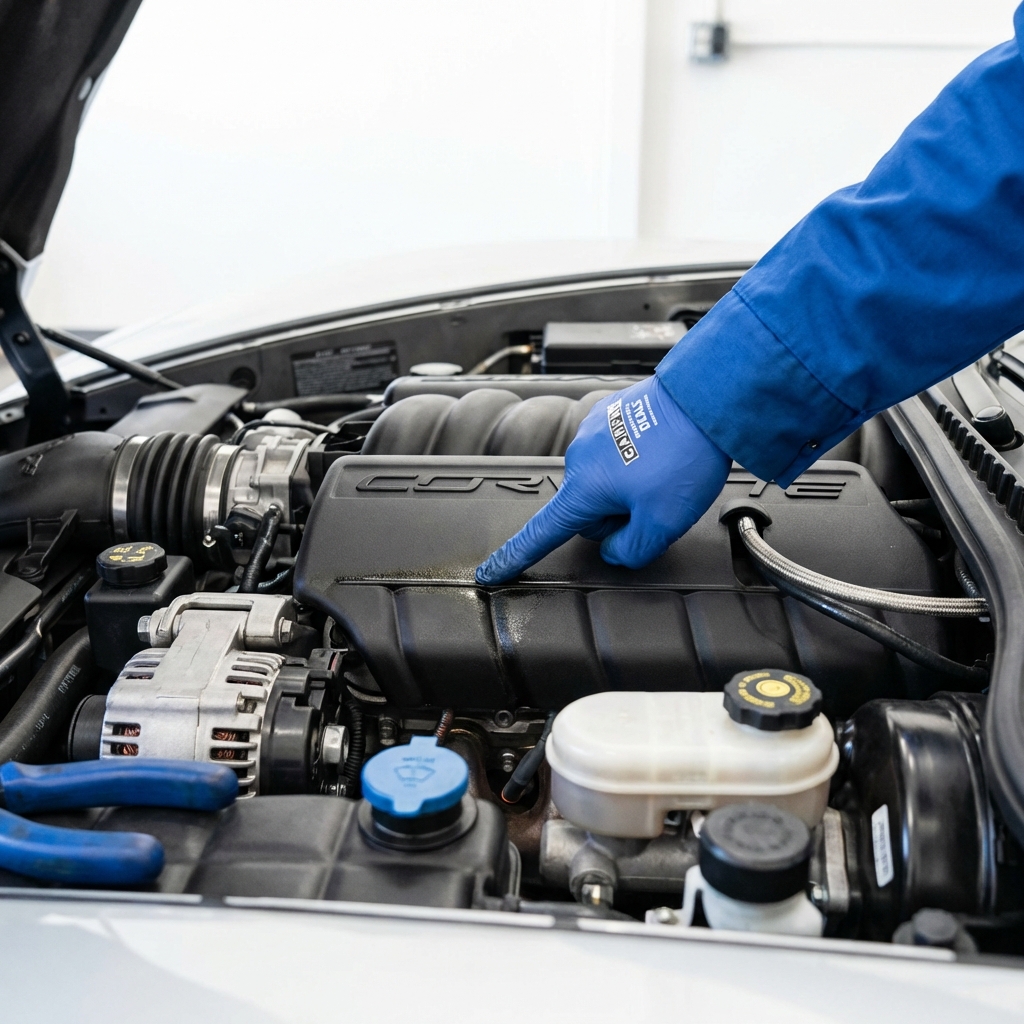
On a used listing, prioritize checks that detect those faults: look for oil on the engine or under the car, smell for burning oil, and watch for rough idle or misfires during a test drive.
Get the Corvette inspection checklist
Use this checklist to guide a focused visual and test drive inspection without jargon. It lists key signs to note and questions to ask the seller.
Check the underside for fresh oil or coolant drips, inspect around valve covers and oil pan seams for seepage, and look for wetness at axle seals and transmission housings; documented service history for oil changes and driveline repairs reduces uncertainty and gives context.
For higher mileage engines, ask the seller for compression or leak-down test results, or have a mechanic run them before purchase, since these tests help reveal internal wear that visual checks cannot confirm CarComplaints Corvette page.
Electrical, sensors and infotainment faults to watch for
Why early production redesigns often show sensor faults
Sensors and infotainment systems are a frequent source of complaints, especially in early production of redesigned models where new electronics or software are introduced; fuel-level sensor failures and other module errors are commonly reported in those early runs Car and Driver buying guide.
Symptoms you can catch on a test drive
During a test drive, test every screen, cycle climate controls, and watch gauges for erratic movement; intermittent warning lights during or after the drive can indicate sensor or module faults that may need software updates or component replacement.
Ask the seller or mechanic to scan for stored diagnostic trouble codes and for documentation of any module replacements or software updates to confirm repairs were completed and to understand the scope of work previously done MotorTrend common problems.
Safety recalls and NHTSA records: what to check on the VIN
How to read recall and complaint listings
NHTSA records and official recall notices show safety-related recalls for certain Corvette model years, including issues with airbags, seat-belt modules, and electronic modules, which demonstrates manufacturer remediation for some recurring failures NHTSA recall listings. Reporting in CorvetteBlogger provides additional context CorvetteBlogger.
To check a specific car, run the VIN through the official lookup and review any open recalls or campaign notices; ask the seller for proof of recall repair if any are listed for that VIN.
Check for oil and coolant leaks, transmission shift quality, electrical and sensor faults, and verify title, ownership and service history via a VIN report; pair that report with focused mechanical tests and a scan for stored diagnostic codes.
Remember that recalls address safety defects identified by the manufacturer or regulator, but they do not cover all reliability items or later mechanical wear reported by owners.
Transmission behavior and early-run design faults
Transmission complaints by model and year
Transmission and shifting complaints are reported more often in early production runs of major redesigns, with owners noting delayed engagement, slipping, and hard shifts in some early C7 and initial C8 vehicles MotorTrend common problems and forum reports CorvetteForum thread.
What to test during a test drive
During a test drive, monitor shift quality at low and high speeds, check for hesitation or slipping under acceleration, and listen for clunks during gear changes; if possible, drive long enough to note transmission temperature behavior and any change in shift feel as the system warms.
If available, request a post-drive scan for transmission-related DTCs and the vehicle's service history for transmission fluid changes or repairs to identify recurring issues or recent maintenance RepairPal reliability guide.
Ownership costs: maintenance, repairs and option-related risks
Typical higher maintenance profile for a performance car
Owning a Corvette generally carries higher maintenance and repair costs than an average passenger car, and optional equipment or advanced powertrain choices can increase the chance of sporadic, high-cost repairs; reliability aggregators and cost studies note this pattern Consumer Reports reliability summary.
Use price analysis labels and local market context to estimate whether a listing's price reflects likely ownership costs for tires, brakes, scheduled maintenance, and any option-related repairs.
When options add drivetrain complexity or nonstandard components, factor potential repair exposure into the total cost to own rather than judging price on sticker alone RepairPal reliability guide.
What to look for in a vehicle history report (and how CarFax Deals can help)
Key report items: title status, ownership and service history, reported damage
Critical VIN-report items include title status, ownership history, service history entries, reported accidents, and mileage checks; these data points help prioritize which cars to inspect and which to avoid when possible Car and Driver buying guide.
A history report is valuable for surfacing recorded events but may miss unreported damage or later mechanical wear; pair the report with focused inspection steps and test drives to reduce risk.
CarFax Deals can serve as a decision support layer by surfacing vehicle history reports and price analysis labels to help prioritize listings, but a history report alone does not guarantee absence of issues.
A focused pre-purchase inspection checklist for used Corvettes
Quick checks you can do before buying
Do a quick visual check before you buy: look for oil and coolant leaks, inspect tire and brake wear, cycle lights and infotainment, and take a test drive that includes low speed and sustained acceleration to feel for misfires or transmission issues.
Note any intermittent dash lights, gauge inconsistencies, or unusual noises and photograph them for the seller and your mechanic to review later CarComplaints Corvette page.
What to ask a mechanic to test
Ask a trusted mechanic to run compression or leak-down tests for higher mileage engines, scan for stored DTCs across powertrain and body modules, inspect suspension mounts and bushings, and check for coolant and oil leaks that are hard to see on a short visual review.
Request a road test that stresses the transmission under load and a documented report of findings so you can compare the mechanic's notes with the seller's service history Car and Driver buying guide.
How to read price analysis labels and prioritize listings
What pricing context tells you
Price analysis labels such as Great Deal, Good Deal, and Fair Deal provide local market context that helps you rank listings, but they do not replace a VIN check or a focused mechanical inspection; use labels to set priorities, not as proof of mechanical condition RepairPal reliability guide.
When a listed price needs deeper inspection
Prioritize listings that combine a favorable price label with clean title, single-owner history, and no reported accidents; treat very low-priced listings as higher-risk and demand more documentation and a thorough inspection before proceeding.
Cross-check the price label against service history, title status, and any open recalls listed for the VIN before assuming a low price is a bargain Consumer Reports reliability summary.
Common buyer mistakes and how to avoid them
Mistakes that increase risk
Relying only on listing photos, skipping a test drive, or ignoring a DTC scan are frequent errors that increase risk; many mechanical problems require inspection and diagnostic scans to detect Car and Driver buying guide.
Simple practices that lower risk
Do a VIN lookup, request service records, run a focused mechanical inspection, and have a trusted mechanic perform compression and leak-down tests on high-mileage cars; document everything to support negotiations or to walk away if findings are negative.
Be cautious if the VIN shows open recalls or if owner complaints for that model year reference recurring issues that match what you find on inspection NHTSA recall listings.
Practical scenarios: a first-time buyer and a family buyer example
Scenario 1: first-time buyer with budget constraints
A first-time buyer should run a VIN report, prioritize single-owner, no-accident-history listings with clear service records, and book a focused inspection that checks for oil leaks, compression, and transmission shift quality; use the price analysis label to prioritize which cars to inspect first Car and Driver buying guide.
If the inspection or VIN report raises unresolved issues, walk away rather than accepting a high repair risk for a lower purchase price.
Scenario 2: family buyer prioritizing reliability
A family buyer should focus on later production years within a generation, documented service history, and a VIN with no open recalls; prioritize cars that show routine maintenance and verified oil and transmission service records to reduce unexpected ownership costs Consumer Reports reliability summary.
Ask for a mechanic's written pre-purchase report and compare expected total cost to own against similar listings in your local market before you commit.
Summary: a simple decision framework and next steps
Three-step decision checklist
Check the VIN history and open recalls, run a focused inspection and test drive, and evaluate the price analysis label against expected ownership costs before you contact the dealer; this three-step framework helps separate listings that deserve deeper review from those to avoid.
Where to go from here
Document every finding, keep service records and inspection reports together, and, if uncertain, have a trusted mechanic perform a deeper diagnostic check before purchase; later production runs often have fewer new-design faults, but always check the specific VIN and service history and review how to use these tools how to use these tools.
Common mechanical issues include oil leaks, misfires, and transmission or shifting complaints; these are frequently reported across generations and should be checked during a test drive and visual inspection.
No. A VIN-level vehicle history report can show title events, reported accidents, service entries, and mileage checks, but it may miss unreported damage and later mechanical wear; pair it with an inspection.
Avoid early production years of a major redesign if you want to limit risk, since first-year production runs often show more electronics and new-design complaints; instead prefer later production runs with documented fixes and service history.
Document what you find, and keep inspection reports and service records together when you talk to a seller. If any finding raises doubt, a trusted mechanic or a targeted diagnostic test is the right next step before committing to a purchase.


 Blog
Blog