A calm, step-by-step guide to what is the best way to negotiate a car price. Learn practical research steps, scripts, checklists, and tactics for separating price, trade-in, and financing so you get a fair out-the-door deal. Includes scripts, EV-specific tips, digital-quote strategies, and how to use verified vehicle history and CARFAX Deals to reduce risk and drive a smarter negotiation in 2024–2025.
A rav4 used for sale can be a sensible pick for many research-oriented buyers because reliability aggregators rate the model above average and safety ratings are generally strong. This guide explains how to vet listings, what model years tend to be better, and a step-by-step checklist to reduce risk before you buy.
This guide explains how to estimate the cost of buying an R34 Skyline, with attention to import rules, condition-driven price tiers and landed cost. It shows which factors move value, how to verify history and paperwork, and offers a checklist you can follow when you search for a nissan skyline r34 for sale.
This guide helps buyers set realistic expectations for tacoma trucks for sale by explaining the main price drivers and a repeatable method to build conservative, typical, and ambitious offer ranges. It shows how the 2024 redesign, valuation guides, and vehicle history reports interact to change asking prices and reduce purchase risk.
This guide answers the key question, "What is the best way to negotiate a car price?" with a calm, practical plan you can use for any used vehicle in 2024–2025. You’ll find research steps, scripts, checklists, and examples to help you keep the conversation focused on out-the-door numbers, use vehicle history as leverage, and avoid common traps like payment-focused bargaining.
1. Research wins: buyers who compare recent local sale prices to dealer asks can lower the price by an average of hundreds to thousands of dollars depending on model and region.
2. Written offers matter: saving email quotes and itemized out-the-door numbers keeps negotiations honest and prevents last-minute add-ons.
3. CARFAX Deals stat: listings that combine verified history with transparent price labels help buyers make decisions faster and reduce surprise risks—making negotiation smoother and more data-driven.
What is the best way to negotiate a car price?
Buying a used car shouldn’t feel like decoding a secret language. The best way to approach that question - what is the best way to negotiate a car price? - is to break the process down into clear, repeatable steps. With a little research, a few simple scripts, and a steady willingness to walk away, you can move from anxious haggling to calm, confident decisions.
Why a clear plan wins
The market today is less chaotic than in 2020-2022, but it still changes by region, model, and fuel type. If you ask "what is the best way to negotiate a car price?" the short answer is: separate the deal into parts, gather evidence, ask for written numbers, and keep your emotions out of the math. This method lets you compare apples to apples and avoid surprises at signing. For ongoing price trends, see the CARFAX used car index for monthly data and insights: CARFAX Used Car Index.
First things first: research beats instinct. Spend focused time collecting recent sale data, the dealer’s asking price, and vehicle-history information. That foundation answers the opening question - what is the best way to negotiate a car price? - before you ever step onto a lot.
Tip: If you want to reduce uncertainty quickly, consider using a transparent tool that pairs verified vehicle history with price context. For example, you can run a CARFAX Deals report to see a vehicle's history and how its price stacks up against comparable cars in your area. That kind of clarity helps you act confidently and anchor conversations to real data.
How to negotiate car price: a clear step-by-step plan
Below is a stepwise approach that answers the central question - how to negotiate car price - so you can follow a calm, logical process and get a fair result.
1) Start with focused market research
Gather comparable sales for the same year, trim, mileage, and condition in your region from the past 60-90 days. Use price guides and local transaction records. The objective is to find a realistic range for what similar cars actually sold for, not what they were listed at.
When you research, write down two numbers: the typical sale price for comparable vehicles nearby and the exact dealer asking price for the car you want. If the dealer is asking notably more than recent sales, you have room to open with a lower market-based anchor.
Get a verified report and negotiate with confidence
Ready to check a car’s history and price context before you negotiate? Run a CARFAX Deals report to get vehicle history and local price comparisons in one place.
One of the most common mistakes buyers make is combining everything into a single conversation. Instead, treat these as separate negotiations:
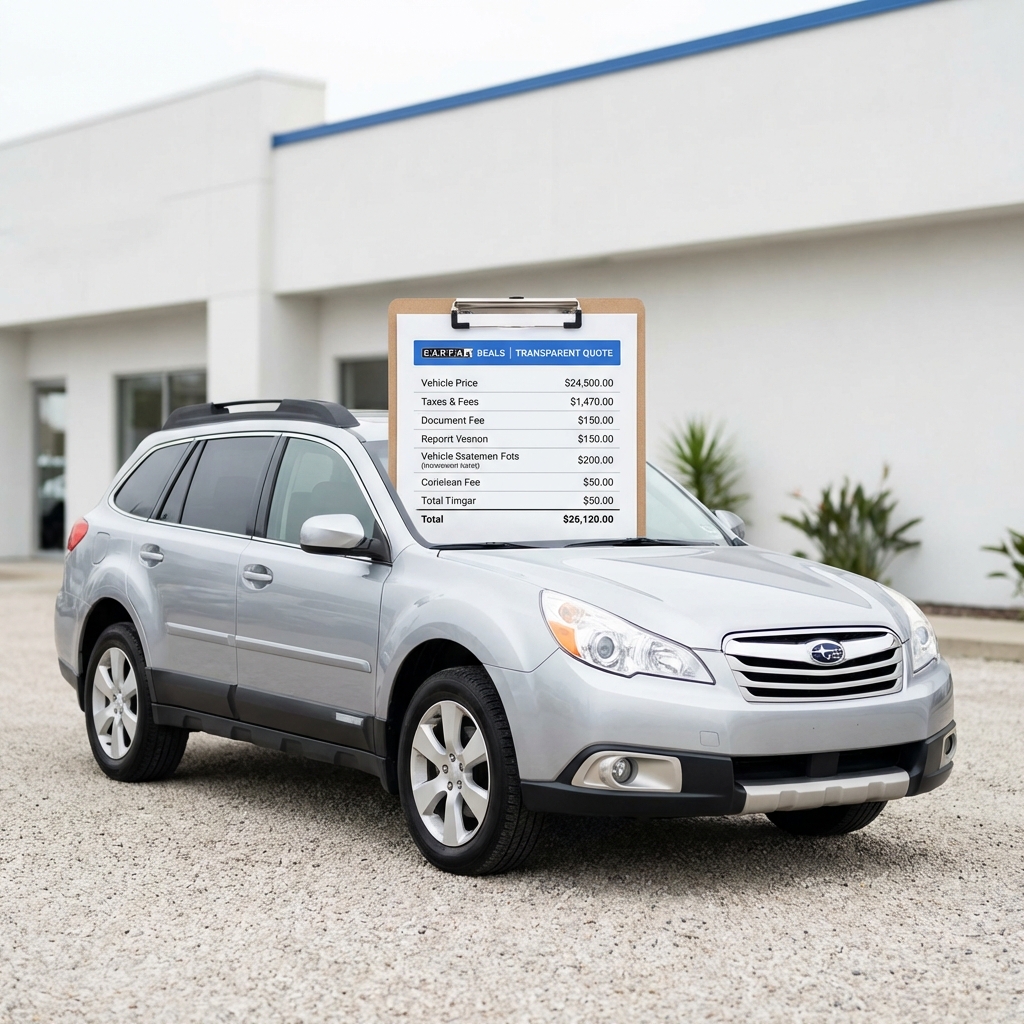
Price: Focus first on an itemized, out-the-door price for the vehicle you’re buying. Ask for a written quote that lists taxes, fees, and add-ons.
Trade-in: Only bring up the trade-in after you have a firm purchase price. Get at least two separate offers for your trade from dealers or online appraisal services.
Financing: Secure a pre-approval before you visit the dealer. That gives you a baseline APR and prevents sales staff from masking a worse deal behind low monthly payments. If you consider dealer financing, negotiate price first, then rate and term.
Treat the transaction like three separate deals—price, trade-in, financing—and get every number in writing. That separation makes trade-offs visible and stops monthly-payment framing from hiding the true cost.
3) Use written offers as your guardrail
Words vanish; paper holds. Always ask for written, itemized quotes that include VIN, out-the-door price, and any conditions. Save email threads and texts. Written offers let you compare apples to apples and push back calmly if the final contract shifts numbers.
4) Make a precise, research-based opening offer
Open with a number anchored to your market data. If comparable sales are $18,000-$20,000 and the dealer asks $21,500, an opening offer around the low end of that band is reasonable. A simple opening sentence works well: "I’ve reviewed recent area sales; comparable cars are selling around $18,500 to $20,000. I’ll offer $18,250 out the door today." That shows you’ve done the homework and are ready to act.
5) Keep itemized fees visible and push back on vague charges
Dealers add margin through options, protection plans, and documentation fees. Ask for a complete list of add-ons. If a charge reads "dealer prep" or "market adjustment," ask what it covers. You can decline unwanted packages; if a salesperson claims an item is mandatory, ask for the policy or legal citation that requires it. Often, a firm but polite refusal gets the fee removed. For context on common fees, see the pricing page.
Scripts and language that work
Knowing what to say removes a lot of stress. Here are short, practical scripts you can adapt when you negotiate car price.
Opening the conversation
"I’ve seen comparable sales in our area between $17,900 and $19,800. I’m ready to buy today for $18,250 out the door."
Refocusing from monthly payments back to price
"I want to agree on the out-the-door price first. Once that’s clear, we’ll talk financing and monthly payments."
Declining bundled add-ons
"Please show me a complete, itemized out-the-door price without dealer-added packages. If there are optional items, I’ll decide after we agree on the base price."
Walking away calmly
"I appreciate your time. Your number is too far from market value for me today. If you can reach an out-the-door price of $18,250, I’ll be ready to sign."
Using vehicle history and transparency as leverage
A verified vehicle history report cuts through uncertainty. If the report shows clean maintenance records and no accidents, you’ll have fewer concerns. If it shows an accident or title issue, use it to lower your offer. Tools that combine verified history with price context - like CARFAX Deals - help you move faster and with confidence. A transparent label that says "Great Deal" or "Fair Deal" is a powerful negotiating tool. A simple visual label like "Great Deal" can help you spot good listings quickly.
How to handle trade-ins
Don’t introduce your trade-in too early. Get independent appraisals and at least two offers. If the dealer’s trade-in value is low but they won’t budge on selling price, propose a clear math-based compromise: "You’re asking $1,000 more than comparable sales and offering $800 less for my trade. Raise the trade-in by $1,500 and I’ll meet you at $19,500 out the door." Keeping the arithmetic visible prevents hidden offsets.
Financing: use pre-approval as leverage
A pre-approval locks in a baseline APR and term so the dealer can’t hide a worse overall cost behind a lower monthly payment. When the dealer shows a finance offer, ask them to give you the amount financed, APR, term, and total amount paid over the loan life. If they propose rolling add-ons into the loan, ask to see the monthly and total cost impact.
Special rules for used EVs
Used electric vehicles add battery health, remaining warranty, and charging history to the mix. Ask for a recent battery health report and any transferable warranties. If a battery shows capacity loss, reduce your offer to reflect possible replacement costs. In regions with tight EV supply, sellers may be less flexible; in others, incentives or lower demand can create negotiation room.
Regional timing and leverage
Where you live and when you visit a dealer matters. Markets with abundant inventory give buyers more leverage; scarce markets give dealers the upper hand. Timing within a month or quarter also helps: sales teams often push to hit targets near month-end or quarter-end. Combine timing with a written offer and pre-approval to increase your chance of a better deal. For broader market context and analysis, see industry reports such as the US used car market forecast: US Used Car Market Analysis (Technavio) and coverage of retail used-car price movement from AutoRemarketing: Carfax and J.D. Power watch retail used-car prices rise.
How digital quotes change the dynamic
Many dealers now send itemized digital quotes. That can be an advantage - you can compare clear offers without dealership theatre. Still insist on an out-the-door number and save every email. If a competing dealer emails an itemized quote, use it: "Dealer A offered $18,100 out the door including taxes and fees. If you can match or beat that, I’ll come in today."
A real-world example that demonstrates the method
A friend wanted a 2018 midsize sedan listed at $18,900. He researched recent sales - $16,700 to $18,000 - and got pre-approved at 4.5 percent. At the lot he opened at $17,250 out the door. The dealer countered $18,400 but wouldn’t itemize. He insisted on written numbers and the itemized quote showed a $1,200 "appearance package" and a high documentation fee. He declined the extras, pressed the manager, and the price moved to $17,950. With his pre-approval and a saved email from a competing dealer, they finally agreed to $17,400. He left with a signed, itemized contract and a clear vehicle-history report. The lesson: numbers, written proof, and the willingness to walk away win.
What to watch for in the final paperwork
Before you sign, check three things: the VIN and vehicle description match what you inspected; the out-the-door price and line items match the written offers; and no last-minute add-ons appear. If anything differs, pause and demand an explanation. Don’t sign until the contract reflects the written agreement.
How to keep negotiations calm and productive
Use a neutral tone, speak in market terms, and treat the process like math. Ask for what you want directly, and keep the conversation focused on the out-the-door number. If the salesperson becomes evasive, return to written quotes or walk away. Calm options and clarity often yield better results than pressure tactics.
Common questions answered
Is it rude to make a low opening offer?
No, if it’s grounded in market research. A reasonable, data-based opening is expected and frames the conversation. Lowballing without evidence can waste time; a grounded offer shows you’ve done the homework.
Should I tell the dealer my pre-approval rate?
You don’t have to volunteer it. You can say, "I have outside financing I can use; show me your best price and rate and I’ll choose the best offer." That keeps flexibility and avoids weakening leverage.
How much room is there to negotiate on a used car?
It depends on supply, demand, and how long the vehicle has been on the lot. Cars unsold for 30-60 days usually have room to move. The smaller the gap between asking price and recent comparable sales, the smaller the wiggle room.
What if the dealer won’t give a written out-the-door price?
That’s a red flag. Insist politely and walk if needed. Reputable dealers will provide a written quote; if not, consider other options.
Practical checklists to carry in your head and on your phone
Before you call or visit, gather: recent comparable sales, the dealer’s listing, a printed vehicle-history report, pre-approval documentation, and screenshots/emails with competing written quotes. At the lot, ask for an itemized out-the-door quote and confirm the VIN. If something changes, don’t sign until corrected.
Tactics to avoid
Avoid getting drawn into monthly-payment talk before you agree on price. Don’t accept verbal promises; always get numbers in writing. Don’t reveal desperation or a tight timeline that signals you must buy now. And don’t rush - the right car and a clear price are worth a few patient hours.
Why transparency tools make negotiation simpler
Platforms that pair verified vehicle history with price analysis reduce uncertainty and save time. When a listing shows a clear price label and a full vehicle-history report, you can make an educated offer faster and with less anxiety. That’s especially helpful for first-time buyers who want data-driven reassurance. For tips on how to use these tools, see how to use guides and resources.
Final thoughts: the quiet power of preparation
The best way to negotiate a car price is a calm, math-first approach: research, separate price/trade/finance, insist on itemized written offers, and be willing to walk away. That combination creates clear choices for both sides and usually leads to better outcomes. When you know the numbers and keep the process simple, you’re the one making the decision - and that’s the real win.
Drive with confidence: clear research and calm negotiations get you further than stress and guesswork ever will.
No. A low opening offer isn’t rude if it’s grounded in market data and presented respectfully. A data-based opening establishes a clear anchor and shows you’ve done homework. Keep the tone calm and be ready to explain your numbers; a reasonable opening is expected and helps start a productive negotiation.
Ask for a fully itemized out-the-door quote and question any vague charges like "dealer prep" or "market adjustment." Decline unwanted packages on the spot and ask for the legal or dealer policy that mandates any claimed mandatory fee. If a documentation fee looks high, ask them to reduce or remove it; firm, polite pushback often works.
Yes. CARFAX Deals pairs verified vehicle-history reports with transparent pricing labels, giving you evidence to support a market-based offer. Use a CARFAX Deals report to show the vehicle’s condition and how its price compares to similar cars nearby; that evidence can make your offer more credible and speed up a fair agreement.
In short: research, separate the deal components, insist on itemized written numbers, and be willing to walk away; that’s the best way to negotiate a car price. Safe driving—and enjoy the ride!

 Blog
Blog