Choosing between bank and dealer financing can change how much you pay for a used car and how confident you feel about the deal. This guide lays out clear pros and cons for each route—rates, convenience, negotiation strategy, loan terms, hidden fees, and when dealer offers actually win. It shows step-by-step how to compare APRs, get preapproval, weigh incentives, and make the financing choice that fits your budget and risk tolerance. You'll also find practical checklists, an independent-inspection reminder, and a tip on using CARFAX Deals to compare vehicle history and pricing before you sign.
This guide explains which tacoma trucks for sale show the strongest reliability and safety signals to watch out for, and why mid-2010s and many pre-2016 Tacomas appear most often in complaint and recall records. The article shows how to use vehicle history reports, recall checks, and a focused inspection to reduce risk when evaluating a used Tacoma.
This article helps buyers searching tacoma trucks for sale understand which Tacoma engine tends to be most reliable. It summarizes reliability ratings, owner-complaint clusters, and maintenance-cost differences between the 2.7L I4 and the 3.5L V6, and gives actionable checks to reduce engine-related risk.
Audi reliability varies significantly by model, model year and powertrain, so the most reliable Audi for one buyer is not the same for another. This guide shows research-oriented used car buyers how to compare models using industry dependability studies, owner-reported trends, and per-VIN vehicle history reports. It focuses on checklists, inspection priorities and scenario-based recommendations to reduce risk when shopping a used Audi.
Buying a used car raises many questions—price, condition, and especially, financing. This guide helps you answer one critical question: Is it better to finance through a bank or dealer? You'll get clear comparisons, practical scripts, and step-by-step checks to help you pick the option that saves money and reduces risk.
1. Getting preapproved often gives you immediate negotiation power by making you effectively a cash buyer at the dealership.
2. A longer loan term reduces monthly payments but can add thousands in interest and increase the risk of negative equity on used cars.
3. CARFAX Deals pairs verified vehicle history reports with pricing labels so buyers can compare risk and value before negotiating.
Buying a used car is a big decision—and when the money conversation starts, one question often steals the spotlight: Is it better to finance through a bank or dealer? That question affects the price you pay each month and the total cost of ownership. It also changes how much negotiating power you carry into the lot. This article walks you through the facts, the trade-offs, and a clear, practical approach to choosing the right financing path for your situation.
Is it better to finance through a bank or dealer? A short, honest framing
The short answer is: it depends. Your credit profile, how much time you want to spend shopping for a loan, whether the dealer is offering a special rate, and the exact numbers (APR, term, fees) all matter. Both banks and dealers can be the right choice—what changes is the cost, convenience, and control. Below, we break it down into plain language so you can make a confident call.
Start with the basics: bank financing vs dealer financing
Bank or credit union financing means you get a loan directly from a lender before or after picking the car. Often called preapproval, this gives you a clear APR and monthly payment to compare. Banks and credit unions typically offer competitive rates to borrowers with solid credit histories and are less likely to add hidden fees.
Dealer financing means the dealership arranges credit for you through one of their lending partners—often multiple choices, including banks, captive finance arms (the automaker’s in-house bank), and subprime lenders. Dealers sometimes quote a lower monthly payment by extending the term or rolling fees into the loan. They may also mark up the rate slightly from the wholesale offer and keep the difference as profit.
Why the financing route matters more than you think
Financing shapes your buying power: it affects the monthly payment, the total interest paid, and how quickly you build equity in the vehicle. On used cars, where the principal is lower but repair risk can be higher, an expensive loan can turn what looks like a good price into a costly mistake. That’s why this step deserves close attention.
Comparing rates isn’t just about APRs. Here’s a simple way to make apples-to-apples comparisons:
Comparing rates isn’t just about APRs. Here’s a simple way to make apples-to-apples comparisons:
Check the car’s history and price before you negotiate
Want an easy way to check pricing before you commit? See current pricing and options on the CARFAX Deals pricing page to estimate costs and avoid surprises at the dealer.
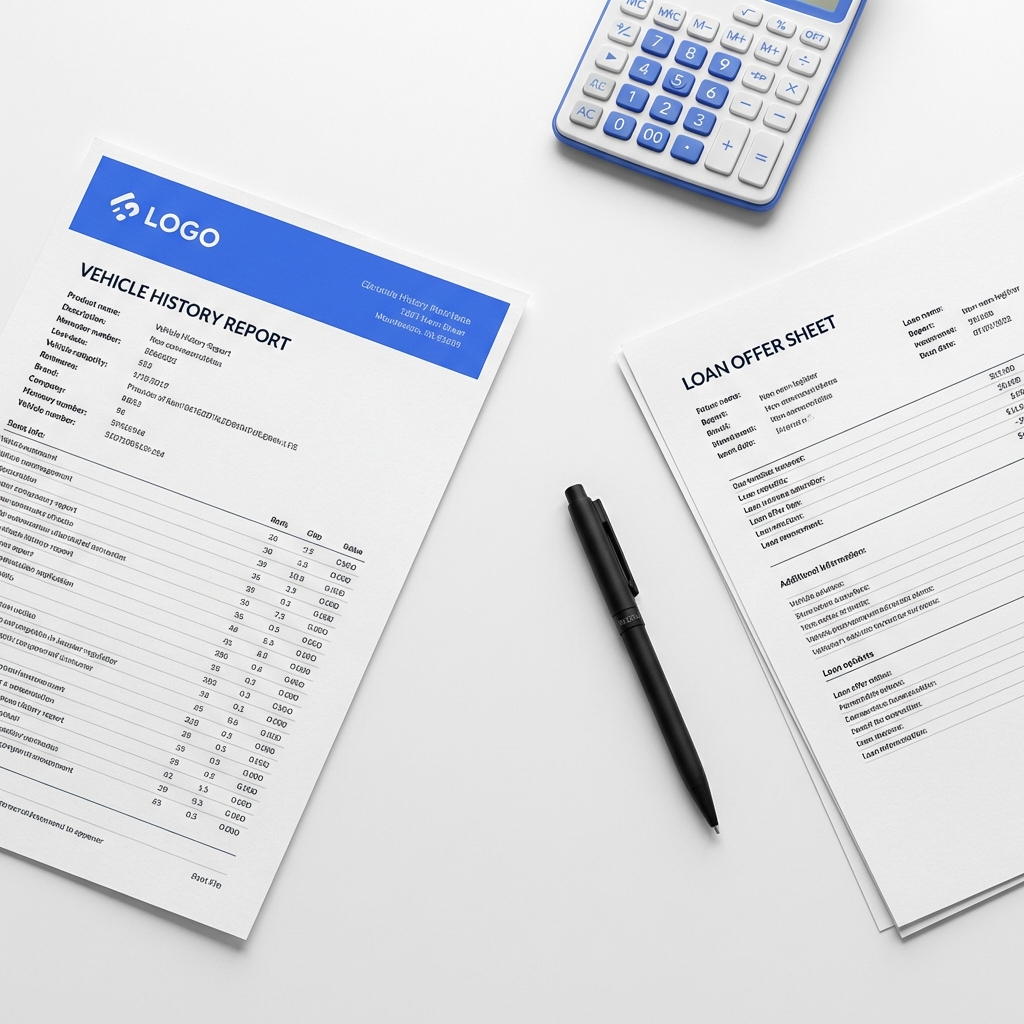
Ask each lender for: APR, loan term (months), total financed amount, any fees (origination, documentation), and prepayment penalties. If a dealer quotes only a monthly payment, ask them to show the full loan schedule. Monthly payments alone can hide long terms or large fees.
2) Calculate the total cost
Total cost = Principal + Total interest + Fees. Use an online amortization calculator or ask for an amortization schedule. The loan with the lower APR might still cost more if fees or the financed amount are higher.
3) Compare one-year and five-year costs
Because used cars depreciate quickly, knowing how much you’ll owe after one year is important (especially if you trade in or sell). Compare the outstanding loan balance after 12 months for each offer to see which leaves you in a stronger equity position.
Pros and cons: bank financing
Pros
- Usually lower interest rates for qualified borrowers. - Transparent terms, fewer surprises. - Preapproval gives bargaining power: you become a cash buyer in the dealer’s eyes. - You can shop for the best rate and choose a lender you trust.
Cons
- More legwork up front (applications, documentation). - Preapproved loans sometimes expire (often 30–60 days), which can complicate timelines. - A very good dealer promotion (0% APR) might beat your bank’s rate - rare for used cars, but possible with certain certified pre-owned offers.
Pros and cons: dealer financing
Pros
- Convenient: one-stop shopping—pick the car and arrange the loan on the same day. - Dealers can offer special promotions or captive financing that occasionally has lower rates for certified pre-owned models. - For buyers with weaker credit, dealers can access subprime lenders or offer loan programs that banks might not extend directly.
Cons
- Dealers can mark up the rate; the quote you hear may be higher than the wholesale lender offer. - Potential for confusing add-ons rolled into financing (extended warranties, gap insurance, dealer fees). - Less transparency unless you ask for written terms and the lender’s name.
Dealer financing is often the best choice when:
- The dealer offers a promotional APR that beats what you can get from a bank or credit union. - You prefer a streamlined process and aren’t comfortable shopping lenders. - You’re buying a certified pre-owned vehicle with a manufacturer’s or captive finance promotion. - Your credit is limited and dealers have access to lenders who will approve your application.
Bank or credit union financing is usually better when:
- You have good or excellent credit and can secure a lower APR. - You want to lock in a rate with a preapproval to strengthen negotiation leverage. - You value transparency and want to avoid dealer markups or rolled-in fees. - You want to shop loan offers to reduce total interest paid.
How to negotiate financing at the dealer without losing leverage
Dealers love monthly payment negotiations because they can manipulate loan terms to make the payment look attractive. Protect yourself with these tactics:
1) Negotiate the vehicle price first
Insist on settling the price of the car before you talk about financing. If you mix them, you risk paying more in interest for a seemingly small monthly saving.
2) Use your preapproval as leverage
A preapproval from your bank or credit union lets the dealer know you’re a serious buyer who understands financing. It often encourages them to produce a competitive finance offer.
3) Ask for the buy rate and the dealer rate
The lender’s wholesale rate is called the buy rate. Dealers may add a markup called the dealer reserve. Ask for both numbers and request the best possible rate. If the dealer refuses to disclose the buy rate, be cautious.
Common dealer add-ons and how they affect financing
Dealers may offer or include extras like extended warranties, paint protection, GAP insurance, and prepaid maintenance. These often increase the financed amount and therefore the total interest you pay. Decide which add-ons are worth buying and which you can decline or buy separately for a better price.
Real-world example: compare two offers
Imagine you’re buying a used car priced at $18,000 and putting $2,000 down.
Offer A — Bank preapproval: 5.5% APR, 60 months, $16,000 financed. Total interest ≈ $2,400. Offer B — Dealer financing: 6.9% APR, 72 months, $16,500 financed (includes dealer fee). Total interest ≈ $3,900.
Monthly payments may be similar at first glance, but Offer B costs about $1,500 more in interest and extends your loan for an extra year. You also owe more principal early on with a longer term, increasing the risk of negative equity.
Credit score, down payment, and their outsized impact
Your credit score is the biggest single factor lenders use to set your APR. Even small score differences can change your rate by a full percentage point or more. A larger down payment reduces the financed amount and often lowers the interest rate. If you can put 10–20% down on a used car, you’ll pay less interest and reduce the chance you’ll be upside-down on the loan.
For recent rate trends and forecasts, see the Bankrate auto loan rate forecast to help set expectations about typical APR ranges.
Subprime loans and special risks
If your credit is below prime, expect to pay higher APRs. Dealers may place buyers in subprime programs with higher rates or longer terms. That can be reasonable if your credit is improving and you need time to rebuild a positive payment history, but be wary of very long terms (84–96 months) that increase total interest and tie you to a depreciating asset for years.
Dealer incentives, rebates, and the cost trade-off
Sometimes dealers or manufacturers offer incentives like reduced APR or rebates for certain models or certified pre-owned vehicles. If you’re offered a rebate, ask whether the dealer will let you take both a low APR and the rebate. Often you must choose one or the other. Run the numbers: a rebate reduces the vehicle price directly, while a low APR reduces finance cost - one may be better depending on the amounts involved.
Gap insurance, extended warranties, and coverage tied to financing
Gap insurance covers the difference between your car’s value and the amount you owe if it’s totaled. Dealers often sell gap at a markup. Check your auto insurance or credit union first; many lenders include gap or offer it cheaper outside the dealer. Extended warranties can be rolled into the loan as well—consider buying these after you compare independent warranty providers.
Refinancing: an important escape hatch
Refinancing lets you replace a loan with a new one at a lower APR or a different term. If your credit improves, or if you find a better rate from a bank or credit union after buying, refinancing can save money. Watch for prepayment penalties on your current loan and compare the refinance fees to the interest you’ll save.
How long-term loans change the ownership story
Longer loans lower monthly bills but increase total interest and may leave you owing more than the car is worth. On used cars, which depreciate and may require repairs, long terms are riskier. Keep loans as short as practical while staying within your monthly budget.
Documentation checklist before you sign
Before you sign any finance agreement, make sure you have:
- Written APR, term, and monthly payment. - A clear list of fees and what the fees cover. - The name of the lender and whether the dealer marked up the rate. - Any promises in writing (repairs, parts, add-ons). - A copy of the sales contract and the loan note.
Special case: certified pre-owned deals and captive financing
Certified pre-owned programs sometimes include attractive financing via a captive lender (the automaker’s bank). If you’re buying a certified car, compare the captive offer to bank offers. Captive promotions can be strong—sometimes worth paying a slightly higher listed price because the long-term interest savings or included coverage make it a better value.
How to spot a genuinely good captive or dealer promotion
Check the numbers yourself. If the dealer claims 0% APR, confirm who’s offering it and whether the loan term is reasonable. If a promotional APR requires sacrificing a rebate, calculate which choice is cheaper overall. Treat dealer promotions like any other offer: confirm details in writing.
Practical scripts: what to say at the dealership
Use short, calm language and ask for written quotes. Here are useful lines:
"I have preapproval at X%—can you beat that? Please show the lender's buy rate and any dealer markup in writing."
"Please separate the vehicle price from any finance or add-on charges so we can look at them individually."
"If you offer a lower APR as a promotion, show that in writing and confirm whether I can still take the rebate."
How to use your time wisely: a checklist for the buying day
- Bring proof of income, ID, and proof of residence (helps speed bank or dealer underwriting). - Bring your preapproval letter if you have one. - Ask for the full finance worksheet and compare numbers side-by-side. - Don’t sign a contract with blank spaces. Read everything; ask questions about anything unclear.
Protecting your peace: independent inspections and vehicle reports
Financing is only one part of the equation. A clear vehicle history and a mechanic’s inspection reduce the risk of costly repairs after purchase. A quick glance at a vehicle history snapshot can often highlight issues to ask about. Use tools that pair pricing context with vehicle history so you know what you’re negotiating on. That’s where a resource like CARFAX Deals can help—by surfacing verified vehicle history information and pricing labels that show how a listing compares to similar cars in the market.
Ask for the full loan disclosure: APR, term, total financed amount (including fees and add-ons), and the lender’s buy rate—this one document lets you compare offers fairly and exposes any dealer markups.
Long-term ownership view: finance decisions and future options
Think about what you’ll do in 12–24 months. If you plan to trade in quickly, a shorter loan or higher down payment preserves equity. If you aim to keep the car for many years, a longer loan has less of a downside as long as the total interest isn’t excessive.
Refinancing timeline and when to reconsider
Re-evaluate your loan when your credit score improves or when rates fall significantly. Many lenders allow refinancing after 12 months—check for minimum seasoning periods. The goal is to lower your cost without adding fees that cancel the benefit.
Final, practical comparisons
For clarity, here’s a compact guide to who should prefer which option:
- Prefer bank/credit union: Good credit, time to shop, want transparency, want to avoid dealer markups. - Prefer dealer: Need one-stop convenience, facing limited credit options, getting a true promotional APR on a certified vehicle.
Common mistakes and how to avoid them
- Signing without comparing offers. - Accepting dealer monthly payments without seeing the loan schedule. - Letting add-ons inflate the financed amount without checking alternatives. - Choosing a longer term to lower payments without checking total interest.
Quick money-saving checklist before you sign
- Get preapproved and use it as leverage. - Put as much down as you comfortably can. - Keep term length reasonable—aim for five years or less when possible. - Say no to dealer add-ons you can buy cheaper elsewhere. - Consider a one-time refinance after 6–12 months if your score improves.
Wrap-up: the practical takeaway
There is no one-size-fits-all answer to "Is it better to finance through a bank or dealer?" The best path depends on your credit, how much time you can spend comparing offers, and whether the dealer’s promotion genuinely lowers your total cost. Start by getting a vehicle history and pricing context, compare written loan offers side-by-side, and protect yourself with an independent inspection. When you do the math, the right financing choice becomes obvious.
Closing note on confidence
Buying a used car is a set of small, deliberate choices. Financing is one of the most important choices because it impacts your budget for years. Take your time, gather the numbers, and don’t be afraid to walk away from a deal that doesn’t make sense on paper.
If you want to research the vehicle and its market price before discussing financing, consider using CARFAX Deals to view verified vehicle history and pricing labels that show whether a listing is a great deal, good deal, or fair deal—information that strengthens your negotiating position before the lender quote even matters.
Getting preapproved is highly recommended. A preapproval gives you a clear APR and loan amount, strengthens your negotiating position, and prevents being steered to a dealer-marked-up rate. It doesn’t obligate you to use the preapproved loan, but it often helps you compare financing offers and saves time during the buying process.
Yes—occasionally. Dealers sometimes have promotional rates, captive finance offers, or manufacturer-backed incentives (especially for certified pre-owned cars) that can beat typical bank rates. However, dealers may also mark up rates or add fees. Always ask for written terms and compare the total cost over the loan term—not just the monthly payment.
If a loan has a prepayment penalty, calculate whether refinancing later will still save you money after paying the penalty. Avoid prepayment penalties if you plan to refinance or expect to pay off the loan early. Ask the lender to explain the exact penalty formula and get it in writing before signing.
In short: compare written offers, use preapproval for leverage, and choose the financing path that lowers your total cost; happy motoring and enjoy the ride!

 Blog
Blog