What is the best site to find the value of a used car? - Practical guide
This guide explains why different valuation sites report different used car prices and how to use their outputs. It covers trade-in, private-party and retail values, summarizes how Kelley Blue Book, Edmunds, NADA and CarGurus create estimates, and gives a step-by-step workflow that pairs multi-site checks with a vehicle history report. Use the checklist and decision framework here to compare listings and reduce uncertainty when you contact a dealer.
A step-by-step workflow for estimating a truck's market value that centers on comparing consumer valuation tools, adjusting for mileage and condition, and checking wholesale market signals. The guide explains private-party, trade-in and dealer retail values and shows how a vehicle history report and pricing insights can change an asking price.
This guide helps research oriented buyers evaluate suv used cars for sale under $25,000 by combining safety ratings, reliability data, local pricing context, and vehicle history checks. It outlines a simple framework, a pre visit checklist, and a decision scoring worksheet so you can compare finalists before contacting a dealer. Use the steps here to narrow candidates and confirm risk signals with a vehicle history report and a pre purchase inspection.
When searching suv used cars for sale, prioritize model year, trim and powertrain before choosing a make or model. This guide explains how safety ratings, dependability studies and local pricing insights combine to produce a short list you can verify with a vehicle history report. It also provides a stepwise checklist you can use before contacting a dealer.
When you search for a used car value you will quickly find several published numbers that do not match. Each number is created for a purpose, such as trade-in, private-party sale or retail purchase, and the right number depends on your plan. This article explains those differences, summarizes how major valuation sites produce estimates, and gives a practical workflow to compare prices and confirm history.
The goal is practical clarity. You will learn how to match an output to your goal, what to log when you compare sites, and when to order a vehicle history report or an inspection so you can approach dealers with more confidence.
Different valuation sites publish trade-in, private-party and retail numbers because they answer different selling or buying scenarios.
Wholesale auction indexes can push retail estimates to change month to month, so note the quote date when you compare values.
Compare at least two valuation sources and order a vehicle history report before you act on a listed price.
What 'value' means for a used car and why different sites disagree
When people ask how much a used car is worth, they are often naming one number but meaning different things. A trade-in value, a private-party value and a suggested retail number are all valid measures, but each answers a different question about what you could expect to receive or pay.
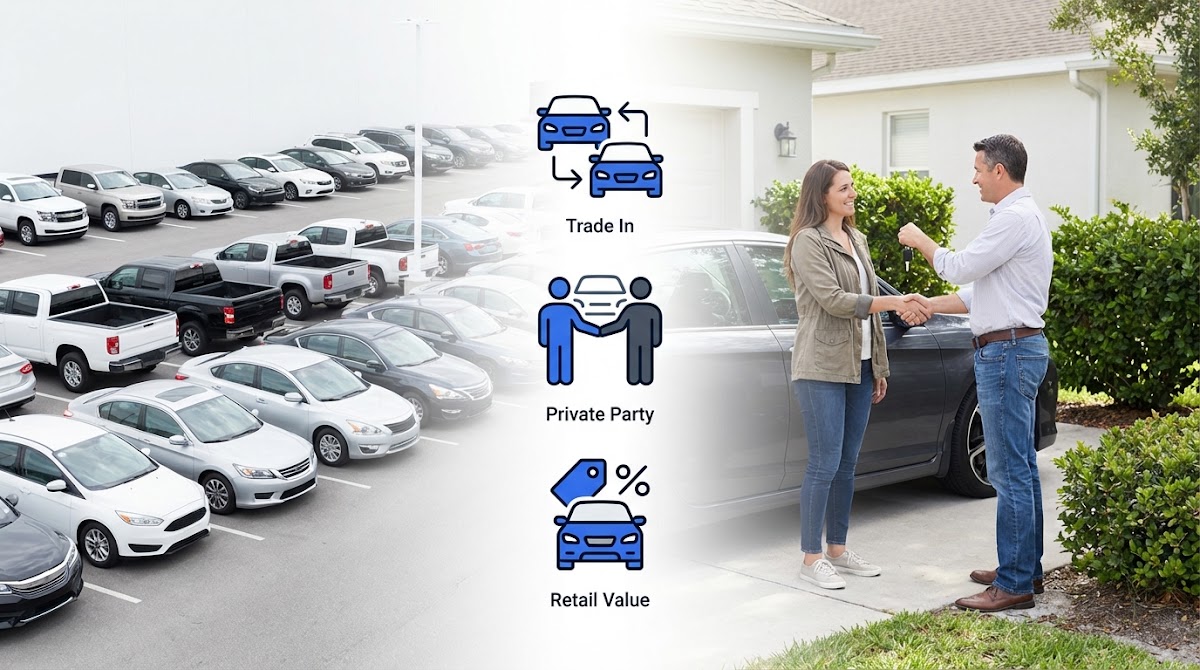
Trade-in values are the estimates dealers use for taking a car into inventory. Private-party values reflect the price between two individuals. Suggested retail numbers are aimed at buyers who will purchase from a dealer and usually sit above trade-in estimates. These basic definitions help set expectations before you compare site outputs.
Valuation sites do not all use the same inputs. Many combine recent transaction records, live dealer listings and local market adjustments, and that mix shapes the result a site publishes. For example, some methodologies weight auction data and dealer-submitted prices differently, which produces consistent spreads between published outputs and regional variations in numbers How KBB Determines Values. For additional context on different valuation references see The Different Books for Car Valuations
Wholesale market shifts also matter because retail estimates often adjust when auction prices move. When wholesale indexes show volatility, retail algorithms can reflect those movements in subsequent updates Manheim Used Vehicle Value Index and Market Report
Compare values and confirm output types
Run a quick multi-site value check and note which type of value each site shows before you assume a single number represents your car.
Understanding the differences among value types prevents surprises. Dealers, private buyers and insurers use different benchmarks, so pick the estimate that matches your plan and document which one you used when you compare listings later.
Overview of major valuation outputs: trade-in vs private-party vs retail
Begin by matching your goal to the output. If you plan to trade the car to a dealer, the trade-in estimate is most relevant. If you expect to sell the car yourself, private-party estimates are the right reference. If you plan to buy from a dealer, retail or suggested retail figures are the most helpful.
Sites may publish multiple outputs for the same VIN. A single vehicle page can list trade-in, private-party and suggested retail numbers so buyers can choose the one that aligns with their plan. Make sure you note which output you are looking at when you log comparisons, since these numbers are not interchangeable How KBB Determines Values
Local market adjustments change the useful value for your area. Two cars with identical mileage and options can show different retail estimates because dealers in separate regions list cars at different prices. When you check values, confirm whether the site adjusts for local market conditions and whether the reported number is trade-in, private-party or retail How Edmunds Calculates True Market Value (TMV)
How Kelley Blue Book, Edmunds, NADA and CarGurus produce their numbers
Kelley Blue Book methodology highlights
Kelley Blue Book publishes multiple consumer-facing values, including trade-in, private-party and suggested retail, and it uses a mix of transaction and listing data plus local market adjustments to produce those outputs How KBB Determines Values. You can also compare KBB to Edmunds directly Compare KBB vs Edmunds
The practical effect is that a KBB trade-in estimate is intended to reflect dealer acquisition expectations, while the suggested retail figure is a consumer-facing price benchmark. Readers should match the KBB number they use with their buying or selling plan rather than treating every KBB figure as interchangeable.
Edmunds TMV and NADA emphasis
Edmunds publishes a True Market Value estimate that is calculated from recent transactions with a view to reflecting what buyers in the local market tend to pay, and it separates trade-in and private-party estimates to match different seller scenarios How Edmunds Calculates True Market Value (TMV)
NADA Guides often emphasizes wholesale and lender-relevant data in its valuations. That focus historically aligns NADA numbers more closely with trade-in and wholesale pricing used by dealers and finance sources How We Value Cars. For a comparison of NADA, KBB and Manheim outputs see NADA vs KBB vs Manheim
No single site captures every perspective. Use a combination of valuation sites that match your goal, verify VIN-specific history, and adjust for condition and local market context to find a confident value.
CarGurus publishes an Instant Market Value and uses price analysis labels that compare dealer-listed prices to its internal benchmark. Those labels provide a retail-focused signal that helps shoppers see how a listed price sits relative to available market listings What Is Instant Market Value and How CarGurus Calculates It
Each site has a distinct output and audience. KBB tends to present multiple consumer values with explicit definitions, Edmunds aims to reflect local transaction levels through TMV, NADA provides wholesale-focused context, and marketplace sites offer listing-based signals that are often more retail oriented.
Why wholesale indexes such as Manheim matter for retail pricing
Wholesale indexes track auction-level price volatility and can move quickly month to month. Because retail algorithms often reference recent wholesale trends, a sharp auction move can lead to retail estimate updates shortly after Manheim Used Vehicle Value Index and Market Report
For buyers and sellers this means values can change on a monthly cadence when underlying wholesale conditions shift. During volatile periods, cross-checking values and noting the quote dates helps you avoid relying on a stale number.
Decision framework: which reported value should you trust for your situation
Start by clarifying your goal. If you will trade to a dealer, use trade-in figures. If you plan a private sale, rely on private-party values. If you intend to buy from a dealer, focus on retail or suggested retail estimates.
Also remember to adjust for vehicle-specific details such as trim, mileage and condition rather than taking a headline value at face value. Matching the output type to your plan reduces mismatch risk and helps you set realistic expectations How KBB Determines Values
As a rule, check at least two valuation sources and a vehicle history report before acting. Multiple sources make it easier to spot a valuation outlier and to understand whether a reported number reflects auction trends, local listing prices or lender-oriented data How Edmunds Calculates True Market Value (TMV)
A step-by-step workflow: compare prices, confirm history, then act
Step 1, gather VIN-specific values from at least two valuation sites and note which output type each one shows. Log the site name, value type, the quoted number and the date you checked the value so you can compare later, or run a VIN report Run Report.
Step 2, order a vehicle history report and confirm title status, ownership history and reported accidents before relying on a price. A history report can expose items that materially change the value you should accept for a given listing How to Find the Value of a Used Car
Step 3, reconcile differences by adjusting for mileage, trim and condition. Look at local dealer listings for comparable cars and note whether a listing has price analysis labels or dealer transparency signals. For many buyers, pairing history context with pricing insights helps surface risk signals you might need to factor into your offer How to Find the Value of a Used Car
If a valuation spread is large, recheck the VIN details, confirm which output type each site used, and consider an inspection before you commit. Recording the dates of each quoted value helps explain differences that appear after algorithm updates or market movement.
Quick checklist for comparing site estimates and listing signals
When you compare sites, log these items: site name, value type, reported number, quote date, mileage, trim, and any price analysis label. This creates an apples-to-apples comparison that you can revisit if prices move.
Also record dealer signals such as reviews, ratings and profile information. These details provide context about seller reliability and can influence how you approach a dealer, although they do not replace VIN-specific checks.
a compact comparison template to log values and listing details
Save one row per valuation check
Save screenshots or short notes for each quoted value so you have a timestamped record. Screenshots are useful if a dealer updates a listing or if algorithms refresh in the days after you first compare prices.
Common mistakes buyers make when relying on a single valuation
Relying on a single site is risky because different data mixes produce different numbers. A value based on auction transactions will usually differ from a value derived from live dealer listings, and that difference can be more pronounced in volatile segments.
Buyers also overlook condition and trim differences. Headline values often assume average mileage and typical condition, so failing to adjust for optional packages, higher mileage or a history of service issues can create a significant mismatch between expectation and reality How to Find the Value of a Used Car
Special cases: why EVs and luxury used cars often need extra checks
EVs and used luxury vehicles commonly show larger model-level variance and more frequent algorithm updates, so cross-checking is particularly important for these segments. Battery health and certification status for luxury models can change the cost picture materially, and valuation algorithms are still adjusting to these dynamics Manheim Used Vehicle Value Index and Market Report
For EVs, check powertrain and battery condition and any available service history. For luxury models, confirm service records and any certification or extended warranty options before treating a headline price as definitive.
How to adjust a reported value for mileage, trim and condition
Headline values assume typical mileage and average condition. If mileage is higher or the car shows more wear, you should adjust the expected value downward. If the car has well documented service history and desirable options, adjust upward in your mental comparison.
Items that commonly change value include optional packages, aftermarket equipment, nonstandard wheels and any accident history shown in a vehicle history report. Document condition with photos and notes to justify an adjusted number when you discuss price with a dealer or buyer How KBB Determines Values
Using pricing labels and dealer transparency signals in listings
Marketplace price analysis labels compare a listed dealer price to an algorithmic benchmark and communicate how that listing stacks up against the site benchmark. These labels are a retail-focused shorthand, not a replacement for VIN-specific checks What Is Instant Market Value and How CarGurus Calculates It
Dealer reviews, ratings and profile information provide additional context about the seller. They can affect negotiation posture and help you prioritize which listings to pursue, but they do not replace a vehicle history report or a condition check.
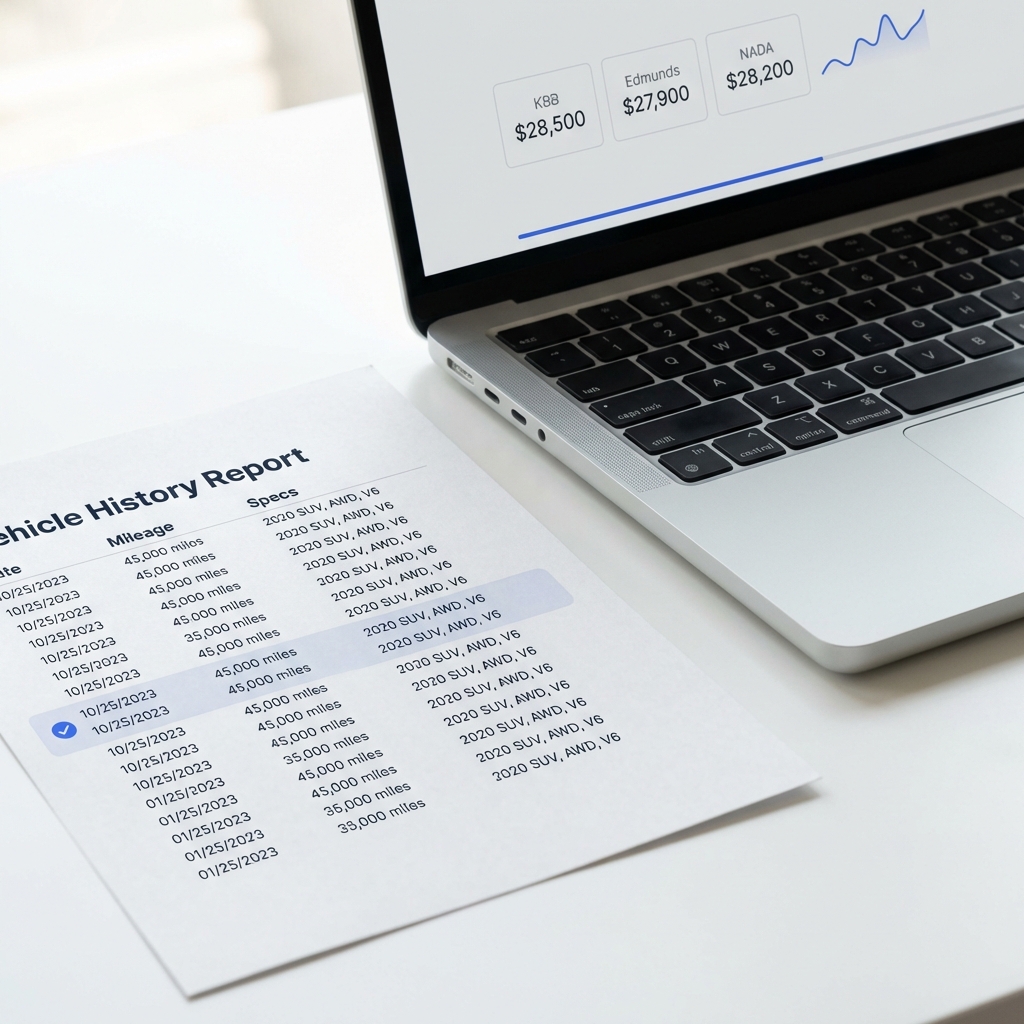
A cautionary sample comparison: what to expect when three sites differ
Site-to-site spreads are common and often reflect different inputs and output types. The same VIN can produce values that differ because one site leans on auction data, another uses live dealer listings and a third emphasizes lender or wholesale pricing How to Find the Value of a Used Car
To reconcile differences, confirm the VIN details, check which output each site published, and adjust for condition and trim. Record the date of each quoted value so you can tell whether a difference is due to market movement or to an inconsistent data mix.
When to order a pre-purchase inspection or seek expert help
Order a mechanical inspection when you see red flags in the history report, if title documents do not match records, if service history is inconsistent, or if valuation spreads are large enough to change your decision. An inspection validates condition-related adjustments and can be a cost effective way to avoid surprise repairs.
Factor inspection findings into your negotiation or acceptance decision. A documented inspection that confirms issues gives you leverage in price discussions or a clear reason to walk away if repairs outweigh the value proposition How to Find the Value of a Used Car
Conclusion: a practical checklist to find a confident value
Recap the workflow: check multiple valuation sites, order a vehicle history report, adjust for vehicle-specific factors and get an inspection when needed. This sequence helps reduce uncertainty when you evaluate a listing.
Document comparisons, note quote dates, and contact the seller with informed questions. Avoid relying on a single number and treat valuation site outputs as complementary signals that you reconcile with VIN-specific facts and local listings.
Check at least two valuation sites and order a vehicle history report. Comparing multiple sources helps reveal data-source differences and highlights outliers to investigate further.
Use a trade-in estimate when you plan to trade to a dealer, since that output is designed to reflect dealer acquisition expectations and wholesale influences.
No, price analysis labels provide a retail-focused price signal but do not replace a VIN-specific vehicle history report or a condition inspection.
Use this workflow and checklist to make side-by-side, dated comparisons. When values diverge, return to the VIN, verify the output type on each site, and use documented history and inspection results to inform your final offer or acceptance.
If you need a quick way to confirm title or ownership history, consider ordering a vehicle history report for the VIN before you visit the seller.

 Blog
Blog