What is the best mini van to buy? A research-first guide
This guide helps research-oriented buyers evaluate mini vans for sale using safety ratings, reliability studies, fuel-economy data and vehicle history reports. It shows a repeatable, checklist-driven process to compare listings, prioritize risks and narrow a short list before contacting a dealer.
This guide helps research-oriented buyers compare used Tacoma options and decide which model years and trims match their priorities. It distinguishes third-generation 2016–2023 Tacomas, which have a long service and parts history, from the 2024 redesign that introduced i-FORCE powertrain options. Use a VIN-based vehicle history report and a professional pre-purchase inspection to reduce risk before you contact a dealer.
This guide explains which tacoma trucks for sale show the strongest reliability and safety signals to watch out for, and why mid-2010s and many pre-2016 Tacomas appear most often in complaint and recall records. The article shows how to use vehicle history reports, recall checks, and a focused inspection to reduce risk when evaluating a used Tacoma.
This article helps buyers searching tacoma trucks for sale understand which Tacoma engine tends to be most reliable. It summarizes reliability ratings, owner-complaint clusters, and maintenance-cost differences between the 2.7L I4 and the 3.5L V6, and gives actionable checks to reduce engine-related risk.
Buying a used minivan is often a research-led decision for families who need space, safety and predictable costs. This guide outlines a checklist-driven approach to find and evaluate mini vans for sale so you can narrow a short list with evidence rather than guesswork.
We focus on steps you can take before you visit a dealer: filtering listings for basic risk signals, ordering VIN-level vehicle history reports, and comparing safety and reliability data for the exact model year and trim. Following these steps helps you prioritize time and reduce avoidable risk when you inspect vehicles in person.
Use VIN-level vehicle history reports and price analysis labels to prioritize which used minivans to inspect in person.
Check IIHS and NHTSA ratings for the exact model year and trim, and compare EPA combined MPG for hybrid versus non-hybrid powertrains.
Combine dependability study signals with documented service history to estimate long-term ownership cost risk.
How to begin searching mini vans for sale: the research-first approach
Where to look and which filters matter
Start by defining must-have filters that reduce obvious risk and narrow results. Prioritize clean title, single owner, no accident reported, and well maintained as search filters so the first page of results contains listings that meet basic risk criteria.
Use price analysis labels and local market context to avoid shortlisting only the lowest listed price. Price labels can show whether a listing sits below or above similar local listings, which is helpful when comparing offers from different sellers. For practical price context, consult aggregated buyer guides that combine pricing and ownership cost analysis to see how listing premiums and local demand typically move value.
Before you contact a dealer, confirm the VIN and plan to run a vehicle history report for any listing you shortlist.
Quick filters to apply when searching listings
Use to prioritize shortlist criteria
Why listing context and market signals change your priorities
Listing context matters because used-market pricing and resale trends vary by region and model year, and those differences affect how much risk you accept for a given price. Local demand can push prices above typical values and certified pre-owned status often carries a premium that may be reasonable for some buyers.
Dealership type and the presence of a transparent dealer profile, including reviews and ratings, should influence where you place trust during early research. Confirm dealer transparency signals when possible to reduce uncertainty before scheduling a visit. For regional pricing and buyer guidance, buyer-oriented analyses explain how listing context alters expected costs.
Quick buyer checklist for choosing among mini vans for sale
Key questions to answer before you visit
Use a short checklist to compare shortlisted listings at a glance. Key items to confirm on every listing include VIN, title status, ownership history, service history and a mileage check. These items are often available through the listing or a vehicle history report and form the minimum verification set.
Numbered checklist for first screening:
Verify the VIN and confirm title status and ownership history.
Check service history entries and mileage consistency.
Review price analysis label and compare to local market context.
Confirm certified pre-owned status if offered and note dealer type.
Note listed safety features and the exact trim and model year.
How to weight safety, space and cost for your family
Decide your weighting early. If you carry children frequently, safety ratings and LATCH fit can move to the top. If you rely on long daily driving, prioritize fuel economy and powertrain choice. If resale and predictable repairs matter most, use dependability rankings and service records to favor certain manufacturers.
Consider certified pre-owned premiums, which can be sensible when a buyer values a limited warranty and dealer-verified service history. These premiums vary by seller type and local demand and should be weighed against the actual condition and vehicle history documentation for the specific listing.
Safety ratings to check on any mini vans for sale
Which NHTSA and IIHS ratings matter and why
Safety ratings are often central to family choices, but they are model- and trim-specific so always check the exact model year and trim on the listing. Independent crash-test programs provide objective measures of crashworthiness that you can use to compare candidate vehicles.
Consult the IIHS Top Safety Pick and the NHTSA vehicle ratings pages to see crash-test results for the specific model year and trim you are considering. These pages list test results and explanations that help you interpret how a given trim performed in crashworthiness and crash avoidance tests. IIHS vehicle ratings
How to check the exact trim and model year for crash-test relevance
When a listing names a trim, cross-check that trim's safety features and optional safety packages against the test entry. Some safety test results depend on equipment that may be optional on nearby trims, so a good practice is to confirm whether the listing includes those options. Using the model year and trim in the test databases avoids mismatches between advertised equipment and tested configurations.
Look at the listing's stated airbags, LATCH anchors and advanced driver assistance features when available and compare them to the test notes for that exact trim. Use safety ratings as one input among several, not as the sole deciding factor, because crash test datasets emphasize crashworthiness but do not capture maintenance history or current mechanical condition.
What reliability studies say about long-term minivan ownership
How dependability affects total cost to own
Industry dependability studies reveal measurable differences in long-term reliability across manufacturers, and those differences translate into estimated maintenance and repair costs over time. Dependability patterns help shape an expected total cost to own for a given make and model family.
Use summarized dependability reports to set expectations about which manufacturers typically require fewer unscheduled repairs. Then compare those high-level signals with the vehicle history report's service history for the specific vehicle you consider. For recent dependability trends, see industry vehicle dependability findings.
Using J.D. Power and similar studies to set expectations
Combine manufacturer-level dependability signals with the VIN-level service history. A model that typically scores well in dependability studies can still be a risky buy if the vehicle history report shows erratic maintenance or ownership patterns. Conversely, a model with middling dependability but strong documented service history can be a sensible choice for a careful buyer.
Remember that model-year changes and powertrain options can shift dependability expectations, so check that any general study conclusions apply to the specific model year and powertrain shown in the listing.
Fuel economy and powertrain choices when browsing mini vans for sale
Hybrid vs non-hybrid V6: what EPA data shows
EPA fuel-economy data indicate hybrid-equipped minivans typically deliver substantially better combined MPG than non-hybrid V6 minivans, which can lower estimated fuel costs in total-cost calculations. For buyers focused on running cost, powertrain choice is an important lever to reduce fuel spend over ownership and can be especially relevant for high-mileage households. EPA fuel economy data
Compare EPA combined MPG numbers for the exact model year and trim in the listing when estimating running costs. Keep in mind that local fuel prices and driving patterns will change actual spend, so use EPA numbers as a consistent baseline for comparison rather than a precise forecast.
Run a Vehicle History Report on CarFax Deals
Consider whether a hybrid powertrain matches your typical driving before making trade-offs on price. A hybrid can reduce fuel cost but may carry different maintenance expectations; use EPA figures and VIN-level history to compare scenarios.
How fuel economy affects your estimated running costs
Fuel economy is only one driver of total cost to own, alongside depreciation and repair costs. Use EPA combined MPG as a comparator and fold it into a simple annual fuel cost estimate based on your expected miles per year and local fuel prices to see how much the powertrain choice matters for your budget.
When comparing hybrid and non-hybrid candidates, also consider typical maintenance items unique to the powertrain and how those will interact with the vehicle history report's service entries. This combined view tends to produce a more realistic ownership cost estimate than focusing on sticker MPG alone.
Using vehicle history reports and pricing-insight labels to reduce uncertainty
What to look for in a vehicle history report
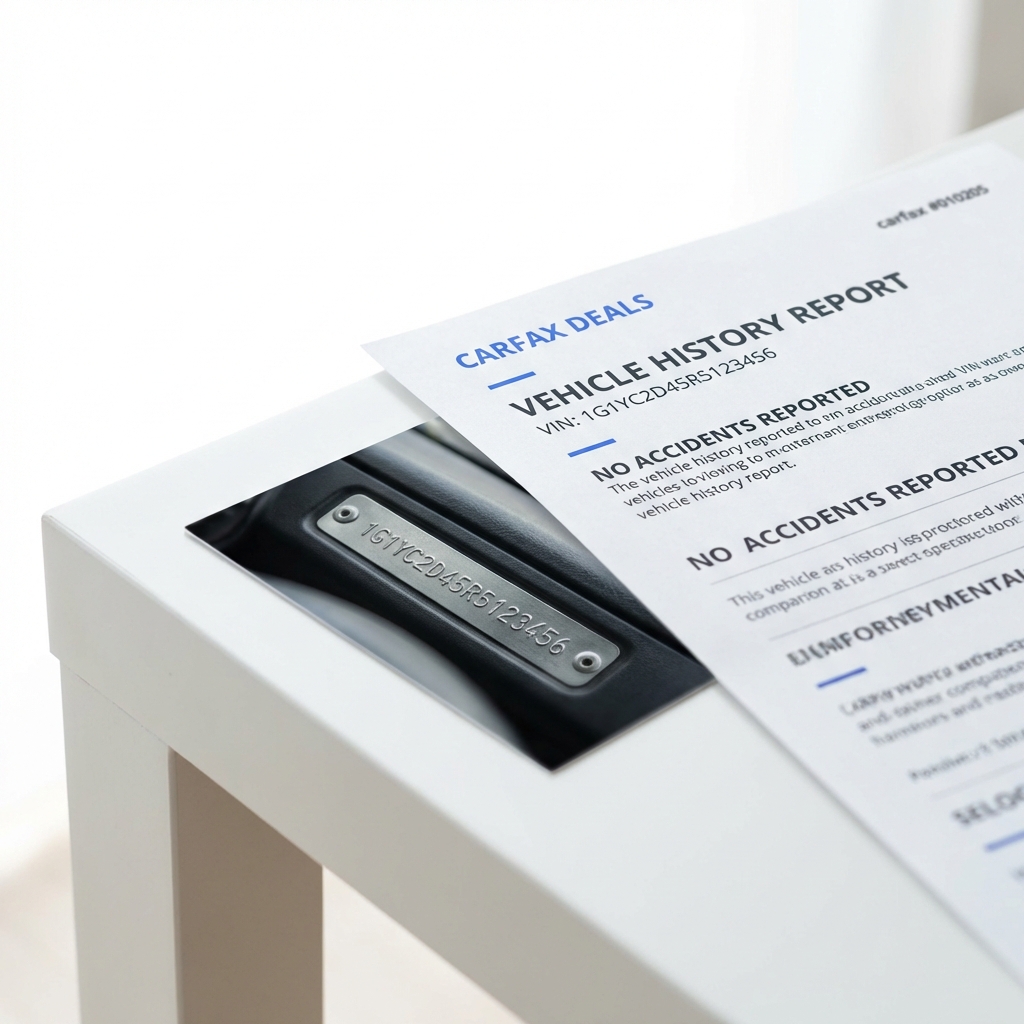
Order a vehicle history report for every shortlisted VIN. Common report items that matter include accident history, ownership history, service history, mileage checks and title status. These entries often reveal mismatches between a listing description and the vehicle's recorded history.
Pay special attention to title status and any branded titles, and check mileage consistency across records. Use service history entries to confirm routine maintenance milestones and to flag periods with sparse service activity, which can indicate deferred care.
How price analysis labels help you compare similar listings
Price analysis labels such as Great Deal, Good Deal and Fair Deal provide a quick relative signal against local market context. Use these labels to prioritize which listings to inspect in person, but confirm any label with comparison to similar nearby offers and with the vehicle history report to see if the label aligns with documented condition.
When a listing shows a strong price advantage, use the VIN report to look for causes such as a branded title or incomplete service history. Conversely, small premiums for certified pre-owned vehicles can make sense when they come with documented service and warranty coverage, so weigh labels together with dealer transparency signals and specific report findings.
A step-by-step framework to evaluate any minivan listing
Step 1: confirm listing details and run the VIN report
Step 1 is to verify the VIN on the listing, confirm the model year and trim, and order a vehicle history report for that VIN. The report is the primary tool to confirm title status, ownership history and service history before you invest time visiting the vehicle.
Use the history report findings to update your internal checklist and to flag items that should be inspected during a test drive or by a pre-purchase inspector. A consistent VIN, clear title status and recent, regular service entries generally reduce risk compared to listings lacking those elements. Consumer Reports minivan guide
Confirm VIN-level history, compare safety ratings and dependability signals for the exact model year and trim, and use price analysis labels and dealer transparency to prioritize listings for inspection.
Step 2: compare pricing label and similar local listings
Step 2 is to compare the listing's price analysis label with nearby listings for the same model year and trim. This provides context on whether the asking price aligns with local demand and typical resale values. Adjust for certified pre-owned premiums and documented maintenance where relevant.
If the price is unusually low, use both the history report and the listing photos to verify title and condition and ask the dealer for maintenance records to rule out hidden issues before a visit.
Step 3: schedule inspection and test drive
Step 3 is a scheduled inspection and test drive, ideally with a standardized checklist and, where indicated, a professional pre-purchase inspection. During the test drive, verify items called out in the report such as recent repairs, and listen for suspension, transmission or engine symptoms that might not be obvious in photos.
When inspection findings diverge from the vehicle history report, ask the dealer for clarification and supporting maintenance records. If discrepancies remain, consider walking away or asking for a deeper mechanical evaluation.
Decision criteria: how to pick the right minivan for your needs
Prioritizing safety, space, and running cost by household type
Create a simple rubric that assigns weights to safety ratings, dependability, fuel economy, seating and cargo flexibility, and price. For example, families who prioritize occupant protection might give safety ratings 40 percent of the decision weight, while budget-focused buyers might allocate more weight to running cost and dependability.
Use objective inputs for each criterion: safety rating from test programs, dependability signals from industry studies, EPA combined MPG for fuel economy and VIN-level service history for maintenance confidence. This structured approach helps to move choices from subjective preference to consistent comparison.
How to balance reliability and budget in a short list
If you must choose between a lower price and a cleaner history, quantify expected repair and maintenance exposure using dependability trends and the vehicle history report. Paying a premium for certified pre-owned or a lower-mileage unit can be sensible when it measurably reduces projected repair risk for your planned ownership horizon.
Match the specific model year and trim to buyer needs rather than selecting by nameplate alone. Model-year changes in features, powertrain options and safety equipment can change which trim best fits your priorities, so the trim-level match matters more than the model name when evaluating listings.
Typical mistakes and pitfalls when shopping mini vans for sale
Overlooking service history and title notes
Common mistakes include skipping the VIN check, ignoring inconsistent service records, and trusting listing photos without an inspection. These errors increase the chance of unexpected repairs or title complications after purchase.
Avoid these pitfalls by ordering a vehicle history report early, comparing reported mileage against service records, and asking the dealer for original maintenance receipts when possible. If the report shows branded title indicators or gaps in service, treat those listings cautiously and seek further documentation.
Relying only on listing photos or a single price label
Photos and a single price label do not substitute for a VIN-level review and local price comparison. Use price analysis labels to triage listings but verify reasons for outlier prices with the history report and dealer-provided records before prioritizing a visit.
When a listing seems like an outlier, either unusually cheap or expensive, step back and verify title status, maintenance history and the dealer profile. This simple verification routine reduces the chance of buyer's remorse.
Practical buyer scenarios: matching five family profiles to minivan priorities
Example profiles: commuter family, large-family hauler, budget-minded buyer
Scenario 1, the commuter family: Prioritize EPA combined MPG and a reliable powertrain if you cover high annual miles. Use EPA numbers to estimate fuel spend and a vehicle history report to confirm steady maintenance.
Scenario 2, the large-family hauler: Prioritize safety rating, seating configuration and cargo flexibility. Confirm that the specific trim includes the seating layout you need and check crash-test relevance for that trim and model year. Car and Driver safest minivans
Scenario 3, the budget-minded buyer: Emphasize dependability and service history. A vehicle with strong documented maintenance and favorable dependability signals can be a better long-term value even if the sticker price is slightly higher.
How the framework changes per scenario
Each profile shifts the relative weights in the decision rubric. For a commuter household, fuel economy and maintenance predictability may dominate; for a large family, safety and interior utility carry more weight. Use the step-by-step evaluation framework and checklist to apply the same comparison logic across all listings and scenarios.
Remember these scenarios are illustrative. Always verify VIN-level and trim-level data for the specific listing before making a commitment.
Inspecting, test-driving and using a pre-purchase inspection guide
What to inspect on a used minivan
On a visual inspection, check frame and corrosion signs, fluid leaks, suspension components and interior wear that matches the mileage check. Compare wear patterns to the mileage recorded in the vehicle history report to spot inconsistencies.
During the test drive, listen for unusual transmission or engine noises, test steering and braking under varied conditions, and verify HVAC and electronic convenience features. Note any discrepancies between what the seller claims and what you observe for follow-up with a pre-purchase inspector.
How to interpret inspection findings in the context of the vehicle history report
If the inspection finds repairs not reflected in the service history, ask the dealer for documentation. If the vehicle history report shows frequent repairs in a specific subsystem, target that area during the test drive and consider a specialist inspection for those components.
When inspection findings and history reports align and show regular maintenance, risk is often lower. When they diverge, require written clarification or a further mechanical evaluation before committing.
After you pick a listing: dealer transparency, paperwork and next steps
What dealer signals to confirm before committing
Confirm dealer reviews, ratings and profile information to assess transparency. Dealers who provide clear profiles and readily share maintenance records reduce the time you spend chasing documentation and lower uncertainty in the final negotiation stage.
Ask the dealer for copies of service invoices that correspond to entries in the vehicle history report and request written confirmation of any promises about condition or repairs. Retain copies of the report you used for the decision and any written dealer statements.
Paperwork and title checks to complete
Essential paperwork checks include verifying title status, obtaining an odometer statement if required, and reviewing any branded title disclosures. Confirm that the title name and odometer readings match the VIN and the documentation the dealer provides.
Where applicable, have the title and bill of sale reviewed by a third party or an attorney if the transaction includes complexities. For most private and dealer sales, documented confirmation of title status and any outstanding liens is essential to avoid post-sale surprises.
For most private and dealer sales, documented confirmation of title status and any outstanding liens is essential to avoid post-sale surprises.
Conclusion: choosing the best mini van to buy with confidence
Key takeaways
To choose confidently, verify the VIN and order a vehicle history report, compare safety and reliability data for the exact trim and model year, and use price analysis labels together with local market context. These steps reduce uncertainty and make comparisons more consistent across listings.
A final short action plan
Use the checklist and the step-by-step framework for every shortlisted listing, confirm dealer transparency signals and get a pre-purchase inspection when needed. Rely on VIN-level evidence and documented service history to inform a conditional purchase decision rather than assumptions about the nameplate.
Yes, ordering a vehicle history report before visiting helps confirm title status, ownership history and service records so you can prioritize listings and avoid surprises.
They are important reference points but must be checked for the exact model year and trim; combine ratings with VIN-level history and inspection findings.
Hybrid minivans typically offer better combined MPG, which can lower fuel costs over time, but assess the premium against your expected miles and maintenance expectations.
A disciplined, checklist-driven approach reduces uncertainty but does not eliminate all risk. Use VIN-level evidence, safety ratings and professional inspections to make informed, conditional choices and keep documentation of the reports and dealer statements you relied on.
If you apply the framework consistently across shortlisted listings, you can compare options more objectively and choose the minivan that best matches your household priorities.


 Blog
Blog