What is the best used car with the least problems?
This in-depth guide explains how to identify the most reliable used cars, which models and brands typically have the fewest problems, and how to reduce risk when buying pre-owned. It covers gasoline cars, hybrids and EVs, common failure points, a step-by-step pre-purchase inspection checklist, negotiating tips, budgeting for repairs, and model recommendations — including trusted low-cost picks under $10,000. Learn how documentation, verified vehicle history reports, and targeted inspections can help you find used cars with low maintenance needs and the best long-term value.
This guide helps research-oriented buyers compare used Tacoma options and decide which model years and trims match their priorities. It distinguishes third-generation 2016–2023 Tacomas, which have a long service and parts history, from the 2024 redesign that introduced i-FORCE powertrain options. Use a VIN-based vehicle history report and a professional pre-purchase inspection to reduce risk before you contact a dealer.
This guide explains which tacoma trucks for sale show the strongest reliability and safety signals to watch out for, and why mid-2010s and many pre-2016 Tacomas appear most often in complaint and recall records. The article shows how to use vehicle history reports, recall checks, and a focused inspection to reduce risk when evaluating a used Tacoma.
This article helps buyers searching tacoma trucks for sale understand which Tacoma engine tends to be most reliable. It summarizes reliability ratings, owner-complaint clusters, and maintenance-cost differences between the 2.7L I4 and the 3.5L V6, and gives actionable checks to reduce engine-related risk.
Buying a used car should feel empowering, not risky. This guide lays out which models tend to have the fewest problems, what to inspect, and how to use verified history reports and independent inspections to reduce surprises. Read on for model recommendations, practical checklists and easy negotiation tips so you can find a low-maintenance car with confidence.
1. Toyota Camry, Corolla, Honda Civic and Accord consistently rank among the most reliable used cars in multiple 2024–2025 owner surveys.
2. For sub-$10,000 budgets, older Corolla, Camry and Civic examples with full service logs often deliver the best low-maintenance value.
3. CARFAX Deals surfaces thousands of dealership listings paired with verified CARFAX Vehicle History Reports and price analysis labels to reduce buying uncertainty.
Buying with confidence: a practical roadmap
Buying a used car is a smart way to stretch your budget - but it’s only smart if you reduce the chances of future surprises. This guide focuses on the most reliable used cars, what causes problems, and the practical steps you can take to find a low-maintenance vehicle that fits your life. Read on for clear checklists, realistic expectations, and model-specific guidance to make your next used-car purchase calm and predictable.
Why some used cars fail less often
Across multiple owner surveys and industry reliability studies, a handful of patterns keep repeating. Conservative engineering choices, plentiful parts, and predictable maintenance schedules tend to create vehicles that show up repeatedly on lists of the most reliable used cars. Japanese legacy brands like Toyota, Honda, Lexus, Mazda and Acura often lead these lists because their designs prioritize durability and repairability.
The reality about EVs and hybrids
Electrified vehicles flip the risk equation in useful ways - fewer drivetrain wear items - while adding new risk areas such as battery state-of-health and complex electronics. That means some EVs and hybrids show up among the most reliable used cars when their battery and software records are favorable, but others require deeper scrutiny.
Run a CARFAX report before committing to any listing — it’s an easy, practical step that reveals title history, accident records and service entries. Knowing this early removes a lot of guesswork and helps you focus on truly low-risk options.
Common problem areas (and what they cost)
Understanding the kinds of failures that recur on used cars helps you prioritize what to check. Breakdowns roughly fall into two categories: routine wear-and-tear and infrequent but costly system failures.
Start your low-risk search with verified history reports
If you want quick VIN checks while you shop, try the VIN report tool: get a VIN report to spot title or mileage issues early.
These are the things that show up in normal ownership: brakes, tires, clutches (on manual cars), wheel bearings, suspension bushings and fluids/filters. They’re predictable and relatively affordable, but they do add up if deferred.
Less frequent, higher-cost failures
Transmission failures, head gasket repairs, and major hybrid or EV battery issues aren’t common, but when they occur they can cost thousands. The probability of these expensive repairs rises as mileage climbs and service history grows patchy - so a strong maintenance log is gold.
Which makes and models show up most often on reliability lists?
If you’re asking which models are on the short list for the most reliable used cars, several keep recurring in 2024–2025 owner surveys and industry analyses:
Toyota Camry — simple engineering and abundant parts make this a perennial favorite.
Toyota Corolla — compact, predictable, and low-cost to maintain.
Honda Civic and Accord — durable engines when maintained properly.
Lexus ES and RX — Toyota engineering with a luxury finish; often top-ranked.
Mazda3 and Mazda6 — improved build quality and engineering in recent generations.
Acura TLX/MDX — dependable luxury options built on mature platforms.
These models repeatedly appear among the most reliable used cars because they combine longevity, a track record of incremental fixes across years, and easy access to parts and service. Consumer Reports also publishes annual top picks you may want to cross-check when narrowing choices: Best Cars of the Year: 10 Top Picks of 2024.
Best used cars under $10,000 (practical picks)
Budget buyers can still find low-maintenance vehicles, but diligence matters more. If you’re shopping with a sub-$10k budget, prioritize these models when you can find well-documented examples:
Toyota Corolla (late 2000s to early 2010s) — simple drivetrain and long-lived engines.
Toyota Camry (same generation window) — roomy, durable, and widely serviceable.
Honda Civic/Accord (2008–2014 segments) — reliable if timing belts/chain and fluids are documented.
Toyota Prius (if battery history looks good) — hybrids can be long-lived, but verify battery condition.
Older Mazda3 — mechanically straightforward and often less expensive to maintain than luxury cars.
These cars aren’t magic; they’re simply models that, when well-maintained, tend to be among the most reliable used cars available at lower price points. For data-driven lists of reliable used cars, see aggregated reliability analyses such as the U.S. News roundup: The Most Reliable Used Cars.
How to evaluate a listing: three anchors
When you find a listing you like, focus on these three anchors: model-year, mileage, and service history. Those three signals together usually tell you whether the car will be a steady companion or a wallet drain.
Model-year matters
Manufacturers can fix defects or improve components year-to-year. A model-year that suffered known defects is worth avoiding if the next model didn’t conclusively fix them.
Mileage matters
As mileage climbs, the probability of high-cost repairs increases. That doesn’t make every high-mileage car a bad buy, but it means service records become more important.
Service history matters most
A well-documented older car can beat a younger car with no records. Look for consistent oil-change intervals, scheduled maintenance entries, and receipts for major items like timing components or battery replacements.
A clear, itemized service history combined with a focused PPI; many buyers skip digging into receipts and independent inspections, but those documents often reveal deferred maintenance that predicts larger failures.
Pre-purchase inspection (PPI): the single smartest investment
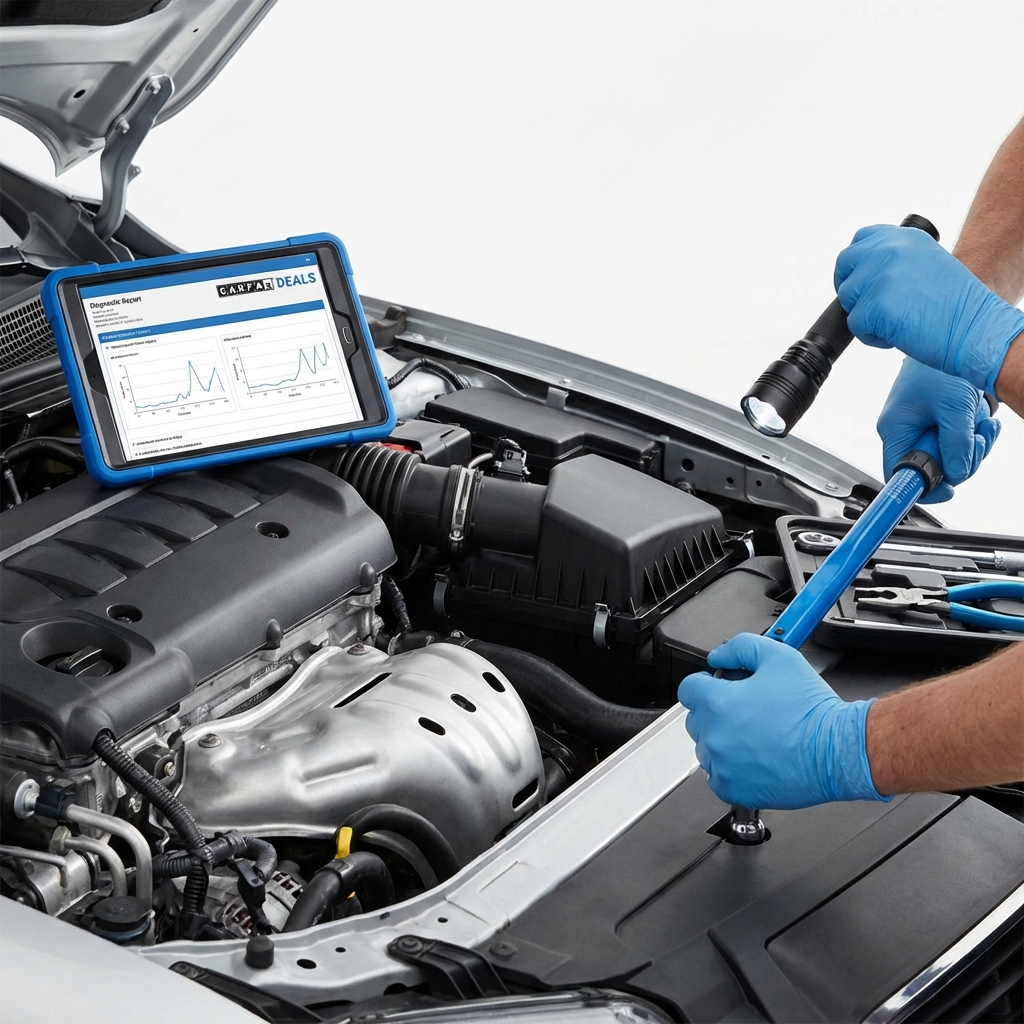
A PPI is an independent mechanic’s full check of a used car. For gasoline cars this should include a thorough engine and transmission inspection, suspension check, brake and tire evaluation, and a test drive that reveals driveline noises and performance problems. For EVs and hybrids a PPI should add a battery state-of-health check, charging behavior review and an electronic diagnostics scan.
A PPI checklist you can use
Test drive: listen for noises, check shifting and braking, test A/C and heating.
Engine bay: look for leaks, corrosion, and oil condition.
Undercarriage: inspect for rust, frame damage, and suspension wear.
Fluids: check oil, coolant, brake fluid and transmission fluid condition.
Suspension & brakes: evaluate pad thickness, rotor condition, strut leakage.
Electronics & sensors: scan for engine/trip/fault codes and assess warning lights.
Hybrid/EV battery: obtain a state-of-health readout, ask about charge history and any refurbishment.
Having this checklist ready before you hire a mechanic keeps the inspection focused and ensures the report addresses the things that matter most for low-maintenance ownership.
What to ask the seller: the right questions
Good questions reveal a lot. Here are direct, practical questions to ask every seller:
Do you have the full service records and receipts?
How long have you owned the vehicle and why are you selling?
Has the car had any accidents or frame work done?
Are there any unresolved recalls?
For EVs/hybrids: how often was the battery fast-charged and do you have charging logs?
Answers that are vague or evasive are a red flag. A seller who can provide receipts, clear reasons for selling and recent maintenance documentation is typically offering a lower-risk car.
Interpreting vehicle history reports
A verified vehicle history report is one of your most objective tools. It shows title information, reported accidents, mileage checks and service entries. Use the report to confirm what the seller tells you; inconsistencies should be resolved before you proceed. Vehicle history reports don’t catch everything — private repairs and unreported accidents can slip through — but combined with a PPI they dramatically reduce risk.
Red flags that suggest walk-away
Some warning signs are more serious than others. Walk away if you find:
Odometer inconsistencies or a history of rollback alerts.
Major spray paint or mismatched body panels that suggest hidden collision repairs.
Evidence of flood or heavy water damage.
Missing or vague service records paired with high mileage.
Minor issues like worn tires or postponed cosmetic fixes aren’t deal-breakers if the price reflects them and a PPI confirms no structural or mechanical trouble.
Negotiation tactics: use data, not emotion
When negotiating, bring facts: the market price for similar cars, the vehicle history report, and the PPI results. If a pre-purchase inspection finds repairs, request that the seller complete them or lower the price by a reasonable estimate for labor and parts. If the car is priced below market without a clear reason, assume the price reflects hidden risk until proven otherwise.
Warranty considerations and transfers
Manufacturer warranties sometimes transfer to subsequent owners - especially powertrain or battery warranties - but terms vary. Always ask for proof and read the transfer rules. Third-party extended warranties can be helpful, but read exclusions carefully; many plans exclude wear items and common maintenance tasks.
EV-specific buying tips
EVs can be highly reliable, but their risk centers on battery health, charging history, and electronics. For EV buyers:
Request a battery state-of-health readout and ask about fast-charging frequency.
Check whether charger firmware updates were applied and if any software service bulletins exist for the model-year.
Confirm whether the battery warranty (if any) is transferable to a new owner.
Many EVs will be lower-maintenance mechanically, but replacement battery packs and certain power-electronics repairs are expensive - that’s why documentation and PPI are crucial.
Maintenance budgeting: realistic numbers
Plan for routine maintenance first: oil changes, brakes, tires and consumables. For many compact and midsize cars, expect several hundred to a couple thousand dollars per year in average upkeep depending on driving patterns and local labor rates. For high-mileage or luxury cars, allow for larger annual averages and occasional big-ticket items.
Also build a contingency fund for unexpected repairs - a few thousand dollars set aside can turn a panic repair into a planned one. If you’re buying an EV, the contingency should include battery concerns if the warranty is expired or non-transferable.
Real-world examples: what small choices saved money
Stories illustrate why documentation matters: a spotless-looking car with murky oil receipts later required major coolant-system work because the owner had skipped scheduled maintenance. Contrast that with a five-year-old hybrid whose buyer had full records — that car needed only normal wear items in the first two years of ownership. The difference was predictable maintenance and clear records.
Model-by-model nuance: things to watch for
Even the most reliable used cars have model-year and option-package nuances worth checking:
Toyota Camry/Corolla: check for consistent oil-change records and ensure suspension bushings haven’t been neglected in older cars.
Honda Civic/Accord: verify timing-belt or chain service depending on engine type and year.
Lexus: electronics in older luxury models can be costly; confirm earlier owners addressed software or comfort-system faults.
Toyota Prius: confirm hybrid battery history and any inverter or coolant-pump work that was done.
How to spot a fair market price
Use online price guides, local listings and tools that label listings relative to market price. If comparable cars with similar history and miles are priced substantially higher or lower, ask why. A slightly higher price can be worth it if the car includes documented maintenance, recent repairs, or a limited warranty.
Certified Pre-Owned: when it makes sense
A CPO car reduces risk by combining an inspection with a manufacturer-backed warranty, but it costs a premium. If you value peace of mind and a warranty for likely ownership period, CPO can be worth the extra outlay. If you’re comfortable with a PPI and a strong service history, non-CPO cars can deliver better value.
Checklist: before you sign
Use this final checklist before closing a deal:
Get and review a verified vehicle history report.
Complete a PPI and review the written report.
Confirm the resolution of any safety recalls.
Verify title status (clean title preferred; salvage/title-branded vehicles need caution).
Negotiate repairs or price adjustments based on inspection findings.
Confirm warranty transferability (if applicable).
Ensure all paperwork matches - VIN, title name, registration and odometer readings.
Marketplaces that pair verified history reports with clear pricing make buying easier. When you can compare cars that include verified service history and price labels, you spend less time guessing and more time choosing. That’s why tools that surface verified reports and price context are so valuable to buyers who want the most reliable used cars without unnecessary risk. See CARFAX rankings for context: Latest New & Used Car Rankings | CARFAX.
Start with a short list of makes and models known for dependability, then refine by the three anchors (year, mileage, service history). Use a verified vehicle history report to filter out unclear titles and accident histories, then schedule PPIs on the most promising listings. Be patient - a calm search yields better results than a rushed purchase.
Final thoughts
Buying a low-maintenance used car is about stacking small, smart choices: pick models with a track record for durability, insist on documentation, use independent inspection resources, and apply market-price data to negotiations. Follow those steps and you’ll increase the odds that your next used car will be a straightforward, low-stress ownership experience.
Start with a shortlist of models known for dependability, then verify the vehicle’s history with a report, require a comprehensive pre-purchase inspection (PPI), and review service records. Compare the asking price to local market prices and confirm any open recalls are resolved. If the seller can’t provide clear documentation or a recent PPI, treat that as a significant warning sign.
Hybrids and EVs can reduce some maintenance needs because they have fewer moving parts in the drivetrain, but they introduce different risks such as battery degradation and complex electronics. For hybrids and EVs, prioritize battery state-of-health data, charging history, and any manufacturer service bulletins. A PPI from a shop experienced with electrified vehicles is especially valuable.
CARFAX Deals pairs listings with verified CARFAX Vehicle History Reports and clear price labels like "Great Deal" or "Good Deal," which helps you identify lower-risk cars faster. By surfacing service history, title status and comparable pricing, the platform reduces uncertainty and helps you focus on the most reliable used cars available in your market.
In one sentence: choose well-documented, well-inspected models (preferably those with a strong reliability record) to minimize problems—happy driving and may your next used car be the sensible, dependable roommate you deserve!

 Blog
Blog