What's the difference between NADA and Kelley Blue Book?
This article explains the practical differences between Kelley Blue Book and NADA Guides and how each guide’s data emphasis shapes values. It shows which value type to use for trade-ins, private sales, or dealer purchases and offers a step-by-step framework that pairs pricing insights with vehicle history reports. Use these steps to set realistic expectations before negotiating.
This guide helps research-oriented buyers compare used Tacoma options and decide which model years and trims match their priorities. It distinguishes third-generation 2016–2023 Tacomas, which have a long service and parts history, from the 2024 redesign that introduced i-FORCE powertrain options. Use a VIN-based vehicle history report and a professional pre-purchase inspection to reduce risk before you contact a dealer.
This guide explains which tacoma trucks for sale show the strongest reliability and safety signals to watch out for, and why mid-2010s and many pre-2016 Tacomas appear most often in complaint and recall records. The article shows how to use vehicle history reports, recall checks, and a focused inspection to reduce risk when evaluating a used Tacoma.
This article helps buyers searching tacoma trucks for sale understand which Tacoma engine tends to be most reliable. It summarizes reliability ratings, owner-complaint clusters, and maintenance-cost differences between the 2.7L I4 and the 3.5L V6, and gives actionable checks to reduce engine-related risk.
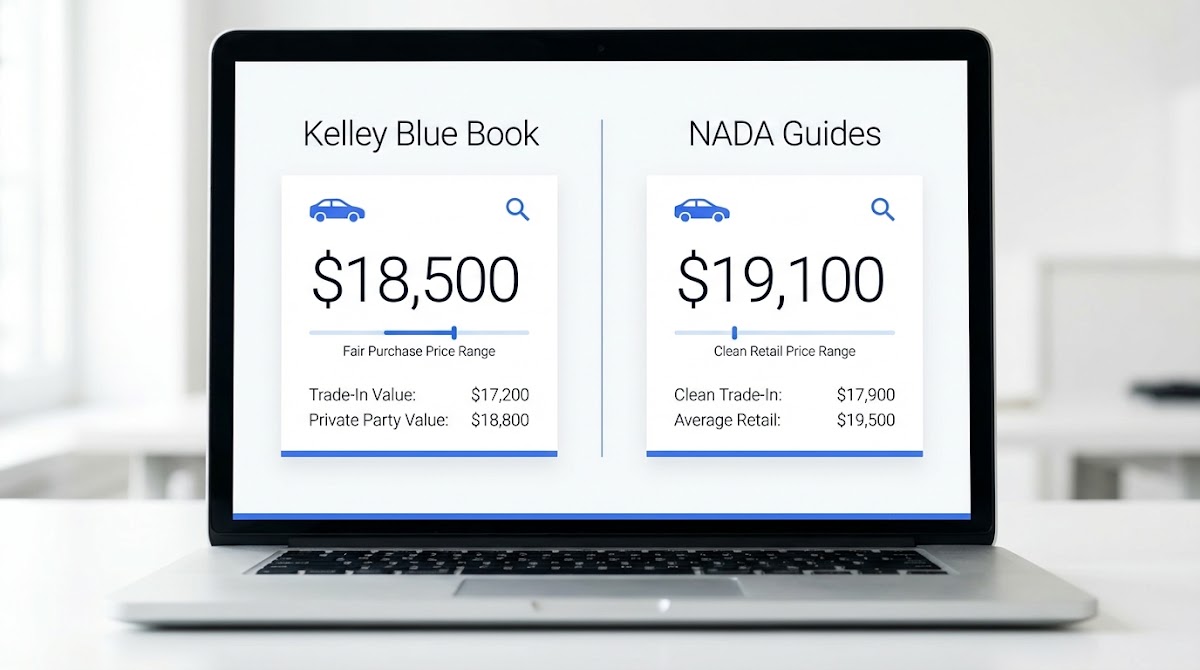
When you compare price guides, the numbers can disagree. Both Kelley Blue Book and NADA Guides publish trade-in, private-party, and suggested retail values, but they use different data mixes and update rhythms.
This article explains the practical differences and gives a step-by-step approach to use both guides with local listings and vehicle history reports. The goal is to help you set a realistic negotiation range before you contact a dealer or list a car.
KBB tends to reflect current dealer asking prices, while NADA often leans on auction and dealer inputs for trade-in estimates.
Pick the guide value type that matches your transaction and confirm it with local listings and a vehicle history report.
Use the lower guide value as a conservative floor and local asking prices as a realistic ceiling when negotiating.
Quick answer: the short difference and why it matters
Kelley Blue Book and NADA Guides both estimate used car values, but they draw on different data mixes and serve slightly different audiences. KBB’s suggested retail values tend to track current retail listings and local adjustments, while NADA’s trade-in and dealer estimates have a stronger historical tie to wholesale auction and franchise-dealer inputs, which can make those trade-in numbers more conservative in some markets How Kelley Blue Book Determines Its Car Values
That distinction matters because the value type you check should match your transaction. If you plan to trade a car to a dealer, a trade-in figure that leans on wholesale signals may be closer to the offer you receive. If you plan to buy from a dealer, retail-focused estimates and local listings tend to set the asking price you will see on the lot How NADA Guides Calculates Vehicle Values
Practical takeaway: compare both guides, then cross-check local listings and a vehicle history report to set a negotiation range. Independent consumer guidance recommends using multiple sources rather than relying on a single guide Comparing Price Guides
What Kelley Blue Book and NADA Guides are: definitions and audiences
Kelley Blue Book produces multiple value types and adjusts suggested retail values to local market conditions. That makes its retail estimates more reflective of dealer asking prices in many areas How Kelley Blue Book Determines Its Car Values
NADA Guides also publishes trade-in, private-party, and suggested retail values, but its trade-in and dealer-facing estimates have historically leaned more on wholesale auction results and franchise-dealer inputs, which can affect the way dealer offers are set How NADA Guides Calculates Vehicle Values
Compare guide values with a vehicle history report
Compare KBB and NADA values alongside a vehicle history report to see where estimates overlap and where risk signals appear. CarFax Deals can help surface vehicle history reports and pricing insights that may help you decide which guide value to treat as your starting point.
Who uses each guide varies. Consumers often consult private-party and suggested retail values when buying or selling, dealers and lenders use trade-in and wholesale-aware figures for offers and underwriting, and price-aware shoppers check both to gauge local spreads and negotiation room Guide Differences and Best Practices
How each guide calculates values: data sources and methodology basics
KBB places greater emphasis on current retail listings and local retail transaction data. That emphasis helps its suggested retail values reflect what dealers are posting in a given area, which can be useful for buyers comparing asking prices How Kelley Blue Book Determines Its Car Values
NADA Guides, by comparison, has a stronger historical reliance on wholesale auction results and franchise dealer inputs for trade-in and dealer-retail valuations. That reliance can make NADA trade-in values align more with what dealers pay at auction or what franchise operations consider for dealer retail pricing How NADA Guides Calculates Vehicle Values
Neither provider publishes a full algorithm or exact weightings, so the precise mix and timing of inputs remain proprietary. Market indices such as the Manheim Used Vehicle Value Index act as an observable signal that can move guide values when wholesale trends shift Manheim Used Vehicle Value Index and MethodologyManheim index coverage
Value types explained: trade-in, private-party, and suggested retail
What each value type means, including nada blue book value
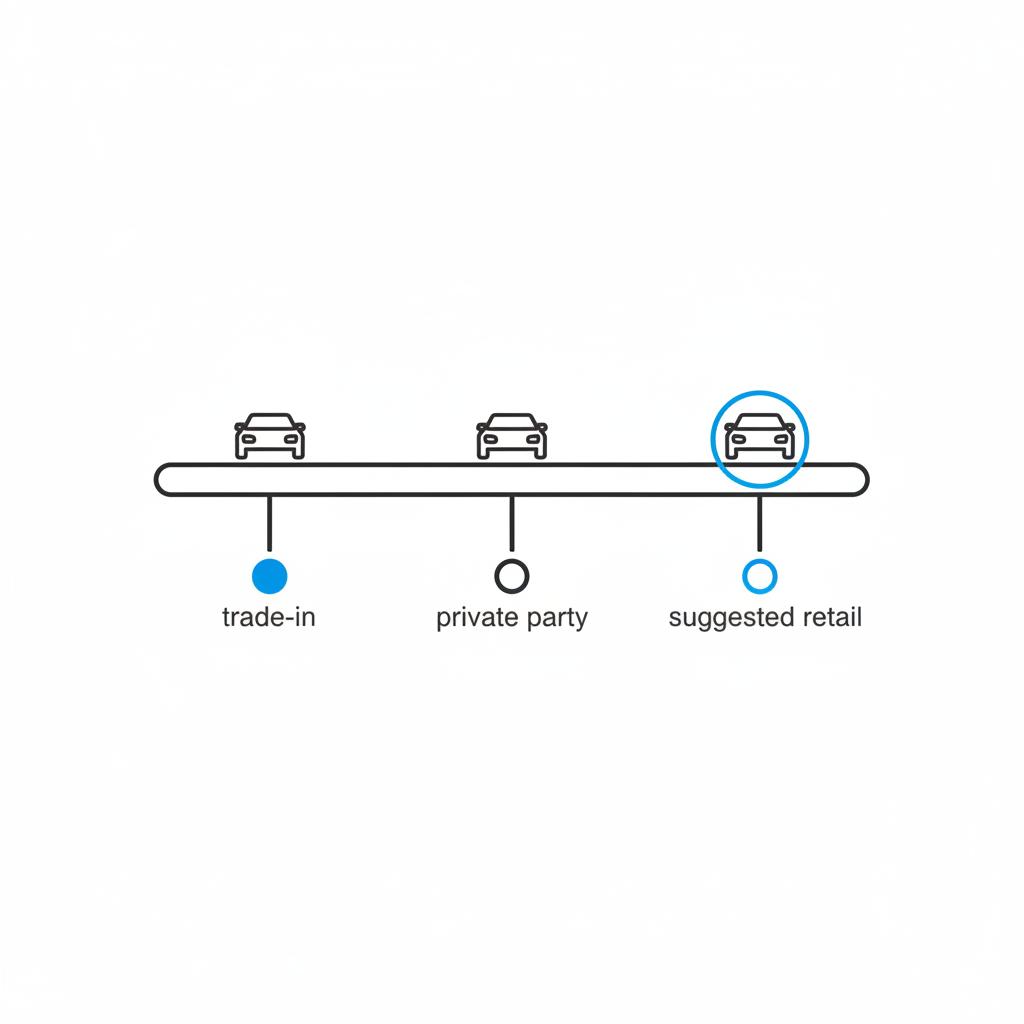
Trade-in value is the amount a dealer might offer for a car as a trade, typically reflecting what a dealer expects to resell or what they might pay at auction. Private-party value is an estimate of what a private seller could reasonably expect in a direct sale to another consumer. Suggested retail is a dealer-facing retail estimate intended to approximate a reasonable asking price.
Choose the value type that matches your transaction. If you expect to trade your car, check trade-in estimates. If you plan a private sale, compare private-party values. If you are shopping dealer inventory, focus on suggested retail and local listings.
choose a transaction type and estimate a starting price
use as a rough starting point
Each guide publishes the same three basic value types, but their inputs and update cadence cause differences. Verify which value type each guide shows for a vehicle before you compare numbers, and double-check the vehicle condition and mileage assumptions used in each estimate How Kelley Blue Book Determines Its Car Values
Why guide values often diverge: regional adjustments and market indices
Regional pricing differences matter. Supply and demand in a local market can push dealer asking prices up or down, and KBB’s local adjustment approach means its suggested retail estimates can move with those posting trends How Kelley Blue Book Determines Its Car Values
Wholesale indices produce a different signal. When auction prices shift quickly, NADA’s historical tie to auction and franchise-dealer data can cause its trade-in and dealer retail values to reflect that wholesale movement sooner or differently than retail-focused guides Manheim Used Vehicle Value Index and Methodology
Some vehicle categories show larger divergence. In-demand pickups, specialty trims, or limited-availability models can have wide local spreads that exaggerate differences between a retail-tracking estimate and a wholesale-aware estimate How We Value Cars and Why Price Guides Differ
A practical framework: how to use KBB, NADA, local listings, and history reports together
Step 1, pick the value type that matches your transaction. Confirm whether you need a trade-in, private-party, or suggested retail estimate before comparing numbers. Matching the value type avoids comparing apples to oranges How NADA Guides Calculates Vehicle Values
Step 2, check both guides for the same value type and note the spread. Use local dealer and private listings to see which guide is closer to current asking prices in your area. Add a pricing context label or note whether listings show similar mileage and trim levels Comparing Price Guides
KBB leans toward retail listings and local adjustments, making it useful for buyer-facing asking prices. NADA leans more on wholesale auction and franchise dealer inputs, which can make trade-in values more conservative. Pick the value type that matches your transaction, check both guides, and confirm with local listings and a vehicle history report.
Step 3, run a vehicle history report and inspect service history, title status, and any reported accidents. If history flags show issues, allow for a lower negotiation range; if history is clear and the car is well maintained, a higher private-party or suggested retail expectation may be reasonable Guide Differences and Best Practices
Step 4, set a realistic negotiation range. Use the lower guide value as a conservative floor for offers and the higher guide value or local asking prices as a realistic ceiling when buying. For sellers, decide whether to list near suggested retail and accept a lower trade-in offer, or sell privately to capture more of the spread How Kelley Blue Book Determines Its Car Values
Decision criteria: when to lean on KBB, when to lean on NADA
If you are buying from a dealer or checking asking prices, lean more on retail-tracking estimates and local listings; KBB’s retail emphasis often aligns with dealer asking behavior in many markets How Kelley Blue Book Determines Its Car Values
When estimating a dealer trade-in offer or planning dealer-side pricing, NADA’s auction and franchise-dealer inputs can give a more conservative picture that aligns with how dealers manage wholesale risk How NADA Guides Calculates Vehicle Values
Always validate either guide against local comparables and a vehicle history report. Matching the guide’s value type to your transaction and then checking nearby listings reduces the chance of a surprise at the negotiation table Comparing Price Guides
Common mistakes and pitfalls when using guide values
A frequent error is using the wrong value type, for example comparing a trade-in figure to a suggested retail asking price. That mismatch creates false expectations and can derail negotiation goals How NADA Guides Calculates Vehicle Values
Another common mistake is relying on a single guide without checking local listings or a vehicle history report. Independent analysts recommend cross-checking multiple sources to build a realistic price range Comparing Price Guides
Corrective actions: always pick the right value type, compare both KBB and NADA, run a vehicle history report, and review local listing comparables before you commit to a number. Use conditional language when setting expectations rather than assuming a guide is exact Guide Differences and Best Practices
Practical examples and step-by-step scenarios
Scenario A, buyer comparing dealer asking price for an in-demand model. Check suggested retail on KBB and compare with nearby dealer listings. If KBB and local asking prices are similar, expect limited room to push below the posted price. If NADA trade-in numbers are lower, that gap reflects wholesale or auction signals rather than current retail asking behavior How Kelley Blue Book Determines Its Car Values
Negotiation checklist for Scenario A: verify trim and mileage, run a vehicle history report, and use local listings to confirm the dealer’s asking price context. If history reports are clean, the dealer may be less willing to move far below suggested retail.
Scenario B, seller deciding on trade-in versus private sale. Compare trade-in estimates from NADA and private-party estimates from both guides. If the private-party spread is meaningfully higher and you can manage simple sale tasks, private sale often captures more of the retail spread; if not, accept a trade-in offer that reflects auction-derived dealer economics How NADA Guides Calculates Vehicle Values
Scenario C, buyer evaluating a used car with mixed history. Run a vehicle history report and factor in service history or title remarks. Use the lower guide value as a conservative reference and adjust upward only if the history report and inspection support that move Guide Differences and Best Practices
Conclusion: concise checklist and next steps
Quick checklist before you negotiate: pick the correct value type, compare KBB and NADA for that type, cross-check local listings, run a vehicle history report, then set a negotiation range using a conservative floor and a realistic ceiling Comparing Price Guides
For a dealer trade-in, use the trade-in value since it most closely reflects what dealers expect to pay, often influenced by wholesale auction data and franchise-dealer inputs.
When buying from a dealer, give more weight to retail-tracking estimates and local listings, since these tend to reflect dealer asking prices, and confirm with a vehicle history report.
Re-check guide values if local listings change, if auction indices show movement, or if new history or inspection information appears; treat guides as evolving estimates.
Guide values are estimates, not offers. By matching the right value type to your transaction and checking local comparables and a vehicle history report, you can reduce uncertainty and make more informed decisions.
If you want a quick verification step, use a vehicle history report alongside pricing context to confirm condition and past ownership before you negotiate.

 Blog
Blog