Learn exactly how the NADA car value lookup works, why VIN-based checks matter, and how to use trade-in, private-party and retail figures to get the best price. This practical guide explains what inputs change NADA values, common mistakes to avoid, negotiation tactics, and when to rely on live market checks. Includes a step-by-step VIN tip and a quick way to run a combined VIN + valuation report with CARFAX Deals.
A rav4 used for sale can be a sensible pick for many research-oriented buyers because reliability aggregators rate the model above average and safety ratings are generally strong. This guide explains how to vet listings, what model years tend to be better, and a step-by-step checklist to reduce risk before you buy.
This guide explains how to estimate the cost of buying an R34 Skyline, with attention to import rules, condition-driven price tiers and landed cost. It shows which factors move value, how to verify history and paperwork, and offers a checklist you can follow when you search for a nissan skyline r34 for sale.
This guide helps buyers set realistic expectations for tacoma trucks for sale by explaining the main price drivers and a repeatable method to build conservative, typical, and ambitious offer ranges. It shows how the 2024 redesign, valuation guides, and vehicle history reports interact to change asking prices and reduce purchase risk.
Want a straightforward answer to “How do I find the NADA value of my car?” This guide explains in plain language how the NADA car value lookup works, which inputs matter most (VIN, mileage, condition), and how to use trade-in, private-party and retail numbers to set realistic expectations. You’ll get step-by-step instructions, negotiation scripts, and practical tips for preparing your car so the published numbers translate into real offers.
1. The VIN is the single most important input — a VIN-based lookup eliminates most trim and option errors.
2. Typical spreads between NADA retail, private-party and trade-in range from 5–25% depending on vehicle demand and region.
3. CarFax Deals combines VIN-based history and NADA-style pricing signals to help buyers and sellers make data-backed decisions.
Quick start: If you want a reliable number, start a NADA car value lookup with the vehicle VIN, exact mileage, and an honest condition rating — those three inputs will change the result more than anything else.
What the NADA numbers mean and why they matter
The NADA Guides publish three main values that most buyers and sellers see: trade-in, private-party, and retail. Each is a shorthand for a different kind of transaction and a different place in the used-car market. Understanding which number applies to your situation is the single best way to avoid surprises.
Trade-in describes what a dealer typically expects to pay a consumer when the dealer plans to add the car to wholesale inventory or send it to auction. Private-party is the mid-point you might get selling directly to another person. Retail is the top line — what a dealer would ask for a car on the lot after reconditioning and warranty coverage.
Why NADA numbers can feel authoritative (and where they fall short)
NADA's values are widely used by dealers, lenders, and buyers as a reference; see NADA Market Beat. But they are not a guaranteed offer. Think of them as a well-informed opinion: based on equipment, mileage, condition categories, and geography. If you change the inputs, the number changes. If the local market swings fast, that single snapshot can trail real prices.
How to run a useful NADA car value lookup
To get a meaningful NADA car value lookup, follow these steps carefully. The order matters because each input shifts the outcome:
1) Use the VIN whenever possible
The VIN decodes the precise trim, engine and factory options. Mistyping a trim or guessing packages is the fastest way to get an inflated or deflated value. If you don’t have the VIN, be as precise as possible about the trim and options.
2) Enter exact mileage
Valuations respond to mileage as an annualized rate. A car with 12,000 miles per year looks different than one with 20,000 miles per year. Use the odometer reading at the time you run the lookup.
3) Choose condition conservatively
NADA condition categories range from excellent to rough. If you’re not sure whether a ding or a worn seat counts as average or fair, pick the lower category. Dealers usually assume higher reconditioning costs than private buyers, so conservative entries reduce surprise downward adjustments at appraisal.
4) Add optional equipment correctly
Navigation, upgraded audio, sunroofs and safety packages can move retail and private-party values - sometimes only slightly. Use the VIN to capture factory-installed options rather than trying to remember which package the car has.
5) Use your ZIP code or region
Geography matters. NADA applies regional adjustments so that values reflect local supply and demand. A pickup may trade much higher in rural areas than in urban markets; a convertible may be seasonal. Always enter your ZIP to get a regionally calibrated number.
Which NADA number should you use?
Ask yourself: are you selling privately, trading in, or expecting a retail sale? Use the corresponding NADA line. If you’re trading in and also buying another car, be careful - dealers sometimes blend figures to make a deal look better on paper.
Here’s a simple example: retail $25,000, private-party $22,000, trade-in $19,000. Selling privately might net you $22,000 in many markets. Walking into a dealer asking for $25,000 will usually result in an offer closer to the trade-in line unless you trade the car in as part of a purchase and the dealer adjusts the numbers across the whole deal.
If you’d like a single VIN-based report that shows those NADA figures alongside vehicle history details, try running a quick VIN report — Get a VIN-based report on CARFAX Deals - which surfaces standard values and a CARFAX history snapshot to help you justify your asking price.
Common mistakes people make with NADA
Most mistakes come from bad inputs or misplaced expectations:
Wrong trim or missed option packages
Rounded-up mileage estimates
Overly optimistic condition ratings
Assuming NADA equals a firm offer
Not checking local listings to confirm whether NADA’s retail line aligns with current market activity
One real-world example: a seller entered the wrong trim and priced their car $3,500 above what the VIN-backed NADA value showed. The car didn’t sell until they corrected the trim via VIN lookup - lesson: a few accurate clicks save weeks on the market.
How dealers and lenders actually use NADA numbers
Dealers, lenders and auction houses reference NADA to inform trade allowances, loan-to-value calculations, and financing decisions. For lenders, the distinction between retail and trade-in matters when calculating maximum loan amounts. For dealers, NADA provides a starting point for how much they’ll risk putting into a car.
Negotiation tactics using NADA figures
Armed with the right NADA numbers, you can negotiate more confidently. Here are practical tips:
Bring evidence
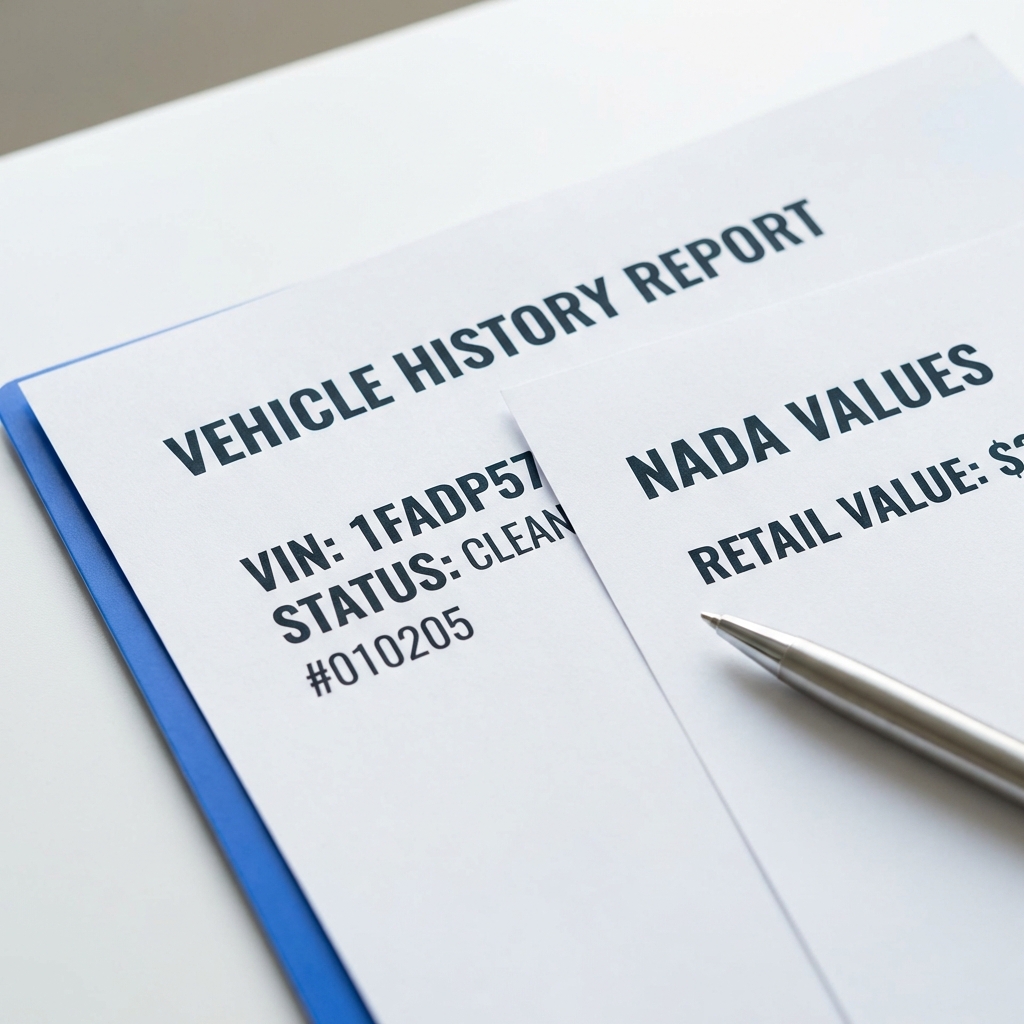
Print the NADA report, show service records, and provide a vehicle history report. If you’re using a price from a VIN-based NADA car value lookup, that report is your anchor.
Separate the transactions
Ask for a trade-in appraisal in writing first. Then negotiate the price of the car you’re buying separately. Dealers often compress math to make a deal look attractive; separating the two transactions makes arithmetic transparent.
Ask for a breakdown
If the dealer offers significantly less than the NADA trade-in line, ask them to list the precise deductions: repairs, auction fees, or regional adjustments. If they can’t explain the gap in writing, ask for time to get another appraisal.
The biggest mistake is assuming a high trim or option set applies to the car without verifying the VIN. That error can inflate your price expectation by thousands and leave you waiting for offers that never arrive.
Preparing your car to capture the highest realistic value
If your goal is to command the private-party line, presentation matters. Small, low-cost fixes often offer the best return: replace burned bulbs, fix a torn trim piece, patch a minor dent. These changes reduce buyer friction and can push offers closer to private-party numbers.
Documentation also matters. A neat folder of service receipts, recent inspection reports and a clean vehicle history report calms buyers and supports asking for the higher end of the range.
When NADA may be less reliable - and what to do
NADA is most vulnerable when markets shift quickly. Examples include sudden incentives, regional shortages, or model-specific recalls. Electric vehicles are a special case: incentives, charging concerns and battery health influence demand differently than conventional cars, and values can swing more rapidly. See the NADA DATA report for broader trends.
Real-market example: spreads that tell a story
Spreads between retail, private-party, and trade-in vary by vehicle and location. A compact sedan might show retail only 5-10% above private-party, and private-party 5-10% above trade-in. Popular SUVs, trucks, or limited-supply models can carry spreads of 15-25% or more. That’s why local checks are essential: national guides smooth regional spikes that sellers can sometimes capture by selling privately.
How to check NADA trade-in value by VIN - step-by-step
Here’s a short checklist to pull NADA trade-in value by VIN accurately:
Locate and enter the full VIN.
Confirm the decoded trim and options on the report.
Enter current odometer miles - don’t round up.
Choose a conservative condition rating if unsure.
Input your ZIP code for regional pricing.
Download or print the report and save the timestamped page.
That printed report is useful at the dealership when you ask why an offer differs from the listed trade-in line.
That printed report is useful at the dealership when you ask why an offer differs from the listed trade-in line.
Using NADA numbers to decide between trade-in and private sale
Think about the total time and effort versus net price. Private-party sales usually return more money but take time: cleaning, listing, photos, and meeting buyers. Trade-ins are faster and often the simplest option if you’re buying another car at the same dealership. Use the NADA trade-in line to benchmark the quick route and the private-party number as your target if you’re willing to spend time selling.
Quick negotiation scripts (word-for-word)
Try these short lines when you’re at the dealership:
“I ran a NADA car value lookup by VIN and the trade-in line shows $X. Can you explain the deductions down to the line items?”
“If you’re deducting for specific repairs, can you write those down? I’d like to compare with two other written appraisals.”
Asking for written reasons changes the tone of the appraisal and often improves transparency.
Checklist before you list or trade
Before you decide, do this:
Run a NADA car value lookup with VIN and save the report.
Cross-check local listings for identical trims and mileage.
Fix inexpensive items that reduce buyer friction.
Gather service records and vehicle history reports.
Decide if you want speed (trade-in) or maximum money (private-party).
How to interpret gaps greater than NADA spreads
If a dealer’s offer falls well below the NADA trade-in line, ask for specifics. They may be using additional wholesale data or applying conservative reconditioning costs. Don’t accept vague answers - ask them to write the reasons down. If the explanation is unsatisfactory, get a second appraisal or sell privately.
Using the VIN locks in the car’s equipment and removes guesswork. The VIN-backed NADA car value lookup is far less error-prone than manual entries. It also helps you present a precise, defensible number at the dealership: no one can claim your trim assumption was wrong if the VIN decodes it.
Why running a VIN-based report saves time
Using the VIN locks in the car’s equipment and removes guesswork. The VIN-backed NADA car value lookup is far less error-prone than manual entries. It also helps you present a precise, defensible number at the dealership: no one can claim your trim assumption was wrong if the VIN decodes it.
Get a fast VIN report with NADA figures and CARFAX history
Ready to check your car right now? If you want a single, fast VIN report that bundles standard valuation lines with vehicle history context, Run a VIN report on CARFAX Deals to see NADA values alongside verified CARFAX history and pricing signals.
Sometimes listings tell a more up-to-date story than a guide. If many local listings show the same trim priced below NADA retail, accept that retail may be optimistic in your region. Conversely, if local demand is high and comparable cars are selling above NADA retail, you may be able to capture the premium with a strong listing and good documentation. For a comparison of valuation methods, see this NADA vs KBB comparison.
Final practical tips
Pull the VIN, run the NADA car value lookup, and then step outside with the printed numbers in your hand. Look at the car the way a buyer would: odors, upholstery wear, tires, small dings, and service history. That sensory check informs your price strategy more than spreadsheets.
Resources and next steps
If you’d like, I can walk you through a live VIN example, decode each line, and draft negotiation language you can use at a dealer. That walk-through usually takes 10-15 minutes and can be done entirely on the VIN report.
Parting note
Use NADA as a measured friend, not an oracle. It gives three useful opinions - trade-in, private-party and retail - and each serves a purpose. Combine the NADA car value lookup with live local checks and honest inputs, and you’ll be far more likely to reach the right price, quickly.
A NADA car value lookup is a well-informed estimate based on vehicle specs, mileage, condition and geography. It’s widely used by dealers and lenders, but it’s not a guaranteed offer. Accuracy improves significantly when you use the VIN, exact mileage, and a realistic condition rating. Always cross-check NADA figures with local listings and recent sales for the most reliable picture.
Yes — a NADA trade-in value by VIN is a strong reference. Print the VIN-backed report and ask the dealer to explain any differences in writing. Dealers may use additional wholesale data or adjust for reconditioning costs, but a clear written comparison helps you push for a fairer offer or shop competing appraisals.
If you want the highest net price and have time, private-party usually pays more than trade-in. If speed and convenience matter most, a trade-in is faster. Use NADA’s private-party line as your target for selling privately and the trade-in line as a benchmark for a quick sale. Also consider market signals — local demand can justify prices above or below NADA lines.
NADA gives you three useful reference values — trade-in, private-party, retail — and the best result comes from using the VIN, honest condition ratings, and local market checks; with those in hand you’ll avoid surprises and get a fair price for your car. Happy pricing — now go claim that value (and maybe give your car a quick wash while you’re at it!).

 Blog
Blog