What is a Tesla worth after 5 years? (What a Tesla is worth after 5 years)
This guide explains typical five year retention bands for Tesla models and how to translate those ranges into an estimate for a specific vehicle. It uses industry valuation reports and technical literature to show why Model 3 and Model Y tend to retain more value than Model S and Model X, and which checks can materially change a used Tesla car price.
A rav4 used for sale can be a sensible pick for many research-oriented buyers because reliability aggregators rate the model above average and safety ratings are generally strong. This guide explains how to vet listings, what model years tend to be better, and a step-by-step checklist to reduce risk before you buy.
This guide explains how to estimate the cost of buying an R34 Skyline, with attention to import rules, condition-driven price tiers and landed cost. It shows which factors move value, how to verify history and paperwork, and offers a checklist you can follow when you search for a nissan skyline r34 for sale.
This guide helps buyers set realistic expectations for tacoma trucks for sale by explaining the main price drivers and a repeatable method to build conservative, typical, and ambitious offer ranges. It shows how the 2024 redesign, valuation guides, and vehicle history reports interact to change asking prices and reduce purchase risk.
This article explains what industry reports and technical studies say about the typical five year resale value of Tesla cars and how to turn those headline ranges into a realistic estimate for a specific vehicle. It focuses on practical checks buyers and sellers can run, including verification of vehicle history, battery condition, and local market pricing.
The goal is to give research oriented used car buyers a clear, evidence based starting point. The guidance relies on aggregated valuation reports and peer reviewed findings about battery condition, and it frames ranges as guidance rather than guarantees.
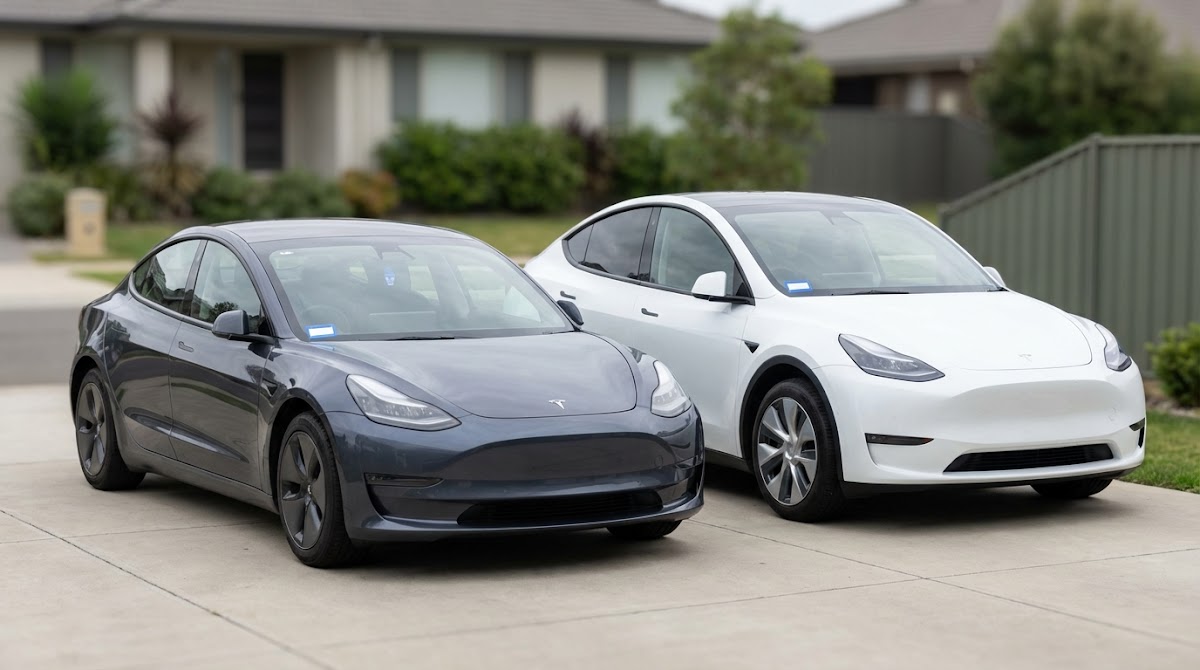
Model 3 and Model Y typically retain about 50 to 65 percent of original price after five years, Model S and Model X often 40 to 55 percent.
Battery state of health, mileage and local market demand are the strongest drivers of used Tesla values.
Use a vehicle history report and local pricing insights to move from a headline range to a listing specific estimate.
Quick answer: What is a Tesla worth after 5 years? (tesla car price, headline summary)
As a headline estimate, mainstream Tesla models such as the Model 3 and Model Y often retain roughly 50 to 65 percent of their original price after five years, while full size luxury models like the Model S and Model X commonly fall in a lower band around 40 to 55 percent, depending on trim and market conditions. These ranges are aggregated from industry valuation services and retail market reports rather than single market snapshots, so treat them as guidance rather than a guarantee Cox Automotive used vehicle market insights.
Those headline bands can shift for an individual car. Trim choice, battery configuration, evidence of battery state of health, mileage, and local demand all move a specific car up or down inside the range, and software feature transferability can add or subtract value depending on policy at sale time J.D. Power residual value analysis.
Short headline ranges by model group
Model 3 and Model Y, typical five year retention band: about 50 to 65 percent of original price. Model S and Model X, typical five year retention band: about 40 to 55 percent Edmunds analysis of used EV price trends.
Why there is no single number
Five year outcomes are conditional on technical and market variables. Battery capacity and health are measurable risks that valuers discount, wholesale price cycles change realized retail values, and local incentives or strong EV adoption can lift demand in a region Journal of Power Sources review on battery degradation.
Because of these moving parts, the best starting point is a range and a short checklist to move from a range to a vehicle specific estimate.
How to read tesla car price estimates: definition and context
When reports refer to five year retention they usually mean the percentage of original price a typical vehicle trades for after five years, or a typical transaction price compared to a new list price. Different studies use slightly different base prices and time windows, which is why published ranges vary Kelley Blue Book resale guidance.
Data sources behind these estimates include wholesale indices, retail listing aggregates, auction results, and valuation services that blend transaction and listing data. Each source reflects different parts of the market and a different gross to net pricing process, so combining several sources gives a more robust picture Cox Automotive used vehicle market insights.
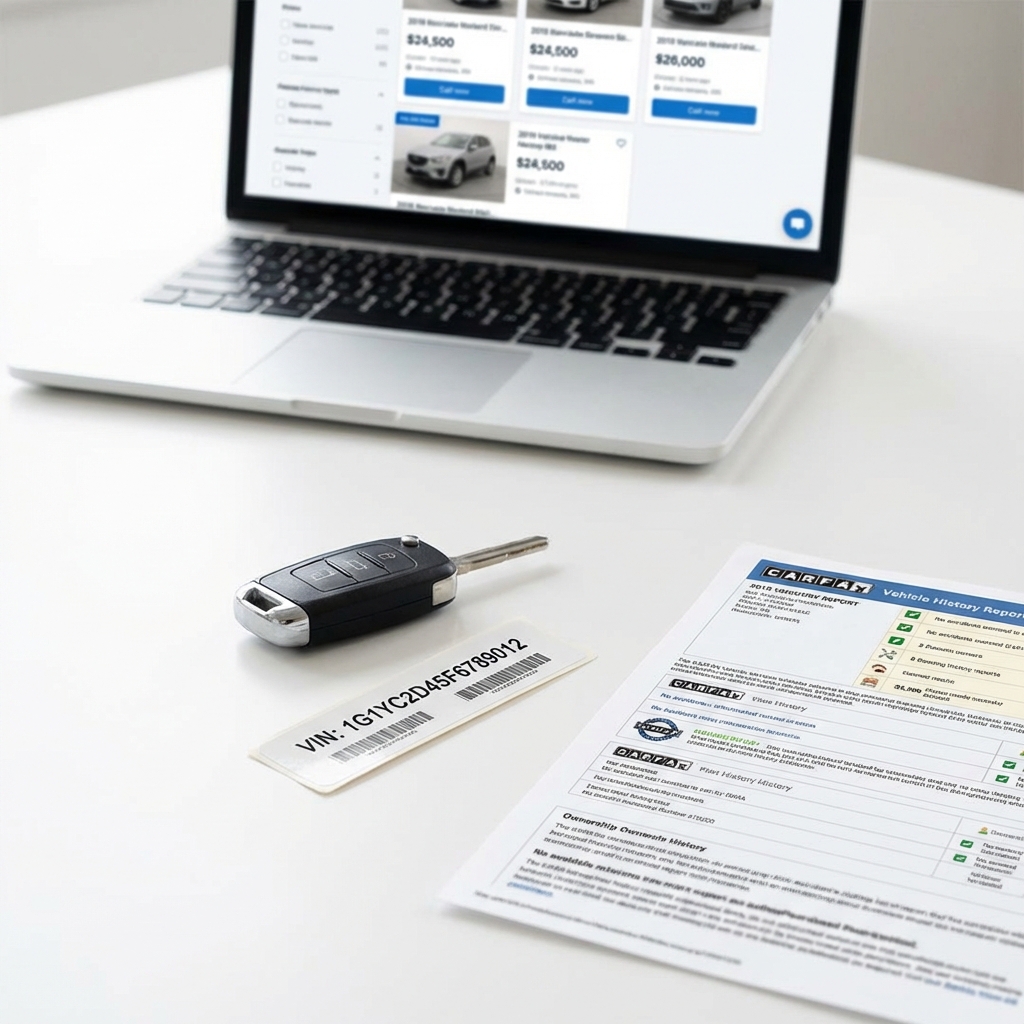
Start with a VIN based vehicle history report to refine tesla car price estimates
Use a vehicle history report and local pricing insights to refine headline ranges into a realistic estimate for a specific listing.
Regional and time period differences matter. A five year retention estimate from one year may not hold in a later year if wholesale supply or incentives shift. Local demand, for example in states with high EV adoption, can raise prices above national averages while regions with weak demand can push prices lower iSeeCars regional used EV depreciation report.
For a buyer or seller, the practical implication is to treat five year numbers as a starting point. Then verify the car specific technical condition and check current local listings.
Typical five year retention ranges for Tesla models - evidence and caveats
Aggregated industry reports commonly place Model 3 and Model Y in a higher retention band, around 50 to 65 percent after five years, while Model S and Model X are often reported in a lower band of roughly 40 to 55 percent; these ranges are aggregated from several market reports and valuation analyses and vary by sample period and geography Cox Automotive used vehicle market insights. See CarEdge for model-specific depreciation charts CarEdge.
Why ranges, not single numbers? Valuation services use different samples, and retail versus wholesale markets price vehicles differently. Report aggregation smooths those differences but does not remove uncertainty Edmunds used EV price trends.
Industry reports show Model 3 and Model Y often retain roughly 50 to 65 percent of original price after five years, while Model S and Model X commonly retain about 40 to 55 percent; individual outcomes depend on battery health, mileage, trim and local demand.
Important caveats when you apply these bands: trim and battery configuration. A longer range battery or a higher range trim tends to sit at the top of its retention band, while base range versions and cars with evidence of battery capacity loss often sit lower. Mileage moves value down with higher use, and local demand or incentives shift results up or down by several percentage points Journal of Power Sources review on battery degradation.
Another frequent caveat is data vintage. Reports that use earlier auction periods or a different national sample can produce point estimates that differ by several points. Use multiple valuation sources and local listings to triangulate a practical estimate.
Aggregated retention bands by model group
Model group headline bands, presented as ranges not guarantees: Model 3 and Model Y: approximately 50 to 65 percent of original price after five years. Model S and Model X: approximately 40 to 55 percent after five years Edmunds used EV analysis.
Important caveats: trims, mileage, region and sample period
Trim and battery range change where a car sits in the band because buyers often pay more for longer range variants. Mileage and documented service history shift realized prices because maintenance records and ownership history reduce perceived risk Kelley Blue Book resale guidance.
Finally, software and feature transferability can affect price. If premium drive assist or software packages do not transfer at sale, buyers may discount the car relative to similar vehicles that include transferable features J.D. Power residual value analysis.
A practical framework to estimate a used Tesla car price for a specific vehicle
Step 1, confirm model year, trim and powertrain. Start by recording the exact model, trim and battery or range option. These core inputs set the base retention band before adjustments for condition and market context Cox Automotive used vehicle market insights.
Step 2, check the vehicle history report and ownership records. A verified vehicle history report that shows consistent service history, single ownership, and clean title tends to reduce buyer discounting and supports a higher expected resale within the retention band Kelley Blue Book resale guidance.
Step 3, assess battery state of health and mileage. Battery condition is a primary technical driver for EV valuation; ask for any available battery health numbers, recent capacity estimates, or evidence of a battery replacement. Combine those data with mileage to refine the likely retention position Journal of Power Sources review on battery degradation.
Step 4, compare local pricing context and dealer listings. Use regional listing aggregates and pricing insights to see where similar cars are trading. If local demand is strong, you may expect to pay or receive a premium; if wholesale supply is high, prices can come down iSeeCars regional used EV depreciation report.
Apply a simple adjustment flow: pick the model band, adjust up or down for documented service and ownership history, subtract for evidence of battery capacity loss, then apply a local market premium or discount based on current listing comparisons. For model-level depreciation charts see CarEdge CarEdge.
Key technical and market drivers that move tesla car price
Battery state of health and mileage are core technical variables. Peer reviewed literature documents measurable capacity fade patterns that valuation teams treat as a discountable risk, so a verified battery health indicator often materially changes an offer price Journal of Power Sources review on battery degradation.
Local demand, wholesale cycles and incentives also shift realized prices. Wholesale price cycles can change dealer acquisition costs and in turn adjust retail listings, and incentive rules or state level EV demand patterns can lift or reduce realized resale by several points Cox Automotive used vehicle market insights.
Quick battery and mileage check before you set or accept a price
Use manufacturer-specific battery metrics when available
Software and feature transferability is an emerging market driver. If a premium driver assist package or software enabled feature does not transfer at sale, many buyers will apply a discount compared to an otherwise similar vehicle where those features remain active J.D. Power residual value analysis.
These drivers interact. For example, a car with strong battery health but unclear software transfer rules may still trade below a comparable with both clean battery data and transferable features. Use the checklist above to break down the effect of each driver on price.
Decision criteria: How to decide if a used Tesla is priced fairly for five year value
Buyer checklist: obtain a vehicle history report, verify service history, confirm title status, request battery health data when available, and compare the listing to similar local listings and pricing insights. These checks reduce uncertainty and help place the car inside or outside the expected retention band Kelley Blue Book resale guidance.
Look for dealer transparency signals such as clear ownership records, visible service documentation, and an explicit mileage check. These signals tend to lower the risk premium a buyer applies and support a price nearer to the top of the expected retention band Cox Automotive used vehicle market insights.
When to walk away or negotiate differently: red flags include inconsistent service history, evidence of high battery degradation, unclear transferability of software packages, or asking prices well above local comparables without justification. Any of these can materially reduce expected five year value and justify a lower offer.
Remember that local market context can justify paying a moderate premium. If similar cars with verified history and good battery health command higher prices in your area, the local premium may be defending future resale prospects rather than representing overpayment.
Common mistakes and valuation pitfalls when estimating tesla car price
Overreliance on a single sticker price is a frequent error. Use multiple valuation sources and local listings to triangulate a practical estimate because single point estimates can mask regional or temporal shifts Cox Automotive used vehicle market insights.
Ignoring battery health or software transferability leads to mispricing. Battery capacity loss is measurable and often discounted by buyers, while nontransferable software features can reduce perceived value even if the car otherwise appears well maintained Journal of Power Sources review on battery degradation.
Treating aggregate ranges as guarantees is another pitfall. Published five year bands are helpful but not predictive at the individual vehicle level unless you verify the car specific condition and the current local market context Edmunds used EV analysis.
Practical examples: estimating five year value for common Tesla scenarios
Example A: Model 3 standard range, moderate mileage, full service records. Inputs: mid trim Model 3, documented service history, mileage roughly 12,000 miles per year, battery showing normal degradation for age. Qualitative estimate: likely sits in the mid to upper half of the 50 to 65 percent band, closer to 55 to 65 percent if local demand is steady Edmunds used EV price trends. Compare those estimates to iSeeCars resale numbers iSeeCars.
Explanation: full service records reduce perceived risk from maintenance, and moderate mileage with normal battery fade tends to support retention near band midpoint or above. Verify with local listings and a vehicle history report.
Example B: Model Y long range, high mileage but new battery replacement. Inputs: long range battery, higher than average mileage for vehicle age, recent battery replacement or warranty work documented. Qualitative estimate: replacement battery can move the car upward in the 50 to 65 percent band for Model Y, possibly to the upper half, but high mileage still applies a downward adjustment that may offset some of the battery uplift Cox Automotive used vehicle market insights.
Explanation: a documented battery replacement materially reduces battery risk; combined with clear service history the vehicle can perform better in resale than a similar high mileage car with the original aged battery.
Example C: Model S older battery, limited service records and special software options. Inputs: earlier Model S with reduced battery capacity evidence, spotty service history, and premium software features that may or may not transfer. Qualitative estimate: likely sits in the lower portion of the 40 to 55 percent band or below if software features are nontransferable and service history is incomplete J.D. Power residual value analysis.
Explanation: the combination of battery degradation and ownership uncertainty increases buyer discounting. Also check software transfer rules before forming an offer since nontransferable features can reduce value.
Seller and buyer checklist: practical next steps to protect five year value
For sellers: document service and ownership history, limit excess mileage where practical, keep charging and battery service records, and present clear title status. These actions tend to improve realized resale according to valuation reports and consumer guides Kelley Blue Book resale guidance.
For buyers: obtain a vehicle history report, request or review any available battery health data, compare pricing insights across local listings, confirm software transfer rules, and check dealer transparency signals before making an offer Cox Automotive used vehicle market insights.
Both parties should document and preserve receipts for battery related work and service to reduce future disagreement and to support price expectations at sale time.
Wrap up: What to remember about tesla car price after five years
Key takeaways: Model 3 and Model Y generally retain more of their original price after five years than Model S and Model X, and exact outcomes depend heavily on battery state of health, mileage, and local market context. Use published retention bands as guidance and verify vehicle specific condition before relying on any single number Edmunds used EV analysis.
Where to check for up to date local data: combine valuation services, local listing aggregates, and a vehicle history report to refine a headline band into a vehicle specific estimate. If you plan to buy or sell, treat the range as a starting point and document or investigate battery and ownership history before finalizing the price. For appraisal-specific values see Edmunds appraisal data.
Mainstream Tesla models like Model 3 and Model Y often retain roughly 50 to 65 percent of their original price after five years, while Model S and Model X commonly fall in a roughly 40 to 55 percent range; actual outcomes depend on trim, battery health, mileage and local market.
Verify the exact model and trim, request a vehicle history report, review battery state of health and mileage, and compare similar local listings to apply pricing insights before forming an estimate.
Yes, premium software packages and driver assist features can affect resale if they are nontransferable or require additional purchase at sale, so confirm transfer rules when evaluating price.
Before you act on any five year estimate, run a vehicle history report and check current local listings. Use documented service history and battery health evidence to justify offers or listing prices. These steps tend to reduce risk and make five year expectations more reliable.
If you need a quick check, begin with a VIN based vehicle history report and local pricing insights to see where a specific Tesla sits relative to the published retention bands.

 Blog
Blog