A practical guide that explains how to judge a used car's odometer reading using national averages and industry mileage bands. The article shows how to convert a car's odometer into miles per year, why service history and driving mix often matter more than a raw number, and which extra checks to run for EVs. It uses vehicle history reports and pricing insights as decision tools for researching used autos near me.
Carfax coupon codes rarely work, and the codes listed on coupon sites are usually expired. The discounts that do exist are bundles (three reports for $64.99, five for $99.99), AAA member pricing, and free reports from dealers and listings. The simplest guaranteed discount is CarfaxDeals at $7.99 per report versus $44.99 at Carfax.com.
A Carfax VIN lookup takes the 17-character vehicle identification number and returns the car's recorded history: accidents, title brands, odometer readings, owners, and service records. Free VIN tools only decode specs or check recalls and theft. The full Carfax report costs $44.99 on Carfax.com and $7.99 at CarfaxDeals.
You can get a free Carfax report from the Carfax.com used car listings, a dealer website, the seller, Carfax Car Care (for a car you already own), or listing sites that include one. There is no free report for any VIN you type in. When no free report exists, a paid one costs $44.99 at Carfax or $7.99 at CarfaxDeals.
Deciding whether a used car has 'good' mileage often starts with a simple question: how many miles per year did the previous owner drive? National travel averages give a practical benchmark, but mileage should be one of several factors you use to evaluate a listing. This guide shows how to convert odometer readings into an age-adjusted comparison, how to apply industry mileage bands, and which records and tests to request for different powertrains.
The goal is to help you compare listings efficiently. Use the age-adjusted miles and industry bands to filter candidates, then rely on vehicle history reports, service records, and pricing insights to judge whether a particular odometer reading is acceptable for your needs.
Average U.S. drivers travel roughly 12,000 to 13,000 miles per year, a common benchmark for evaluating used car mileage.
Mileage bands under 10,000, 10,000 to 15,000, and over 15,000 miles per year are useful heuristics, not strict rules.
Verified service history and driving mix often predict near-term reliability better than odometer numbers alone.
What 'good mileage' means: definition and national context
How annual miles set expectations, used autos near me
When you read an odometer, the number alone does not tell the whole story, but it does have a baseline. In the United States, national travel data show average annual driving of about 12,000 to 13,000 miles per driver, and appraisal services commonly use that range as the benchmark for low, average, or high mileage for a car of a given age Federal Highway Administration travel monitoring. For recent commentary on national averages see Average Miles Driven Per Year (GoAutoInsurance).
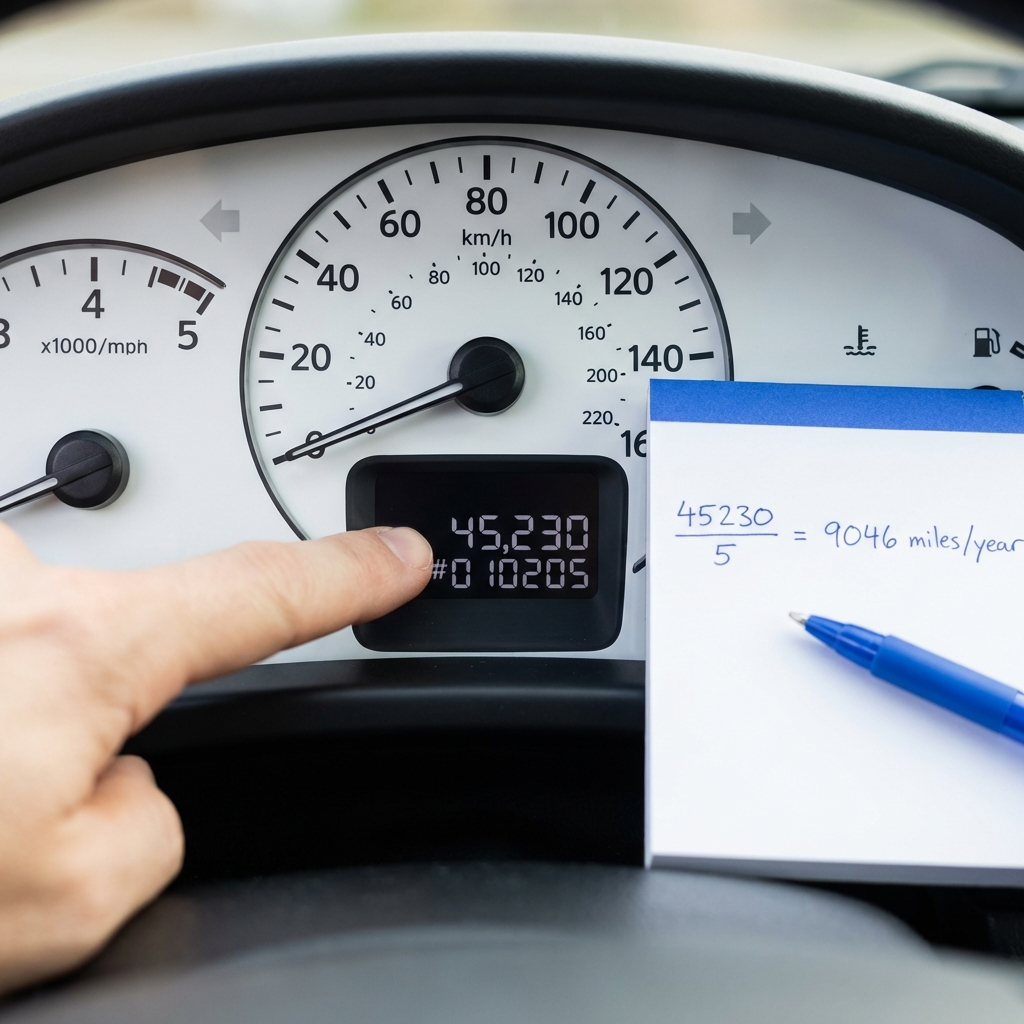
To make that baseline practical, convert the odometer into an age-adjusted expected total: multiply the car's age in years by an average annual miles figure and compare the result to the car's current odometer. For example, a five year old car at roughly 12,000 miles per year would be expected to show about 60,000 miles; differences above or below that amount can be framed as higher or lower than typical for the vehicle's age Carfax guidance on used car mileage.
Keep in mind these are heuristics used by valuation services rather than strict cutoffs. Use the age-adjusted comparison as a starting point and combine it with documented history before deciding if a specific odometer reading represents acceptable wear.
Why age-adjusted mileage is the baseline
Age-adjusted mileage helps separate normal use from potential red flags like odometer rollback or an atypical driving pattern. When a car has much lower miles than expected for its age, that can be legitimate or it can indicate long periods of storage; when mileage is much higher, it may reflect heavy use that increases near-term maintenance needs Federal Highway Administration travel monitoring.
Interpreting age-adjusted numbers requires context: model year, trim, and the car's intended use matter because some models are designed for heavier daily mileage and others are more often second cars with lighter use.
Common mileage bands and how to use them when comparing listings
Low, typical, and high mileage bands
Industry buying guides and valuation services commonly group mileage into bands to simplify comparisons: under about 10,000 miles per year is often called low, roughly 10,000 to 15,000 miles per year is typical, and above about 15,000 miles per year is higher-than-average for many buyers and appraisers Edmunds buyer guide.
To apply these bands, convert the odometer reading into miles per year by dividing total miles by the vehicle age. That per-year figure makes it straightforward to compare two cars of the same model year or to check whether a listing sits inside or outside the expected band for its class Kelley Blue Book mileage guidance.
Check mileage, pricing context, and history before you visit
Compare the listing against local pricing insights and request the vehicle history report before contacting the dealer.
These mileage bands are flexible: for the same odometer a compact commuter car and a large SUV can mean different things because expected use varies by vehicle class. Always apply the bands together with trim and model context rather than on their own.
When you see a listing, use the miles per year conversion to rank candidate cars quickly. That makes it easier to prioritize listings to investigate further with a vehicle history report and pricing insights in your local market.
When to treat bands as flexible rather than fixed
There are good reasons to treat the bands as starting points. Some buyers accept higher-than-average miles for a lower price when recent service is documented and the driving was mostly highway miles, which tend to stress some components less than stop and go city use Edmunds buyer guide.
Conversely, a car with low odometer readings but sparse service records or signs of long storage may be riskier than the raw mileage suggests. Use the bands to filter listings but rely on records and inspection to make a final call.
Why mileage alone is not the whole story
Maintenance, service history and ownership records
Verified maintenance and ownership history often predict near-term reliability better than an odometer reading by itself. A well documented service history that includes routine oil changes, major scheduled services, and timing-belt or chain work tends to reduce uncertainty about upcoming expensive repairs Carfax guidance on used car mileage.
When a vehicle history report shows consistent, timely entries, it suggests the car received routine care; long gaps, missing entries, or a late cluster of service items can indicate deferred maintenance or recent corrective work that deserves closer review.
Driving mix: highway versus city miles
The mix of highway and city miles affects component wear. Highway miles are steady and often cause less cyclical stress on brakes and transmissions than frequent city stop and go, while city driving can accelerate wear on brakes, transmissions, and some engine components over time Edmunds buyer guide.
Read service records and look for entries that note oil changes at regular intervals, transmission service when recommended, and recent brake or suspension work; such notes help interpret whether the recorded miles reflect routine use or heavier wear.
Powertrain matters: assessing mileage for ICE, hybrid, and EV candidates
Internal-combustion and hybrid wear patterns
For internal-combustion engines and many hybrids, conventional wear patterns apply: engine, transmission, and driveline components degrade with time and miles in ways where service history and scheduled repairs remain central to expected remaining life Carfax guidance on used car mileage.
Hybrids may have additional complexity but often follow similar mechanical maintenance routines, so check for battery, inverter, and high voltage system service notes if available and for any manufacturer-recommended inspections.
EV-specific checks: battery state-of-health and charging history
Electric vehicles shift the focus away from traditional engine wear to battery state-of-health, charging patterns, and thermal-management history. Total mileage is informative but does not fully predict remaining battery capacity or performance without battery-specific data Consumer Reports on EV battery checks.
Convert the odometer into miles per year and compare it to the national average of about 12,000 to 13,000 miles per year; then prioritize service history and driving mix when assessing near-term reliability.
Ask sellers for recent battery tests, state-of-health reports, or any available battery warranty transfer details. Charging behavior, frequent fast charging, and past thermal events can change the battery outlook more than miles alone.
How mileage affects price, resale value, financing and insurance
Pricing signals and price analysis labels
Higher odometer readings typically reduce resale value and can influence financing or insurance terms, which is why many buyers match mileage against price adjustments when comparing listings Kelley Blue Book mileage guidance. For broader context on average driving trends see FHWA VMT forecasts.
Combine a vehicle history report with pricing insights or a price analysis label when possible to see if the seller's asking price seems to account for mileage-related risk appropriately. These tools help translate miles into a local-market value adjustment.
When higher mileage is priced appropriately
Higher-mileage listings can still be a reasonable choice if the price reflects the additional risk and the vehicle shows strong service documentation. A realistic comparison example: two same-year sedans where one has 30,000 more miles should ordinarily be priced lower, but if the higher-mileage car has a complete service history and recent major maintenance, its near-term cost profile may be similar to the lower-mileage car.
Use local pricing-insight filters and the vehicle history report to check whether the higher mileage is already discounted in the listing and whether the remaining warranty or manufacturer coverage shifts the value equation.
Step-by-step checklist: evaluate mileage in a used car listing
1. Convert the odometer to miles per year by dividing total miles by vehicle age in years and compare the result to the low, typical, and high bands to see where it falls Edmunds buyer guide.
2. Look for a vehicle history report on the listing that includes accident history, ownership history, service history, mileage checks, and title status; treat that report as a primary decision-support document Carfax guidance on used car mileage.
3. Verify maintenance records for timing-belt or chain service, transmission service, brake and tire history, and any recent major repairs. Pay attention to clustered repairs that may indicate deferred maintenance was addressed all at once.
4. For EVs, request battery state-of-health information, recent battery tests, and a charging history if available; battery-specific information often matters more than total miles for remaining useful life Consumer Reports on EV battery checks.
5. Use filters to prioritize clean title, single owner, no accident reported, and well maintained in your search, then cross-check the listing price against local pricing insights or a price analysis label before contacting the dealer Kelley Blue Book mileage guidance.
6. Note red flags before visiting: inconsistent mileage entries in the history report, evidence of flood or salvage title, long service gaps, or unusual clusters of late maintenance.
Typical mistakes, scenarios and what to watch for
Mistakes buyers make when focusing only on miles
A common mistake is treating the odometer as the single indicator of quality and overlooking service gaps or title issues; a low-mileage car with sparse records can be riskier than a higher-mileage car with full documentation Carfax guidance on used car mileage.
Another error is ignoring powertrain differences: the same mileage has different implications for a compact commuter car versus a towing truck or a high capacity hybrid that sees different types of stress.
Scenario one: a well documented commuter car with mostly highway miles and higher than average miles may still be a good choice if recent major services are completed and the price reflects the mileage differential Edmunds buyer guide.
Scenario two: a returned lease vehicle often has predictable maintenance records and a known service cadence; lease returns sometimes show higher mileage but also come with clearer service and ownership histories, which helps reduce uncertainty Kelley Blue Book mileage guidance.
Scenario three: a long-distance trader or fleet vehicle may have high miles but mostly highway use; the driving mix and documented service patterns are the key factors to weigh rather than the raw odometer alone.
Closing: how to use mileage information to make a confident next step
Summarize the core checks: convert odometer to miles per year, request the vehicle history report and service records, factor powertrain-specific inspections, and compare the listing price using local pricing insights to see if mileage risk is reflected in the asking price Carfax guidance on used car mileage.
Estimate miles per year and a simple valuation adjustment
Use as a quick reference
Three immediate actions to take: request the full vehicle history report, confirm key maintenance records with the seller, and schedule a pre-purchase inspection if any records are incomplete or if mileage and service history produce uncertainty Kelley Blue Book mileage guidance.
When model-specific reliability or EV battery trends are unclear, consult dependability studies or manufacturer warranty terms and consider an independent inspection to reduce risk before finalizing a purchase J.D. Power vehicle dependability findings.
Divide the odometer reading by the vehicle age in years to get miles per year, then compare that number to common bands for low, typical, or high annual use.
Not necessarily; high mileage combined with consistent service history and mostly highway use can still be acceptable if the price reflects the mileage and recent maintenance.
Request battery state-of-health tests, charging history, and any transferable battery warranty details, since miles alone do not fully predict EV battery condition.
Mileage is a useful starting point, but it rarely tells the full story. Combine the miles per year calculation with a vehicle history report, service records, and powertrain-specific checks to make a more informed decision. When in doubt, ask for documentation and schedule a pre-purchase inspection to reduce uncertainty.
Treat price adjustments indicated by local pricing insights and price analysis labels as part of the negotiation context rather than proof of quality, and use dependability studies or warranty terms for model-specific questions.


 Blog
Blog