used bmw x5 models can remain usable after 100000 miles, but buyers should expect higher than average maintenance and repair costs and check for specific high‑mileage failure points. This guide shows what to inspect, how service history changes risk, and practical next steps including ordering a vehicle history report and a focused pre purchase inspection.
A step-by-step workflow for estimating a truck's market value that centers on comparing consumer valuation tools, adjusting for mileage and condition, and checking wholesale market signals. The guide explains private-party, trade-in and dealer retail values and shows how a vehicle history report and pricing insights can change an asking price.
This guide helps research oriented buyers evaluate suv used cars for sale under $25,000 by combining safety ratings, reliability data, local pricing context, and vehicle history checks. It outlines a simple framework, a pre visit checklist, and a decision scoring worksheet so you can compare finalists before contacting a dealer. Use the steps here to narrow candidates and confirm risk signals with a vehicle history report and a pre purchase inspection.
When searching suv used cars for sale, prioritize model year, trim and powertrain before choosing a make or model. This guide explains how safety ratings, dependability studies and local pricing insights combine to produce a short list you can verify with a vehicle history report. It also provides a stepwise checklist you can use before contacting a dealer.
This guide helps buyers decide whether a used BMW X5 with 100000+ miles is a sensible purchase. It summarizes common failure points, explains how service history affects risk, and gives a focused checklist you can use at a dealership or share with an inspector.
For research oriented shoppers and families, the practical advice here shows what to inspect, what records to request, and how to set pricing expectations based on likely repair needs. Use this as a decision support tool to reduce uncertainty before contacting a seller.
BMW X5s can remain usable after 100000 miles, but expect higher than average maintenance costs compared with mainstream SUVs.
Check cooling system, oil leaks, air suspension and transmission issues as priority items on high‑mileage X5s.
A full VIN vehicle history report and an independent inspection are the strongest predictors of acceptable condition.
Quick answer and what this guide covers
Short summary verdict
used bmw x5 models can be serviceable after 100000 miles, but they often carry higher than average repair and maintenance costs compared with mainstream SUVs, so buyers should set expectations accordingly.
Key risks to check include cooling system faults, oil leaks, air suspension wear, electronics issues, and transmission concerns. A focused pre purchase inspection and a VIN vehicle history report are the most important next steps before an in person visit.
Run a vehicle history report before you visit the dealer
Before you visit a dealer, order a VIN vehicle history report so you can confirm ownership, title status, and any reported service entries.
Read the inspection checklist if you plan a test drive, jump to costs to set a repair budget, or review the model year guidance if you are choosing between generations. The article is organized so you can skip to the section most relevant to your situation.
This guide uses aggregated reliability and repair data, owner reports, and used-car buying guidance to explain what to watch for and what records matter most; each section notes the most relevant sources for that point.
What 'reliable after 100000 miles' means for a used BMW X5
Definitions and expectations
When we ask if a used BMW X5 is reliable after 100000 miles, we mean the car is still drivable and predictable in ownership costs, not that it will be repair free. Luxury parts and labor typically raise the total cost to own compared with mainstream SUVs, and that affects how buyers should value a high-mileage X5.
Reliability at this mileage is as much about documented service history and preventive maintenance as it is about the car's mechanical record; vehicles with full service records and recent major services tend to be lower risk.
Expect variation by engine and generation. Later X5 generations reduced some early turbocharged engine failure modes, but luxury component replacement remains expensive and can show up as higher long term ownership costs.
How luxury SUV ownership differs from mainstream models
Luxury SUVs like the X5 often use more complex electronics, air suspension components, and higher-performance powertrains that require specialized parts and labor. That complexity is one reason repair bills commonly exceed those for comparable mainstream SUVs.
When assessing a used BMW X5, prioritize service history, recent major maintenance, and provenance of repairs; a well documented history is among the strongest predictors of acceptable condition after 100000 miles.
Consumer Reports overview is one place reviewers use to compare longevity and the likely total cost to own across generations.
Common mechanical and electronic problems reported after 100000 miles
Engine related issues
Owner reports and repair databases repeatedly note oil leaks and some turbocharged engine complaints on certain X5 model years, which often show up as oil on the engine, burning smells, or low oil pressure warnings.
Cooling system failures, such as failing water pumps or coolant leaks, are also commonly reported on higher mileage examples and can lead to more serious engine damage if not addressed promptly.
A used BMW X5 can remain usable after 100000 miles, but buyers should expect higher than average repair and maintenance costs and prioritize a full VIN vehicle history report and a focused pre purchase inspection to assess condition.
Cooling system and oil leaks
Visible coolant stains under the car, a persistent low coolant level, or an overheating engine during a short drive are practical signs of cooling system problems to investigate before purchase. A leaking water pump or failing hoses commonly trigger those symptoms.
Oil leaks may show as wet deposits on the engine block, drips on the driveway, or the need to top off oil frequently; these can be caused by aging gaskets, seals, or turbocharger related plumbing depending on the engine, and they often require workshop attention.
RepairPal reliability page compiles owner repair profiles and notes that cooling and oil leak issues are common repair items for high-mileage X5s.
Suspension, electronics, and transmission concerns
Air suspension components on the X5 can fail or sag with age, producing uneven ride height, a rough or bouncy ride, or height-related warning messages. Replacing air springs or compressors tends to be costly compared with conventional springs.
Infotainment modules, sensors, and other electronic modules are also frequently serviced on older X5s, producing warning lights or feature degradation that requires diagnostic work to isolate and repair.
Transmission complaints, including rough shifting or hesitation, appear in complaint databases for specific model years. During a test drive, abrupt gear changes, delayed downshifts, or slipping under acceleration are red flags that warrant a specialist inspection.
NHTSA vehicle records show complaint patterns and recalls that highlight transmission and other system issues on particular model years, so always review records for the exact VIN.
A focused pre purchase checklist for a high mileage X5
VIN and vehicle history report checks
Start by ordering a full VIN vehicle history report to confirm title status, ownership history, reported accidents, and service entries before visiting the seller. Knowing whether major services were recorded can change how you approach negotiation and inspection priorities.
Look for single owner records, regular service entries, and recent major maintenance items. Lack of documented preventive maintenance increases uncertainty and should raise caution.
Edmunds used-car guide recommends verifying service entries and title history as a first step in evaluating high-mileage luxury vehicles.
On site inspection steps
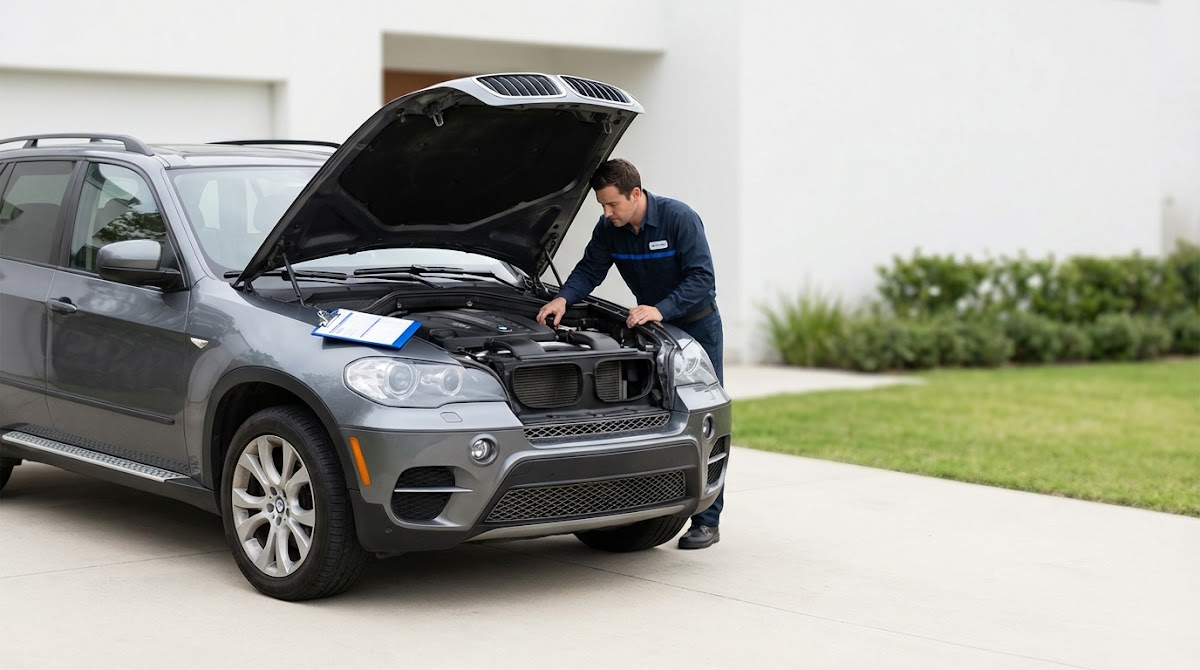
At the inspection, check for visible oil or coolant leaks, uneven ride height, and tire wear patterns. Listen for abnormal engine noises and check for warning lights on the dash during startup and while the car is running.
Perform a thorough test drive that includes city and highway conditions, acceleration and deceleration, and repeated gear changes to observe transmission behavior. Ask the seller to demonstrate any active features, and note infotainment or electronic oddities.
What to ask the dealer and what records to request
Request maintenance records, bills for major repairs, and any recent inspection reports. If the dealer cannot provide clear service history or cannot explain recent repairs, treat that as a higher-risk purchase.
If you find active warning lights, visible leaks, or missing service history, either request a proper repair and documentation before purchase or walk away; these are common reasons an X5 becomes more expensive than expected after 100000 miles.
What to expect in maintenance and repair costs after 100000 miles
Typical service items and their cost drivers
BMW X5 ownership after 100000 miles typically involves higher-than-average repair and maintenance costs compared with mainstream SUVs, driven by luxury parts pricing and specialized labor rates.
Frequent high cost items include suspension components such as air springs and compressors, engine and cooling system repairs like water pump replacement, and electronic module diagnostics and repairs that require dealer level tools or specialist shops.
Repair and ownership studies show that luxury SUVs often cost more to maintain than mainstream models, partly because replacement parts and diagnostics are more expensive and partly because systems are more complex.
When budgeting, factor in local labor rates, whether you will use dealer service or a qualified independent shop, and parts sourcing options. These choices can materially change the total cost to own for a high-mileage X5.
RepairPal reliability page provides aggregated repair frequency and severity data that can help set realistic expectations for maintenance needs and relative costs.
How service history changes the cost picture
A complete, verifiable service history often reduces risk because it shows preventive maintenance and timely repairs. Cars with documented timing services, cooling system work, and recent suspension repairs are typically better candidates for continued use.
Absent records, buyers should assume a higher probability of near-term maintenance and budget accordingly. Getting a pre purchase diagnostic scan and an independent inspection helps reveal issues that may not appear in a visual check.
Model years, generations and engine choices: which X5s age better
Major generations and notable changes
Generations differ in design and known failure modes; later generations such as the G05 (2019+) reduced some turbocharged engine failure patterns reported on earlier X5s, but the luxury repair cost profile remains.
When comparing candidates, focus on the precise model year and powertrain rather than treating every X5 as equivalent; small changes between model years can alter long term ownership risk.
J.D. Power dependability study provides context for generation level dependability and helps buyers weigh model year differences when selecting a high-mileage luxury SUV.
Engine and powertrain considerations
Older turbocharged engines are more frequently mentioned in owner complaint records for certain years; those engines can show higher mechanical complaint rates and may require more frequent attention to seals, turbo plumbing, and oil control systems.
Later revisions addressed some of these failure modes, so prioritizing a later generation or a well maintained engine can reduce risk even if the odometer is high.
How facelifts and later revisions altered failure patterns
Mid cycle updates and facelifts sometimes include mechanical and electronic updates that reduce known failure points. Always check recall and complaint records for the exact VIN to see whether specific issues were addressed for that car.
Even with fixes, parts and labor for luxury components still raise repair bills compared with mainstream alternatives, so factor that into long term cost estimates.
Typical buyer mistakes and red flags to avoid
Common errors during inspection and negotiation
A frequent mistake is buying without a vehicle history report or without requesting service records; missing records increase uncertainty and the probability of unforeseen repairs.
Another common error is skipping a diagnostic scan or a comprehensive test drive, which can miss transmission or electronic faults that only appear under certain conditions.
Independent inspector checklist for high mileage X5 evaluations
Bring the VIN for report lookup
Overlooking records and warning signs
Do not ignore visible oil or coolant leaks, inconsistent ride height, or active warning lights; these are common red flags that often indicate repairs are needed and can be costly on an X5.
If a dealer cannot provide clear maintenance records or resists a third party inspection, treat that as a serious warning and consider walking away or negotiating accordingly.
Misreading pricing signals
Underpricing can reflect legitimate risk such as missing records or active issues, rather than a bargain. Use pricing insights and local market context to compare similar listings and set a realistic offer that accounts for likely maintenance.
Edmunds used-car guide advises buyers to align pricing expectations with documented history and inspection findings before committing.
Practical scenarios: three buyer profiles and recommended approaches
Budget buyer willing to DIY maintenance
A budget buyer who can perform some repairs should prioritize examples with clear ownership history but accept some deferred cosmetic issues. Focus inspections on oil and coolant leaks, suspension condition, and transmission operation to identify tasks you can handle yourself.
For these buyers, an X5 with a recent major service and obvious DIY-friendly issues is usually preferable to one with active leak or transmission warnings.
Family seeking reliability with moderate budget
Families should favor later generations with documented service history, completed timing and cooling system services, and recent suspension work. That reduces the chance of near term disruptions and makes ownership costs more predictable.
Insist on a diagnostic scan and a professional pre purchase inspection if the car will be used for daily family transport; predictable maintenance is often more valuable than a lower purchase price.
Buyer prioritizing low risk and documented history
Low risk buyers should demand comprehensive vehicle history, independent inspection, and clear receipts for major services. Paying a premium for a well documented, well cared for X5 can be a rational choice to lower ownership uncertainty.
RepairPal reliability page offers comparative repair frequency information that can help risk averse buyers decide which model years and engines to avoid or prefer.
Bottom line and next steps for buyers
Decision checklist
Decision checklist: order a VIN vehicle history report, verify title status and maintenance records, complete a focused pre purchase inspection including a diagnostic scan, test drive to check transmission and suspension, and be prepared for higher maintenance costs than mainstream SUVs.
Documented maintenance and a professional inspection are the strongest predictors that an X5 will remain usable after 100000 miles; without those, risk rises and repair bills can be significant.
Resources and recommended first actions
Recommended next steps: run a vehicle history report for any listing you consider, schedule an independent inspection, and compare pricing context for similar local listings to set a realistic offer.
CarFax Deals can help you run a VIN report and compare listings with pricing insights to surface risk signals before you contact a dealer, which often reduces uncertainty in the early stages of research.
You should expect higher than average maintenance and repair costs compared with mainstream SUVs; documented service history and preventive maintenance strongly reduce the likelihood of near term surprises.
Order a VIN vehicle history report, inspect for oil and coolant leaks, test drive for transmission behavior, check suspension and tires, and get a diagnostic scan and independent pre purchase inspection.
Later generations such as the G05 (2019+) reduced some early turbocharged engine failure patterns, so late model X5s with good service records often carry lower risk than older examples.
If you are actively shopping for a high‑mileage X5, start by running a VIN vehicle history report and scheduling an independent pre purchase inspection. Those two steps typically reveal the clearest signals about whether a specific car is worth further consideration.
Keep expectations realistic about parts and labor on a luxury SUV and prioritize documented maintenance when comparing listings.

 Blog
Blog


