What is the lifespan of a Tesla? A practical guide for used buyers
This guide explains how to estimate the remaining lifespan of a Tesla by combining battery research, warranty context, and practical listing checks. If you are evaluating a used tesla for sale, the article shows what to inspect, which claims need verification, and how warranty and battery condition influence value.
A rav4 used for sale can be a sensible pick for many research-oriented buyers because reliability aggregators rate the model above average and safety ratings are generally strong. This guide explains how to vet listings, what model years tend to be better, and a step-by-step checklist to reduce risk before you buy.
This guide explains how to estimate the cost of buying an R34 Skyline, with attention to import rules, condition-driven price tiers and landed cost. It shows which factors move value, how to verify history and paperwork, and offers a checklist you can follow when you search for a nissan skyline r34 for sale.
This guide helps buyers set realistic expectations for tacoma trucks for sale by explaining the main price drivers and a repeatable method to build conservative, typical, and ambitious offer ranges. It shows how the 2024 redesign, valuation guides, and vehicle history reports interact to change asking prices and reduce purchase risk.
This article explains how buyers can estimate the likely remaining life and value of a Tesla when looking at a used listing.
It combines findings from national lab reviews and consumer testing with practical, step by step checks that research oriented buyers can apply before contacting a dealer.
The aim is to reduce uncertainty by showing which signals matter most and which documents to request.
Studies and lab reviews indicate many Tesla battery packs retain high 80s to mid 90s percent capacity after about 100,000 miles.
Tesla's 8 year battery and drive unit warranty sets manufacturer expectations but does not measure remaining capacity on a used car.
A VIN-based vehicle history report plus a range comparison and warranty check is the most evidence based pre-purchase approach.
What determines the lifespan of a Tesla?
Battery condition is a central determinant of usable lifespan for electric vehicles, and it often sets how owners and buyers think about longevity. Real-world studies show that battery packs tend to retain most of their usable capacity through many tens of thousands of miles, but measurable decline occurs with cumulative use and exposure to stressors U.S. Department of Energy overview.
Other components matter as well. Electric drive motors and power electronics typically show lower documented failure rates than batteries according to reliability surveys, so mechanical drivetrain failure is generally less common than loss of range over time Consumer Reports findings.
How the car was used and stored often explains much of the variation in remaining life. Frequent DC fast charging, persistent high state of charge, extreme heat exposure, and very high annual mileage tend to accelerate battery capacity loss in the field NREL review of battery degradation.
Run a vehicle history report for the VIN before contacting dealers
Before you compare listings, consider running a vehicle history report and looking at local pricing context to reduce uncertainty about battery and service history.
Manufacturer warranty terms also shape expectations. Tesla publishes an eight year warranty window for the battery and drive unit with mileage limits that vary by model; this defines a minimum performance expectation but does not specify remaining capacity on a specific used vehicle Tesla New Vehicle Limited Warranty.
When you see a used tesla for sale, these technical and contextual factors come together. Battery pack age and use patterns, the car's service and charging records, and the remaining warranty all influence likely remaining useful life and resale value.
Battery capacity retention versus component failure
Field studies and lab reviews report that many Tesla packs retain capacity in the high 80s to mid 90s percent after roughly 100,000 miles in typical conditions, though results vary by chemistry and use patterns NREL review of battery degradation. See additional large-sample analyses from Geotab.
That level of retention means a car with long mileage can still have useful range, but the exact remaining range depends on original pack size, how the car was charged, and exposure to heat or consistent high charge levels. Expect variation rather than a single outcome.
Manufacturer warranty and what it covers
Tesla's New Vehicle Limited Warranty provides an eight year coverage window for the battery and drive unit, with mileage caps that differ by model year and trim, and this is the manufacturer's baseline for acceptable performance Tesla New Vehicle Limited Warranty.
The warranty gives buyers a clear check to see if a vehicle is still covered, but it should not be read as a precise statement of remaining battery percent. Warranty status is better used as a risk filter than a capacity meter.
Environmental and use factors that matter
Charging behavior is a leading influence. Frequent DC fast charging and keeping the battery at a high state of charge over long periods both tend to increase long-term capacity loss, according to government and lab reviews U.S. Department of Energy overview.
Climate and mileage also matter: prolonged exposure to high temperatures and very high annual mileage correlate with faster degradation, while garage storage and moderate charging habits can slow capacity decline NREL review of battery degradation.
What the studies and lab reviews say about battery degradation
Large-scale reviews from national labs and government agencies aggregate lab tests and field data to estimate typical battery life under varied conditions. These syntheses emphasize that average retention is substantial but not uniform across all vehicles NREL review of battery degradation.
The U.S. Department of Energy frames battery life as dependent on repeated calendar and cycle stressors, highlighting that charging patterns and thermal conditions produce measurable differences in capacity retention over time U.S. Department of Energy overview.
Key findings from national lab and government reviews
Reviews show typical real-world retention in many cases lies in the high 80s to mid 90s percent after roughly 100,000 miles, but they also stress that outcomes are conditional on chemistry and use patterns NREL review of battery degradation. Read additional summaries at ENH Auto.
That range of retention explains why two cars with similar mileage can have quite different remaining range; one may have been charged and stored gently while the other saw frequent fast charges and high state of charge exposure.
Consumer testing and real world owner data
Consumer Reports and similar testing programs collect owner observations and test data that show observable range reductions over time and identify charging habits and climate as common contributors to faster loss Consumer Reports findings.
These sources also recommend practical checks, such as comparing advertised range to historical averages for the same model year, because advertised numbers alone can mask capacity loss.
What varies by chemistry and use
Cell chemistry influences degradation rates; newer chemistries introduced since 2023 aim to reduce calendar and cycle fade, but field evidence covering many years is still emerging and introduces some uncertainty for long-term projections U.S. Department of Energy overview.
Until multi-year datasets accumulate, treat long-term projections as conditional. Practical evaluation of an individual used car benefits more from direct range comparisons and service history than extrapolating from broad chemistry trends.
Tesla warranty and what it means for a used tesla for sale
Tesla's New Vehicle Limited Warranty gives an eight year coverage window for the battery and drive unit and includes mileage limits that vary by model; this is a useful check when assessing a listing Tesla New Vehicle Limited Warranty.
The warranty sets manufacturer expectations for minimum performance during the coverage window but does not promise a specific remaining capacity for a used vehicle. Use warranty status as a valuation signal rather than a precise measure of range.
Checking VIN and warranty status can often be done before you visit a dealer using the VIN report and can materially change your negotiating posture. If a vehicle is still within warranty for the battery and drive unit, that typically reduces near-term risk compared with an out of warranty car.
What the 8 year battery and drive unit warranty covers
The warranty covers defects and sets mileage limits for coverage, which vary by model year and trim. Use the published warranty window as a baseline for expected minimum support from the manufacturer rather than a definitive battery percentage.
How mileage caps affect coverage
Mileage caps matter because two cars of the same age can have different remaining mileage allowance under the warranty. When a listing shows lower mileage relative to the model's cap, that is a practical signal worth confirming with the VIN and service records.
Using warranty status as a valuation signal for a used tesla for sale
Buyers commonly use remaining warranty time and mileage as part of a price assessment because it shapes expected near-term repair risk and potential manufacturer support. Verify warranty status with the VIN before relying on it in a valuation decision.
Mechanical reliability: motors, power electronics, and other non battery systems
Available reliability surveys indicate electric drive motors and power electronics have lower documented failure rates than batteries, so large mechanical failures are less common than gradual battery capacity changes in many datasets J.D. Power reliability insights.
That said, non battery service items do occur. Examples include HVAC issues, suspension wear, and occasional electronics or sensor repairs; these items can affect ownership cost if not disclosed in service history.
What surveys say about motor and electronics failure rates
Surveys and ownership studies generally show fewer drive unit failures relative to battery-related capacity decline, but the frequency and cost of non battery repairs vary with model year, use, and maintenance history J.D. Power reliability insights.
Because these components tend to be more durable, a thorough review of service records often reveals whether recurring non battery issues exist.
Common non battery service issues to expect
Common service items reported in ownership studies include HVAC service, software updates and module replacements, tires and brakes where regeneration patterns change wear, and occasional electronics fixes. These are rarely as central to lifespan as the battery but can affect total cost to own.
Request service history and look for patterns of repeat work in dealer records or the vehicle history report to identify potential trouble spots.
How maintenance history affects longevity
Regular service, documented maintenance, and prompt repairs of known issues tend to support longer useful life. A clear ownership history and detailed service records are practical indicators that a car was monitored and maintained.
When such documentation is missing, buyers should increase caution and consider an independent inspection before purchase.
How to assess a used Tesla listing before you contact a dealer
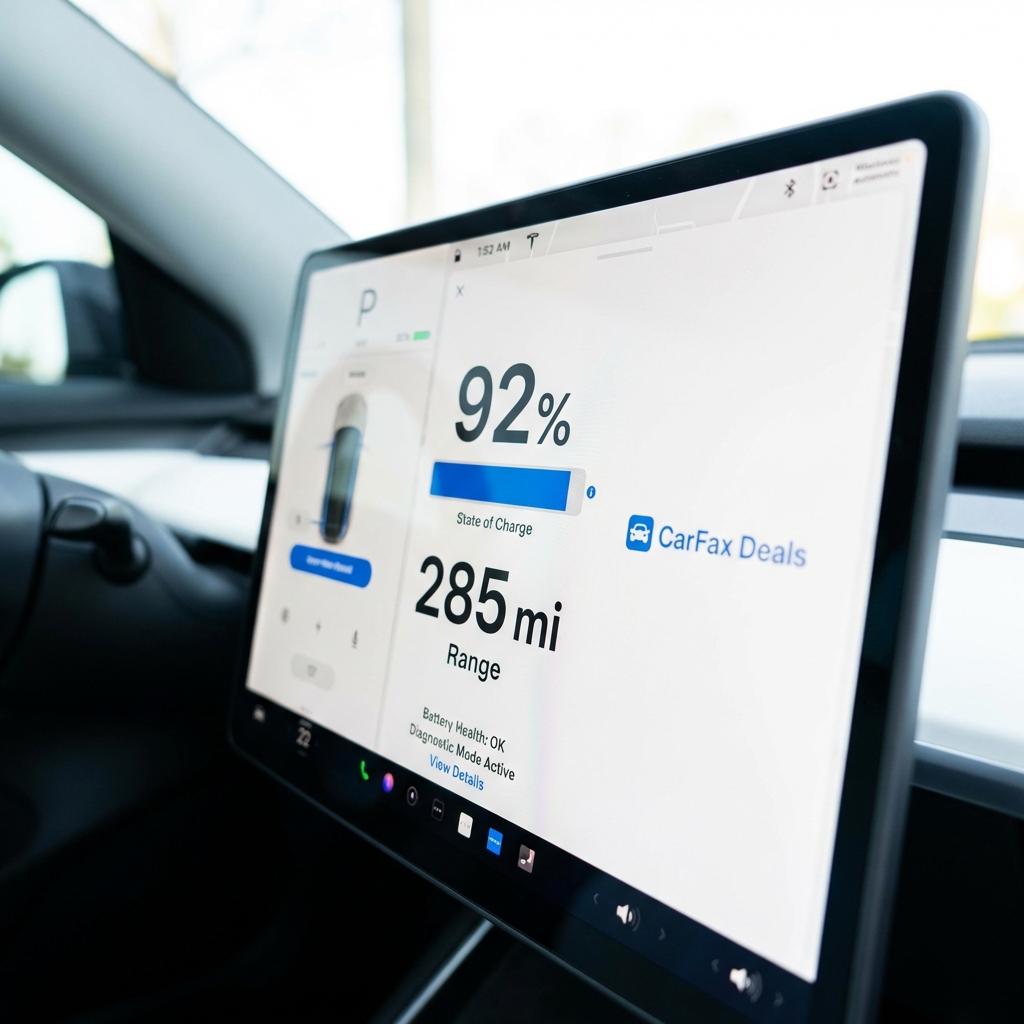
Start with a clear range check: compare the advertised range to the EPA combined range for the model and to typical historical ranges for that year and trim. Significant deviation may indicate battery capacity loss or a reporting mismatch Consumer Reports findings.
Compare advertised range to EPA and historical ranges to flag likely degradation
Use this as a quick screen not a diagnosis
Next, run a vehicle history report to confirm title status, ownership history, service entries, and mileage checks. A VIN-based report can reveal accident history, number of owners, and service events that directly affect risk assessment Run CarFax Report. See our how-to guide for running reports.
Verify charging and service evidence. Ask the seller for charging logs or summaries when available, and review service records for recurring issues or recent battery-related repairs which can inform likely remaining life Consumer Reports findings.
Check remaining warranty and buyback eligibility where applicable. If the car still falls within Tesla's battery and drive unit warranty window, that often reduces short-term risk compared with fully out-of-warranty cars Tesla New Vehicle Limited Warranty.
Use local pricing context and price analysis labels to see how sellers are positioning the listing. Labels and market context can help you compare whether a listed price aligns with similar local vehicles and whether battery or warranty status explains a price differential iSeeCars resale trends. Read more on our blog.
Range check and comparing advertised range to expected EPA and historical values
Simple math can flag potential issues: if advertised range is substantially below EPA combined values for the model, that may indicate capacity loss. Use published EPA numbers and typical historical averages as your baseline for comparison.
When a listing shows typical range or better, that is a positive sign but still verify charging patterns and service history to confirm the claim.
Verifying service, charging, and ownership records with a vehicle history report
A vehicle history report helps confirm title status, single ownership, service entries, and mileage progression. These data points address many of the most common risks in used listings and often change how buyers value a car Run CarFax Report.
Ask sellers for proprietary charging logs or exportable data when possible. These logs can help you see whether the vehicle was routinely DC fast charged, which matters for long-term battery health.
Checking remaining warranty, title status, and pricing signals
Documented remaining warranty and a clean title materially influence buyer willingness to pay. Use warranty checks alongside price analysis labels and local market comparables to judge if a listing is fairly priced for its condition and risk profile iSeeCars resale trends.
When a listing lacks clear warranty or service evidence, factor in potential near-term costs and consider a more conservative offer or an independent inspection.
Pricing and resale value: how battery and warranty affect price
Market studies through 2024-2025 indicate Tesla models generally retain value relatively well compared with many other EVs, but battery condition and remaining warranty materially affect how buyers value used vehicles iSeeCars resale trends.
When a listing includes strong service records and remaining warranty, buyers often pay a premium relative to similar out-of-warranty cars. Conversely, obvious battery capacity loss or unclear history can depress buyer willingness to pay.
Market trends for Tesla resale value versus other EVs
Resale analyses show Tesla models often outperform many peers on retained value, but the advantage narrows when battery condition is poor or warranty has expired, making battery health a major determinant of final sale price iSeeCars resale trends.
Local demand also matters: in markets where EV demand is higher, the price impact of a partial battery fade may be smaller than in weaker markets.
How battery condition and remaining warranty change buyer willingness to pay
Buyers discount listings for known battery degradation and for cars out of warranty because future battery repair or replacement is a significant cost driver. Remaining warranty time reduces that perceived risk and often commands higher offers.
Use price analysis labels and local comparables to see whether a listing's price reflects warranty and reported battery condition.
Using price analysis labels to compare deals
Price analysis labels can rapidly show whether a listing sits above or below local market averages. Combine those labels with warranty checks and a vehicle history report to interpret why two similar listings may have different asking prices iSeeCars resale trends.
Labels do not replace specific checks but function as a quick filter to prioritize which cars to inspect more closely.
Common mistakes buyers make when evaluating used Teslas
A frequent error is accepting the advertised range at face value without cross checking it against EPA numbers and the car's service or charging history; that can mask battery capacity loss Consumer Reports findings.
Skipping a vehicle history report or title check is another common mistake. Missing or incomplete reports increase the chance you overlook accident history, odometer inconsistencies, or repeated repairs.
Overrelying on advertised range without history
Advertised range can be influenced by recent charging practices and software updates. Always compare it to EPA combined range and known historical performance for the model year.
When the numbers diverge, request charging logs or a recent range test to clarify whether the advertised figure reflects true usable capacity.
Skipping vehicle history and title checks
Not running a VIN-based vehicle history report removes a key layer of verification about ownership, accidents, and service. This step often reveals issues that materially affect value and risk.
Use a history report early in the process to decide whether a listing warrants further inspection.
Ignoring charging and climate exposure history
Failing to ask about frequent fast charging or extended exposure to high temperatures can miss major accelerants of battery degradation. Sellers who keep logs or can describe charging patterns provide useful context.
If charging history is unavailable, build a buffer into your offer to account for the uncertainty or require an independent battery health assessment.
Practical scenarios and checklists for different buyer types
Different buyers face different trade offs. A commuter buying a high mileage used Tesla may accept some battery fade if range still covers daily needs, while a family buyer may prioritize remaining warranty and accident history.
Here are short, practical checklists tailored to three common buyer types. Use these as screening steps before a test drive and independent inspection.
Commuter buying a high mileage used Tesla
Checklist: Verify advertised range against EPA and historical values, ask about fast charging frequency, confirm recent service for battery or charging parts, and compare price against local listings to ensure savings justify potential near-term battery decline Consumer Reports findings.
If daily commute needs are modest relative to remaining range, a high mileage car can be a reasonable choice when priced appropriately and when service history is sound.
Family buyer prioritizing reliability and warranty
Checklist: Prioritize listings with remaining battery and drive unit warranty, request a vehicle history report to confirm single ownership and no major accidents, and favor cars with documented service records and recent inspections Tesla New Vehicle Limited Warranty.
Families often value predictable near-term costs, so warranty coverage and clear service history can outweigh small price savings on an out-of-warranty car.
Budget buyer evaluating out of warranty cars
Checklist: Compare price discounts against likely near-term battery service or replacement risk, ask for charging and usage history, and consider an independent battery health check to estimate remaining useful life before purchase iSeeCars resale trends.
For budget buyers, factor in potential repair timing and local resale demand to decide whether savings justify the uncertainty.
Combine published battery retention findings with a VIN-based vehicle history report, an advertised range versus EPA comparison, and warranty checks to estimate likely remaining useful life and near-term risk.
Conclusion and next steps for a confident used Tesla purchase
Evidence from lab and field studies indicates Tesla battery packs often retain substantial usable capacity after many miles, but outcomes vary with chemistry, charging behavior, climate, and cumulative mileage NREL review of battery degradation. See a practical discussion of range loss at GreenCars.
Before you contact a dealer, run a vehicle history report, compare advertised range to EPA and historical numbers, check remaining warranty using the VIN, and use local pricing insights to interpret asking price. These steps together form an evidence based approach to estimating remaining lifespan and price risk Run CarFax Report.
Many studies show typical battery packs retain much of their capacity after long use, but actual range loss varies with charging habits, climate, and mileage. Use a range comparison and service records to assess a specific car.
No. The warranty defines an eight year coverage window with mileage caps and sets minimum manufacturer expectations, but it does not state a specific remaining capacity for a used vehicle.
Ask for the VIN, vehicle history report, detailed service records, and any available charging logs. Confirm warranty status and title information before arranging an inspection.
Use a vehicle history report, a careful range comparison, and a warranty check to prioritize listings that match your risk tolerance and driving needs.
When in doubt, an independent inspection or a specialist battery check can clarify likely near-term costs and help you make a confident decision.

 Blog
Blog