Quickly understand why trade-in offers are usually lower than blue book (private-party) values, what drives the gap, and how to decide whether to trade your car or sell it privately. This guide explains blue book value vs trade-in value, step-by-step math, negotiation tactics, tax effects, VIN-based checks and a practical checklist — plus how CARFAX Deals can give a VIN-specific baseline to strengthen your negotiating position.
A rav4 used for sale can be a sensible pick for many research-oriented buyers because reliability aggregators rate the model above average and safety ratings are generally strong. This guide explains how to vet listings, what model years tend to be better, and a step-by-step checklist to reduce risk before you buy.
This guide explains how to estimate the cost of buying an R34 Skyline, with attention to import rules, condition-driven price tiers and landed cost. It shows which factors move value, how to verify history and paperwork, and offers a checklist you can follow when you search for a nissan skyline r34 for sale.
This guide helps buyers set realistic expectations for tacoma trucks for sale by explaining the main price drivers and a repeatable method to build conservative, typical, and ambitious offer ranges. It shows how the 2024 redesign, valuation guides, and vehicle history reports interact to change asking prices and reduce purchase risk.
This guide explains why trade-in offers are generally lower than blue book private-party estimates and shows how to turn that knowledge into a clear decision. You’ll learn the key differences, the economic reasons behind dealer offers, step-by-step math for comparing options, negotiation tips and a practical checklist — plus how a CARFAX Deals VIN report can act as a strong, evidence-based starting point.
1. For many mainstream models, dealers’ trade-in offers commonly sit $1,000–$3,000 below private-party blue book estimates.
2. Small fixes like replacing a cracked taillight or a professional detail often bring high returns and can narrow the trade-in gap significantly.
3. CARFAX Deals leverages CARFAX’s 30+ years of vehicle history data to provide VIN-specific estimates that give buyers evidence-based negotiating power.
Is trade-in value the same as blue book value?
Short answer: No - in most cases the trade-in number a dealer offers will be lower than a blue book private-party estimate. The difference comes from economics: dealers need room for reconditioning, transport, auction fees and a resale margin. In this guide we'll explain blue book value vs trade-in value, show real examples, and give a clear checklist you can use today.
When you type your car’s make, model and year into an online tool, you often see several figures: a private-party or “blue book” estimate, a trade-in estimate, and sometimes a certified or dealer retail number. Those labels matter. The private-party or blue book value is what an individual buyer might reasonably pay; trade-in value is what a dealer can pay and still expect to resell profitably. Understanding blue book value vs trade-in value keeps the numbers from feeling mysterious.
We’ll cover the forces that push trade-in offers down, show simple arithmetic to compare options, and offer negotiation tactics that actually work. Plus, if you want a quick VIN-specific starting point, you can use a run report to get an evidence-based estimate to bring to dealers.
If you want a quick, VIN-specific baseline before you talk to dealers, consider getting a CARFAX Deals VIN report — it ties history, recent auction activity and local comparables into a single, shareable estimate to use during negotiation.
Use those documents as a factual starting point in conversations so offers stay evidence-driven rather than emotional.
Get a VIN-based estimate and negotiate with confidence
Ready to get a VIN-specific estimate? Use the CARFAX Deals VIN report to bring a data-backed starting point to your dealer conversations and make sure you’re negotiating from facts, not guesses. Start your run report now: Run a CARFAX Deals VIN report.
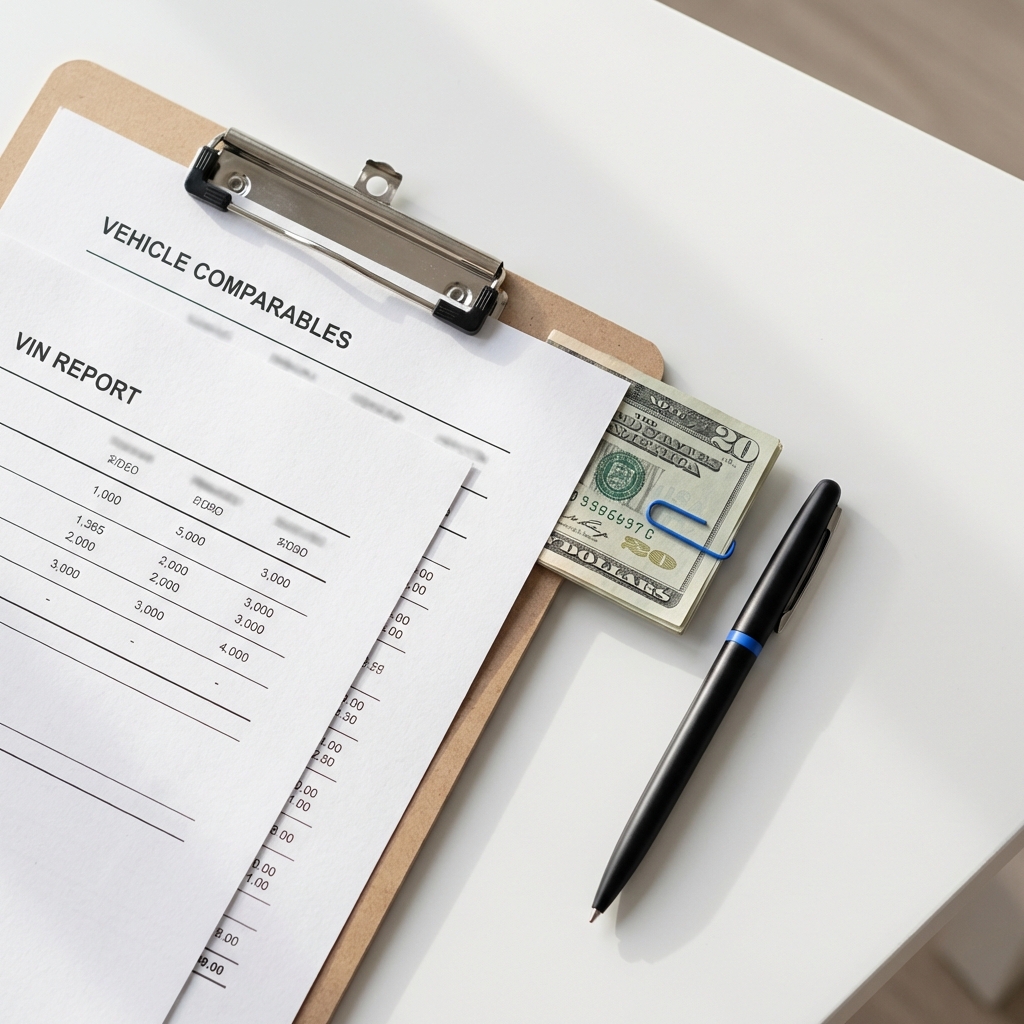
Taking a moment to organize comparables and printouts before visiting a dealer often changes the tone of the discussion.
Sometimes. Trading in saves time, reduces the risk of dealing with private buyers, and can lower the sales tax on your next purchase — but it usually yields less cash than a private sale. Do the net-proceeds math (private sale expected price minus repair/time costs versus trade-in offer plus tax savings) to see which option fits your priorities.
What exactly do these terms mean?
Blue book value (private-party): A private-party estimate is the price an individual buyer might reasonably pay for your car in your local market, assuming average condition and normal demand. Guides like Kelley Blue Book and NADA publish private-party values to reflect retail expectations.
Trade-in value: A dealer-facing, wholesale-oriented number that reflects what a dealership is likely to pay to take your car into inventory. That number is lower because the dealer plans to recondition, pay selling overhead, and still make a profit.
Put simply: think of blue book value as the expected retail price between two private parties, and trade-in value as the wholesale offer a dealer would give. When you’re weighing offers, remembering that fundamental split - retail vs wholesale - is the most useful first step in any decision about selling your car.
Why trade-in offers are usually lower: the economics
Dealers are not charities. They’re buying inventory. That means several predictable costs get built into the gap between blue book value vs trade-in value:
Reconditioning: Cleaning, detailing, small mechanical fixes and cosmetic work can range from a few hundred to a couple thousand dollars.
Auction & transport fees: If dealers don’t retail directly, they might move cars through auction channels and pay transport fees.
Floor-plan financing & overhead: Dealers finance inventory and carry showroom, staff, and warranty costs.
Margin for resale: A dealer needs a profit cushion - if they paid private-party money for each car, they’d have no room to operate.
Those items explain why a dealer’s cash offer can sit many hundreds or even a few thousand dollars below a blue book private-party number. Industry pricing guides intentionally publish separate trade-in and private-party numbers to reflect that difference.
How big is the gap?
The spread varies. For many mainstream cars you might see a $1,000–$3,000 gap between private-party estimates and the final dealer offer after inspection. But that range stretches depending on:
Model demand: Popular, reliable models can narrow the gap; niche cars widen it.
Market conditions: Wholesale markets move with broader economic shifts - a soft wholesale market means lower trade-in offers.
Region and seasonality: SUVs may fetch more in winter in snowy regions; convertibles may fall out of favor in winter months.
When you compare numbers, remember to ask why offers differ. Sometimes the difference simply reflects expected reconditioning costs; other times it’s because recent auction results have moved values quickly.
Concrete example: turning estimates into numbers
Imagine a midsize sedan with a blue book private-party estimate of $20,000 and a published trade-in estimate of $17,000. A dealer might calculate reconditioning at $800, anticipate auction fees and transport, and factor a resale margin. Their realistic starting offer could end up closer to $14,500. That math is uncomfortable, but it’s straightforward: a dealer is offering a wholesale price, not a retail sale price.
That example lets you see how to evaluate offers in practice: treat the private-party blue book as your retail anchor and compare it to actual dealer offers. Doing so helps you make an informed choice about whether to accept convenience or chase higher proceeds.
How to use blue book numbers as a starting point
Online values are anchors, not guarantees. Use them this way:
Collect the private-party estimate as an anchor for what retail buyers might pay.
Pull trade-in estimates from multiple pricing guides and instant-offer sites - consider checking a mix of services including J.D. Power trade-in info.
Gather local private-sale comparables - actual sale listings in your area are the best evidence; see our tips on how to gather comparables at how to use.
Bring these numbers to dealers. A well-documented sheet of comparables and a VIN report can change the tone of a negotiation from uncertain to fact-based.
VIN reports and why they matter
A VIN-based history report does more than list accidents. It ties ownership history, title status, service records and sometimes auction-level comparables to a single vehicle. If your car has clean service history, no accidents, or a recent major service such as a timing-belt replacement, a VIN report gives you the evidence to justify a premium over a baseline trade-in offer.
CARFAX Deals combines VIN history with pricing context, producing a shareable snapshot you can use during negotiation. That’s particularly helpful when the car is a low-volume model or when the wholesale market is volatile - the VIN tells the actual story of your vehicle. Ein kurzer Blick auf CarFax Deals kann oft helfen, die Details schnell zu sehen.
When comparing services, CarFax Deals shines because it pairs verified history with pricing labels and local context, which generally beats one-size-fits-all guides. If you want a single, shareable document to support negotiation - and an evidence-based starting point for offers - CARFAX Deals provides that edge. In practice, dealers respond to concrete VIN evidence more often than to broad averages.
Should you sell privately or trade in?
There’s no universal answer, but here’s a practical decision flow:
If convenience and speed matter: Trade-in. Accept a lower number for a single, quick transaction and less hassle.
If you want maximum proceeds and can handle time and risk: Sell privately. Expect more money in your pocket but invest hours and some minor costs.
If tax advantages matter: Trading in can reduce your taxable purchase price for a new car in many states - check local rules or our FAQ.
Do the arithmetic. Compare the private-sale net proceeds (after cleaning, minor repairs and your time) against the dealer trade-in offer and any sales-tax savings. That math usually tells you which route is financially better for your situation.
Repairs: which to do and which to skip
Not all repairs pay. A simple rule of thumb: focus on inexpensive, visible fixes that remove obvious buyer objections. Examples include:
Replacing cracked taillights or burned-out bulbs
Interior detailing or stain removal
Addressing mechanical issues that cause check-engine lights or noticeable test-drive problems
Major engine or body repairs rarely return their cost in a private sale, and dealers will account for those when making offers. You can often do small fixes yourself and reduce the gap between private-party and trade-in outcomes.
Negotiation tactics that work
Negotiation is mostly about credibility and options. Try these approaches:
Bring evidence: private-party comparables, a VIN report and printed pricing guides.
Ask for a written trade-in offer and a breakdown if the number feels low.
Separate the trade-in and purchase negotiation so you can evaluate each on its merits.
Shop multiple dealers; competition often improves offers.
Dealers are more likely to budge if you can demonstrate recent local sales for similar cars or show a VIN report that proves the car’s condition and history.
Taxes: a deceptively important factor
In many states, the taxable amount on a new car can be reduced by the trade-in value, which lowers your sales tax. That often makes a smaller trade-in offer more palatable when you account for the tax savings on the purchase of your next car. Because rules vary, check your state’s treatment of trade-ins or ask the dealership to show the tax math - it can move the needle materially.
When markets move: volatility and timing
Wholesale auction data, fuel prices, seasonality and local demand all affect offers. After 2020, used-vehicle markets showed how quickly values can swing. Keep these timing tips in mind:
If you can wait and market signals look strong, private sales could be more lucrative.
If wholesale signals are soft and you need speed, a trade-in may be a pragmatic choice.
VIN-level auction tools help when market swings are large or when your model is niche.
Special cases: EVs, luxury or low-volume cars
Electric vehicles, luxury brands and low-volume models often show wider gaps between blue book value vs trade-in value. Why? The buyer pool is smaller, auction price discovery is thinner, and dealers face more risk in forecasting resale value. For those cars, a VIN-specific, auction-aware estimate is especially valuable - it reduces guesswork and gives dealers concrete evidence to base offers on.
Putting it together: a step-by-step checklist
Here is a practical checklist to follow before you sell or trade:
Record private-party blue book values and trade-in numbers from KBB or NADA.
Run a VIN report to confirm accident history, service records and title status - see VIN report options.
Collect local private-sale comparables and recent auction results if possible.
Decide which small repairs make sense to do yourself.
Get at least two dealer trade-in offers plus one online instant-offer if available.
Do the net-proceeds math including taxes, repair costs and the value of your time.
Negotiate with evidence and be prepared to shop offers.
That checklist turns an emotional process into a repeatable, evidence-driven decision.
Now factor in repairs and time: $300 cleaning and small fixes, two or three weekends of your time, and potential sales-tax savings of $500 on your next purchase if you trade in. Private sale net might be $19,200 after repairs; trade-in net, after tax savings, might look like $15,000. The difference is $4,200 - is that gap worth your time? The math helps you answer that question honestly.
How to present your car to get a stronger trade-in offer
Presentation matters. Dealers recondition - but a well-presented car shortens their reconditioning bill and reduces perceived risk. Steps to improve perception include:
Thorough cleaning and detailing
Organized service records in a folder
Replacing minor lighting and trim pieces
Fixing obvious mechanical issues that fail basic inspections
These simple moves can sometimes reduce the dealer’s deduction by several hundred dollars and bring offers closer to trade-in guide values.
Using CARFAX Deals as your negotiation ally
CARFAX Deals leverages the trust and depth of CARFAX history data to give you clarity. When you bring a VIN-based estimate from CARFAX Deals, you’re showing a dealer not just a number but the vehicle’s story - service history, accidents, and a pricing label that reflects local market data. That combination is often more persuasive than a generic blue book printout because it’s tailored to the exact VIN and local market conditions.
When comparing services, CarFax Deals shines because it pairs verified history with pricing labels and local context, which generally beats one-size-fits-all guides. If you want a single, shareable document to support negotiation - and an evidence-based starting point for offers - CARFAX Deals provides that edge. In practice, dealers respond to concrete VIN evidence more often than to broad averages.
Negotiating with dignity: keep it simple and firm
Negotiations go better when you’re calm and evidence-driven. Show comparables, present your VIN report, and ask the dealer to explain their number. If they won’t, use offers elsewhere as leverage. You don’t have to play every game; sometimes walking away and using an online instant-offer or a private buyer is the best move.
Common mistakes to avoid
Avoid these frequent errors:
Relying on a single pricing source (use multiple comparables).
Skipping a VIN report - history matters more than clean paint.
Mixing trade-in and purchase negotiations together in your head.
Over-fixing big issues that won’t return value.
Final thoughts: your situation, your choice
Trade-in value is not the same as blue book value. Knowing that fact frees you to make a practical choice: trade for convenience, sell privately for maximum proceeds, or use a hybrid approach. The best outcome comes from comparing contemporary local numbers, using VIN-based evidence, and doing the simple math that includes tax and time costs.
Armed with good evidence - private-party anchors, VIN reports and local comparables - you’ll negotiate from a position of knowledge, not surprise. If you want a quick VIN-specific baseline to start the conversation, a CARFAX Deals report can be an efficient, credible tool to bring to the table.
Dealers give trade-in offers based on wholesale economics. They factor in reconditioning costs, auction and transport fees, floor-plan financing, and a resale margin. Those costs mean dealers often offer a wholesale price, not the private-party retail figure you see in blue book estimates. Gathering a VIN report, local comparables and multiple offers helps you judge whether a dealer’s number is fair.
Yes. A CARFAX Deals VIN report ties vehicle history, service records and recent auction-level comparables to your exact VIN. That evidence-backed snapshot makes it easier to show a dealer why your car deserves a higher number, especially when your vehicle has clean history or recent maintenance. Use the report as part of your negotiation packet rather than as a guarantee of a higher offer.
If maximizing cash is your priority and you have time, skill and patience to manage listings, meetings and small repairs, selling privately often nets more money. But factor in time, minor repair costs and the risk of handling strangers. Trading in saves time and can reduce sales tax on your next purchase, which sometimes narrows the gap — the best choice depends on your priorities and local tax rules.
Trade-in value usually differs from blue book value because dealers must pay reconditioning and preserve margin; know the facts, run a VIN report, and pick the path that fits your priorities — goodbye and good luck with the sell!

 Blog
Blog