What is the best online site to buy a car? A practical guide
This guide explains online car buying, how platforms differ, and a research-first framework to choose the site that fits your needs. It explains inventory sources, pricing transparency, vehicle history reports, inspection options, and return policies to help research-oriented buyers compare listings with less uncertainty.
Carfax coupon codes rarely work, and the codes listed on coupon sites are usually expired. The discounts that do exist are bundles (three reports for $64.99, five for $99.99), AAA member pricing, and free reports from dealers and listings. The simplest guaranteed discount is CarfaxDeals at $7.99 per report versus $44.99 at Carfax.com.
A Carfax VIN lookup takes the 17-character vehicle identification number and returns the car's recorded history: accidents, title brands, odometer readings, owners, and service records. Free VIN tools only decode specs or check recalls and theft. The full Carfax report costs $44.99 on Carfax.com and $7.99 at CarfaxDeals.
You can get a free Carfax report from the Carfax.com used car listings, a dealer website, the seller, Carfax Car Care (for a car you already own), or listing sites that include one. There is no free report for any VIN you type in. When no free report exists, a paid one costs $44.99 at Carfax or $7.99 at CarfaxDeals.
This article is a practical, research-first guide to choosing an online site to buy a used car. It explains how marketplaces differ by inventory source, pricing transparency, vehicle history reports, inspection options, and return policies.
The goal is to help research-oriented buyers, including first-time buyers and families, decide which platform fits their priorities and to provide a step-by-step workflow from search to inspection and purchase preparation.
Online car buying includes diverse marketplace models, from dealer listings to direct-sale inventories, so choice depends on inspection access and certification.
Compare final out-the-door pricing and watch for progressive fee disclosure to avoid surprises.
Vehicle history reports reduce information asymmetry but do not replace a VIN-specific review or a local independent inspection.
What online car buying means and when it fits your needs
Online car buying refers to using web-based marketplaces and dealer listings to research, compare, and often complete large parts of a vehicle purchase remotely. The term covers a range of site types, from dealer-listed inventories to direct-sale stock, and that difference affects how much of the process can be finished without visiting a dealership.
For research-first buyers and people short on time, online car buying can speed comparison of makes, trims, and local market pricing. Studies of digital buying behavior show that many shoppers begin and complete substantial parts of their search online, then return to a dealer to finalize paperwork or finance terms J.D. Power 2024 US Automotive Retail Study.
Who benefits most depends on priorities. Research-first buyers who value vehicle history context and pricing signals often find online tools helpful, while buyers needing a hands-on inspection or local negotiation may prefer a mixed approach. The choice also depends on inventory source, since dealer listings and direct-sale stock offer different access to certified vehicles and inspection programs.
Use platform filters to shortlist vehicles that show clean title, single owner, and no accident reported
Use these filters before opening a vehicle detail page
Definition and who benefits most
A concise definition: online car buying is a buyer workflow where most research and many purchase decisions happen on a marketplace or dealer website, but the inventory source and local processes can vary. That variance matters because dealer listings often link you to local inspection or pickup options, while direct-sale stock may include vehicles sold with specific return policies.
How online-first shopping changes the buying flow
Online-first shopping moves initial comparison, price checks, and history verification to a digital environment. Buyers tend to gather more comparables quickly, but they also need to plan for inspection, financing, and transfer steps that may require local interaction. Market research finds growing digital-first habits but also notes that completed purchases often revert to dealer interaction for final steps Cox Automotive 2025 Car Buyer Journey.
How online car buying sites differ: inventory, pricing and fees
Not all online car marketplaces are the same. A central difference is inventory source, which determines whether you see mostly dealer-listed cars or direct-sale stock. That in turn affects access to certified pre-owned programs, advertised inspection options, and who handles returns or delivery.
Inventory differences matter because dealer-listed inventories commonly let you arrange local inspections or pick up the car at the dealer, while direct-sale stock may offer centralized inspection services or delivery-only purchase flows. Consumer guidance highlights that inventory source affects inspection access and certified vehicle availability Consumer Reports how-to guide.
Pricing transparency varies across platforms. Some sites show a near-final total price up front, while others reveal fees and add-ons later in checkout, which can make side-by-side comparisons difficult. Industry how-to resources recommend comparing final out-the-door estimates (see pricing page) and watching for progressive fee disclosure Edmunds guide.
Run a vehicle history report on the VIN entry page
Compare listings with available vehicle history reports and look for clear pricing context to reduce surprises when you contact a dealer or schedule delivery
Dealer listings often include vehicles that remain on a local lot, so you can schedule a dealer inspection or test drive and handle paperwork in person. Direct-sale inventories sometimes centralize inspections and may have different return or delivery terms, so availability for a physical check can be limited.
Because the inventory source affects inspection options and certification, verify which party is responsible for inspection reports and delivery terms before you commit. Consumer organizations advise confirming whether a listed inspection is performed by an independent technician or by the selling party FTC buying a used car advice.
Pricing transparency and where fees appear
Check where a site shows fees. If a platform only reveals taxes, dealer fees, or delivery costs late in checkout, your price comparison will be incomplete until the final step. Reviews of online buying flows note that fee disclosure practices vary, and buyers should plan side-by-side comparisons of final prices including expected add-ons Kelley Blue Book delivery and return guide.
Financing integration and trade-in estimates also differ between platforms. Some offer prequalification and instant trade estimates online, while others route financing and trade-in appraisal to dealer partners, which can affect convenience and potential rates.
A step-by-step research-first framework for buying a car online
Follow a structured sequence to keep risks low: search and shortlist, compare pricing context, review vehicle history reports, arrange inspection or independent check, then confirm financing and delivery terms. Each step reduces information asymmetry and helps you prioritize listings based on risk and value.
Start with broad searches and filters to build a longlist, then move to a shortlist using vehicle history and price-analysis signals. Platforms that present a pricing context or price analysis label (for example MarketCheck price analysis) can help prioritize listings by relative value within local market comparables Cox Automotive insights.
Search and shortlist
Use filters for model year, trim, powertrain, and the preferences you need, such as clean title or single owner (compare used cars online guide). Narrow your results to vehicles with service history and no accident reported flags when possible, then compare price analysis labels or pricing context across nearby listings.
Keep a simple comparison table with total listed price, estimated taxes and fees, return window, and whether a vehicle history report is attached. This helps you spot listings that require deeper review or local inspection.
Verify history reports and title status
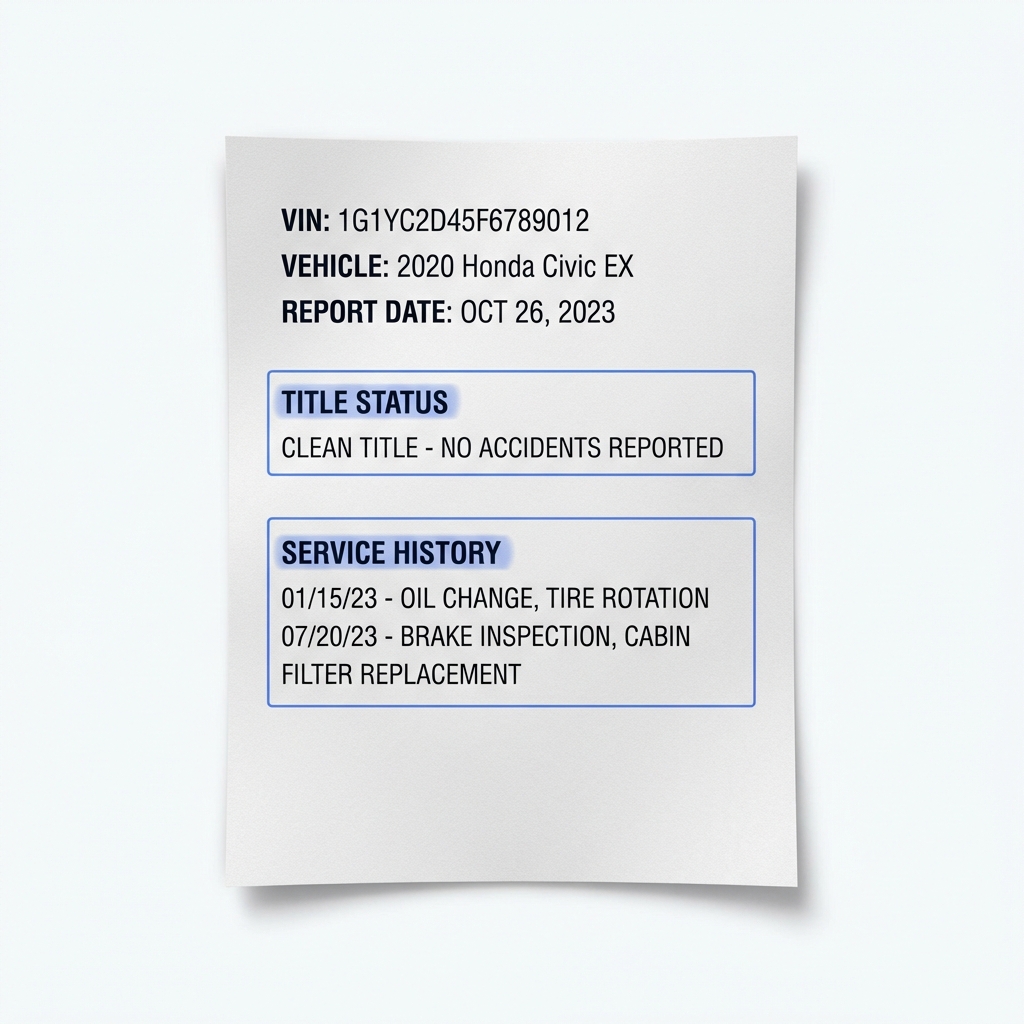
Always open the vehicle history report (run a VIN report) for each shortlisted car and check title status, ownership history, accident history, and mileage checks. Consumer guidance stresses that history reports reduce information asymmetry but do not replace a VIN-specific review and a local independent inspection for higher-risk buys FTC buying a used car advice.
If the history report shows inconsistent mileage or unclear title status, pause and ask for a VIN-specific explanation from the seller. For many buyers, a concerning entry should trigger an independent inspection before purchase.
Arrange inspection and financing before visit
Arrange either a platform-offered inspection or an independent local inspection if you cannot see the car in person. Consumer resources recommend an independent inspection for higher-risk purchases because platform inspections and reports are informative but not fully substitutive Consumer Reports how-to guide.
Prequalify for financing and get trade-in estimates early in the process to understand your expected monthly cost and bargaining room. Where a site offers prequalification, it can speed closing; where financing routes to a dealer partner, expect additional paperwork and potential rate differences.
Decision criteria: how to choose the best site for your purchase
Use a short checklist to evaluate platforms: inventory source, vehicle history report availability, price analysis labels, inspection programs, return window and conditions, and financing options. Weight those features according to your priorities and risk tolerance.
Different buyers prioritize features differently. First-time buyers may want easy financing and clear delivery terms, while families focused on reliability may prioritize service history and safety ratings. Research suggests matching platform features to buyer needs improves outcomes for research-first purchasers J.D. Power 2024 study.
Match the platform's inventory source, pricing transparency, vehicle history report availability, inspection options, and return policies to your priorities; research-first buyers often benefit from sites that combine verified history context with clear pricing insights.
Checklist of must-have platform features
The core items to look for are a clear vehicle history report attached to listings, visible price analysis labels or pricing context, transparent fees and taxes, inspection program details, and a reasonable return window with stated conditions. Also check dealer transparency signals such as ratings and profile information.
Prioritize platforms that let you filter by title status and ownership history, and that disclose whether inspections are independent. These features reduce hidden risk and help you compare listings more reliably Edmunds guide.
How to weight features for different buyer types
For first-time buyers, weight financing clarity and simple return terms more heavily. Families prioritizing safety should emphasize service history and safety rating visibility. Price-conscious buyers should focus on platforms with robust pricing context and transparent fee disclosure so they can compare total cost to own accurately.
Common mistakes and red flags when buying a car online
A frequent mistake is assuming listed price equals final price. Progressive fee disclosure and late-stage add-ons can turn a seeming bargain into a much higher total cost. Consumer how-to guides warn buyers to compare final out-the-door estimates before committing Edmunds guide.
Another red flag is incomplete or missing title and history details on a listing. If a vehicle history report is not provided or shows gaps in ownership history, treat that listing with extra caution and request a VIN-specific review.
Watch for language that says price excludes taxes, dealer fees, or transport. If a listing provides no clarity on expected add-ons, ask for an itemized out-the-door price in writing before you send any payment.
Incomplete or missing title and history details
If a report shows title salvage history, branded title entries, or inconsistent ownership records, ask the seller for documentation and consider an independent inspection. Consumer authorities recommend following up on these issues before taking any further steps FTC advice.
Overreliance on platform inspections
Platform-provided inspection summaries are useful but may not match an in-person independent check. For higher-risk purchases or older vehicles, an independent inspection remains the prudent step because it can reveal mechanical or structural issues not visible in a history report Consumer Reports how-to guide.
Practical examples: three buyer scenarios and recommended site features
Scenario 1, first-time buyer seeking simplicity: prioritize a platform with clear financing prequalification, straightforward return terms, and an easy-to-read vehicle history report. Focus on listings with transparent out-the-door pricing and an attached service history.
Scenario 2, family prioritizing safety: prioritize listings that show service records, safety rating references, and robust vehicle history report details for ownership, accident, and title status. Consider platforms that let you filter for model year and trim so you can compare safety equipment across listings J.D. Power 2024 study.
First-time buyer seeking simplicity
Keep the checklist short: confirm a visible vehicle history report, check the return window, and prequalify for financing. If a site requires too many steps to see final pricing, it may not be the right fit for a buyer who wants a simpler experience.
Family prioritizing safety and reliability
For families, use filters for service history and safety-related trims, and ask sellers about maintenance records. Compare the price analysis label and local comparables to ensure the offer fits your budget and expectations.
Price-conscious buyer comparing multiple listings
Compare pricing context across a tight set of local listings, adjusting for delivery and transport costs. Use side-by-side comparison tools such as Costco's Car Comparison Tool Car Comparison Tool. Use price analysis labels to prioritize listings that look like good local matches, but verify final costs including taxes and any dealer add-ons before deciding.
What to check in vehicle history reports and inspection summaries
Open the vehicle history report and find title status, ownership history, accident history, service records, and mileage checks. These fields are high priority because they directly affect vehicle value and potential hidden costs.
History reports reduce information asymmetry, but they are not a substitute for a VIN-specific review or independent inspection for vehicles with concerning entries. Consumer guidance recommends a local independent inspection for higher-risk purchases FTC buying a used car advice.
Key report items: title status, accident and ownership history
Title status tells you if a vehicle has a branded or salvage title, which can affect insurance and resale. Ownership history reveals how many owners the vehicle had and whether it was used commercially, which can influence wear patterns.
How to interpret mileage, service history, and inconsistencies
Look for consistent mileage records across service entries and emissions tests. If mileage jumps or service history is sparse, ask the seller for maintenance records and consider an independent check. When in doubt, get a VIN-specific explanation and an inspection to confirm mechanical condition Consumer Reports how-to guide.
Final checklist and next steps for confident online car buying
Printable pre-contact checklist: confirm a vehicle history report is attached, verify title status, compare pricing context and price analysis labels, review return and delivery terms, and arrange an inspection if risk is medium or high.
Before committing, prequalify for financing and obtain trade-in estimates to understand your net cost. Read the fine print for return windows and inspection conditions so you know what is refundable and under which circumstances KBB delivery and return guide.
Use this short list when you are ready to contact a seller (see how-to-use): VIN verified vehicle history report, out-the-door price, inspection availability, return window and conditions, financing prequalification status, trade-in estimate if applicable.
A printable pre-contact checklist
Use this short list when you are ready to contact a seller: VIN verified vehicle history report, out-the-door price, inspection availability, return window and conditions, financing prequalification status, trade-in estimate if applicable.
When to walk away and when to schedule inspection or delivery
Walk away if the seller will not provide a VIN-specific report, if title status is unclear, or if final fees are not disclosed. Schedule an independent inspection when the history report shows concerns, inconsistent mileage, or a branded title entry.
A vehicle history report is highly recommended because it shows title status, ownership history, accident entries, and mileage checks, but it does not replace a VIN-specific review or a local independent inspection for higher-risk purchases.
Return windows vary by platform and commonly range from a few days to about a week, often with inspection conditions and mileage limits, so always read the exact return and delivery terms before buying.
Some sites offer prequalification and online financing tools, while others route financing to dealer partners; check each platform's financing integration to understand convenience and potential rate differences.
Take time to compare listings using clear pricing context and attached vehicle history reports. When a listing raises concerns, pause and request a VIN-specific explanation or an independent inspection before moving forward.
Using a structured checklist and knowing what to confirm about title, fees, and inspection options can make online car buying more predictable and safer for most research-first shoppers.


 Blog
Blog