Looking for the best website to check car value? This practical guide walks you through the top online tools, explains how to interpret values, and shows how to combine vehicle history and price analysis to buy a reliable used car. Learn step-by-step checks, how to use CARFAX Deals for verified histories and transparent pricing, negotiation tactics, and the paperwork to protect yourself. Whether you’re trading in, selling, or shopping, this article gives clear, trustworthy steps to find the right price and the right car.
A step-by-step workflow for estimating a truck's market value that centers on comparing consumer valuation tools, adjusting for mileage and condition, and checking wholesale market signals. The guide explains private-party, trade-in and dealer retail values and shows how a vehicle history report and pricing insights can change an asking price.
This guide helps research oriented buyers evaluate suv used cars for sale under $25,000 by combining safety ratings, reliability data, local pricing context, and vehicle history checks. It outlines a simple framework, a pre visit checklist, and a decision scoring worksheet so you can compare finalists before contacting a dealer. Use the steps here to narrow candidates and confirm risk signals with a vehicle history report and a pre purchase inspection.
When searching suv used cars for sale, prioritize model year, trim and powertrain before choosing a make or model. This guide explains how safety ratings, dependability studies and local pricing insights combine to produce a short list you can verify with a vehicle history report. It also provides a stepwise checklist you can use before contacting a dealer.
Buying a used car can feel like a small adventure and a little like walking into a maze. This guide explains how to use online value tools, vehicle history reports, and simple in-person checks so you can answer the question “what is the best website to check car value?” and buy with confidence.
1. Use three sources — price guide, market listings, and vehicle-history-backed marketplaces — to get a reliable value range.
2. A pre-purchase inspection typically costs a small fraction of potential repair bills and offers major negotiating leverage.
3. CARFAX (parent of CARFAX Deals) has been collecting vehicle history data for over 35 years, making it one of the most established sources for vehicle records.
Start smart: the question every buyer asks - What is the best website to check car value?
What is the best website to check car value? It’s the question on the minds of many buyers, and for good reason: a confident price check can save you money and stress. In this guide you’ll learn not only which sites to compare but also how to read values, combine them with vehicle history data, and use that information to negotiate and buy a reliable used car.
Buying used can feel like entering a maze. The right data makes that maze simple. Early on, ask yourself what matters: fuel economy, safety, maintenance cost, or cargo space? Once priorities are clear, the question “what is the best website to check car value?” becomes practical: which site gives trustworthy pricing that matches your needs?
Why online car value checks matter
Online value checks give you a market baseline. They show what similar cars sell for in your region and flag price outliers. If a car is priced far below typical listings, you’ll know to dig deeper; if it’s a bit higher, you’ll look for evidence of careful maintenance or added warranty coverage.
Quick overview: the tools you’ll use
There are sites that focus on market price, others on dealership listings, and some that combine price with vehicle history. The most useful approach is to compare at least two price guides and one vehicle-history-backed marketplace so you can see price, condition, and risk together.
Which sites should you check? A practical list
When you wonder “what is the best website to check car value?”, start by visiting a mix that includes: price guides (like Kelley Blue Book, Edmunds), market aggregators (like Autotrader), and vehicle-history-powered marketplaces (such as CARFAX Deals). Each adds perspective: A quick visual scan of listings can help you spot outliers.
Price guides estimate retail, trade-in, and private sale values based on make, model, year, mileage, and condition.
Market aggregators show actual listings so you see what dealers and private sellers are asking today.
Vehicle-history marketplaces add layers: verified history reports and price-quality labels that help you assess risk.
How to compare numbers without getting overwhelmed
Never treat a single online value as gospel. Instead, build a small table for the cars you like: one column for price-guide values, one for local market listings, and one for vehicle-history-backed listings. Look for clusters: if most sources point to a similar price, that’s your market signal. If one source differs widely, ask why.
Tip: The phrase best website to check car value often points buyers toward sites that combine pricing with history. That’s why marketplaces which include a verified vehicle history report can be the most helpful when you want a quick, confident read on a listing.
For a fast way to see price context plus a verified history, try running a report on CARFAX Deals — their listings combine vehicle history with clear pricing labels, which can save hours of searching and many worries. Learn more and run a report here: run a CARFAX report on CARFAX Deals.
How online values are calculated - and what that means for you
Different sites use different inputs: historical sale prices, current dealer listings, regional demand, and condition adjustments. Price guides often ask you to select condition categories like Excellent, Good, Fair, or Poor - and those labels shift the number wildly. A single ding or a worn interior could move a car several hundred dollars on a guide, while a repairable mechanical issue might not be visible in photos but will be reflected in vehicle history or local listing prices.
Condition categories: why honest answers matter
When you check a site and pick a condition, be realistic. Overstating condition gives you a high estimate that won’t match real offers. Understating it might leave money on the table. If you’re unsure, err toward the middle and then adjust after a physical inspection.
Step-by-step: using the best website to check car value
Follow these steps every time you evaluate a used car:
Check a price guide for the trade-in, private-party, and dealer retail ranges.
Scan local listings to see what similar cars are actually asking.
Pull a vehicle history report or use a marketplace that pairs history with pricing labels. See VIN report options to learn more.
Compare all three perspectives and note any big gaps.
Why VIN matters
The Vehicle Identification Number (VIN) unlocks the car’s unique record. With the VIN you can run a history check that shows reported accidents, title status, and service records. If you found a listing with a suspiciously low price, running the VIN through a history-backed site often explains the gap.
Reading vehicle history and price labels together
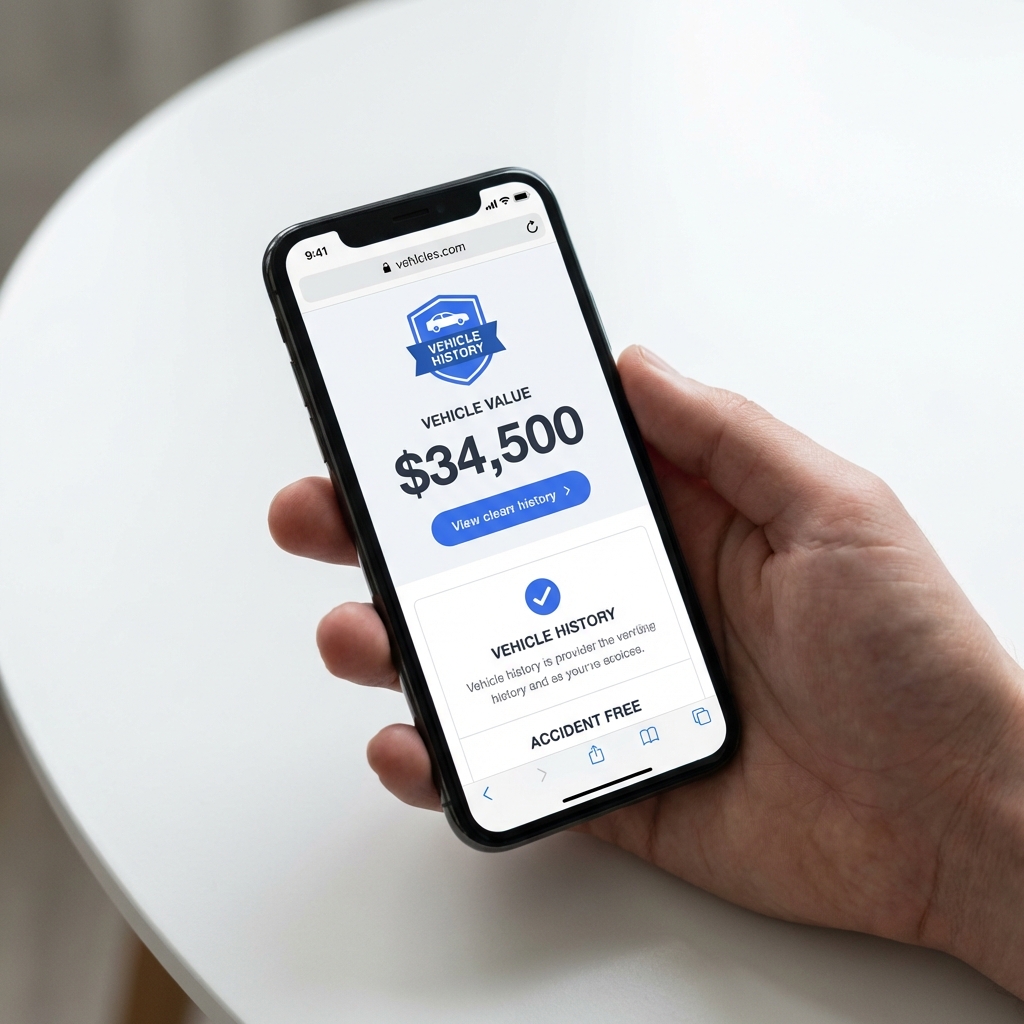
Sites like CARFAX Deals link lists to verified history reports and price-labels such as “Great Deal” or “Fair Deal.” These labels are helpful because they combine the numeric price with context - mileage, accident history, and service records. When a listing shows a “Great Deal” and a clean history, that’s worth attention. When a “Great Deal” accompanies a salvage title or repeated accident reports, it’s a warning flag.
How to use labels in negotiation
If a listing shows a price that’s above market, but the vehicle history is spotless and service records are current, you can reasonably offer market value plus a small premium. If the history shows an accident, use repair estimates and potential future issues to justify a lower offer.
Inspecting in person: what the numbers don’t tell you
Online tools narrow the field, but the physical inspection closes the deal. Bring your checklist: check body gaps, smell the cabin, test electronics, and inspect tires and fluid levels. Small things visible in person are often missed in pictures and may not show up in history reports, but they affect value - and therefore how you use online price data.
The test drive checklist
Listen for odd noises, test acceleration and braking, and check how the transmission behaves. If the online price seems low, a test drive combined with a vehicle history report will usually explain why.
Compare the listing’s price to three sources: a price guide (for baseline), local market listings (what people are asking now), and a vehicle-history-backed marketplace. If the price is much lower than all three, ask for VIN and a history report before getting excited.
How to combine inspection findings with online valuations
After inspection, adjust your expected price. Minor cosmetic issues are easy to fix and often don’t warrant a large price drop. But suspension problems, transmission slip, or evidence of flood damage should dramatically lower your offer or prompt you to walk away. Use the site valuations as starting points - your inspection findings are the reality check.
Negotiation: using data to stay calm and fair
Negotiation is best when it’s rooted in facts. Bring printouts or screenshots from the sites you used and the vehicle history report. Highlight comparable listings and any inspection notes. A calm, evidence-based approach often works better than emotion. If you need to walk away, do it - good deals aren’t worth bad surprises.
Example negotiation script
“I like the car, but my research - including current market listings and the vehicle history - suggests a fair price is $X. The inspection found [issue], which I estimate will cost $Y to fix. With that in mind, my offer is $Z.”
This script centers data and avoids personal pressure.
Paperwork and titles: where mistakes become costly
Once price is agreed, document everything. Verify the title name matches the seller. Check for liens. Ensure the VIN matches across title, history reports, and the car itself. Use a bill of sale even in private transactions to document the terms. If a seller resists paperwork, think twice - that’s a common sign of trouble.
State-level requirements
Every state has rules for title transfer, emissions, and release forms. Check your local DMV website ahead of time so you’re not surprised by fees or required inspections at the time of transfer.
Should you buy from a dealer or a private seller?
Both paths work. Dealers may offer limited warranties and handle paperwork. Private sellers often offer lower prices but fewer protections. If you find a vehicle on a marketplace that pairs price with history (again, sites like CARFAX Deals do this well), you get the price transparency of private listings with the reliability of verified histories - a strong middle ground.
Financing, insurance and ongoing costs
Before any final signature, confirm financing and insurance costs. A car’s value affects loan terms and monthly payments; insurance can vary by model and safety equipment. Compare quotes for the same make and model. A slightly higher priced car with better safety and lower repair costs may be cheaper to own overall.
Fuel and maintenance math
Consider long-term costs: does the car require premium fuel? Are parts expensive or hard to find? Use online ownership-cost calculators to estimate these expenses and fold them into your decision.
When lowest price is not the best deal
Bargain-hunting is natural, but the cheapest listing often carries greater risk. A low price that comes with a clean vehicle history and documented recent maintenance can be a true bargain. But if low price coexists with patchy records, inconsistent mileage, or evasive sellers, the apparent savings may vanish after repairs.
Using the best website to check car value for trade-ins and selling
These same tools help when you’re selling or trading in. Know the trade-in value, the private-party value, and what local buyers pay. If you’re trading in, expect lower offers than private sales. If you want top dollar, prepare the car, fix minor issues, and present maintenance records alongside a clean vehicle history to justify a higher asking price.
Red flags that online checks uncover
Watch for salvage titles, open recalls, odometer inconsistencies, and repeated accident reports. Many of these show up in vehicle history reports. If an online check reveals one of these, treat it seriously: ask for documentation, independent inspection, or walk away.
Timing your purchase
Season, month, and market conditions affect price. Late summer and fall often have good deals on family vehicles as people upgrade. Dealers may be more flexible at month-end when they’re meeting quotas. But don’t let timing make you skip inspection or ignore red flags.
Checklist: before you buy
Run at least one price guide and one market listing check.
Pull a vehicle history report or use a marketplace that includes one.
Inspect in daylight and test drive on mixed roads.
Schedule a pre-purchase inspection with a mechanic.
Confirm title, VIN, and service records.
Get insurance quotes and finalize financing.
A final word about trust
Online valuations answer the “what” and “how much,” but trust comes from consistent signals: matching VINs, clean history reports, and a seller willing to share records and allow inspection. When those align, you’ll know you’ve found a fair price backed by data.
Common buyer mistakes and how to avoid them
Buyer mistakes include relying on photos alone, skipping a pre-purchase inspection, or ignoring recalls. Use online checks as tools, not replacements for in-person scrutiny. When you combine a reliable price check with a verified vehicle history, you roughly halve your chance of a major surprise.
FAQ quick answers
How important is the vehicle history report? Very - it reveals accidents, title issues, and maintenance records that affect value and safety.
Should I always get a pre-purchase inspection? Yes, if you can afford it. It’s often the single best investment to avoid huge future bills.
Is it better to buy from a dealer or private seller? Both can be good; dealers offer paperwork and warranties, private sellers often offer lower prices. Vehicle history-backed marketplaces blend transparency into dealer inventory to help buyers.
Resources and links
Use multiple sites to avoid bias: compare price guides, local listings, and marketplaces that add verified histories. If you want a single place to start that combines history with pricing context, try CARFAX Deals for curated listings and clear deal labels. Also see the site's how-to guide for tips on using reports and listings effectively.
Check price and history together — run a CARFAX Deals report
Ready to check history and price in one place? Run a CARFAX Deals report to see vehicle history and price labels together — it’s a fast way to compare listings with confidence. Visit run a CARFAX report on CARFAX Deals to start.
When you ask what is the best website to check car value, the answer is: a combination approach. Use price guides for baseline numbers, local listings to see the market, and a vehicle-history-backed marketplace like CARFAX Deals to combine price with risk signals. That trio reduces surprises and helps you make a calm, confident purchase.
Buy with patience, gather the facts, and let the data guide your offer. When the numbers, history, and inspection agree, you can sign with confidence.
A vehicle history report is very important. It reveals previous accidents, title issues, odometer inconsistencies, and recorded service history that can explain price differences and uncover hidden problems. Use it alongside an in-person inspection—reports narrow risk but don’t replace a mechanic’s check.
Yes, whenever possible. A pre-purchase inspection by a trusted mechanic can uncover frame damage, transmission problems, or signs of flood damage that aren’t visible in photos or always recorded in history reports. The small inspection fee often saves thousands in future repairs.
Both have advantages. Dealers may offer limited warranties, handle paperwork, and sometimes provide inspected vehicles. Private sellers often list lower prices but provide fewer protections. Marketplaces like CARFAX Deals provide a helpful middle ground by pairing dealer inventory with verified vehicle histories and transparent pricing labels.
If you want a quick, reliable read on value and history, combine a price guide, local listings, and a CARFAX Deals vehicle history — that mix answers the question and keeps surprises low; happy, confident driving!


 Blog
Blog