This guide explains the most commonly reported issues for the Infiniti Q50 and what they mean for buyers. It covers steering, transmission, engine, electronics and suspension concerns, with practical checks and a step-by-step pre-purchase plan. Use a vehicle history report and official recall pages to verify a specific listing before you buy.
A step-by-step workflow for estimating a truck's market value that centers on comparing consumer valuation tools, adjusting for mileage and condition, and checking wholesale market signals. The guide explains private-party, trade-in and dealer retail values and shows how a vehicle history report and pricing insights can change an asking price.
This guide helps research oriented buyers evaluate suv used cars for sale under $25,000 by combining safety ratings, reliability data, local pricing context, and vehicle history checks. It outlines a simple framework, a pre visit checklist, and a decision scoring worksheet so you can compare finalists before contacting a dealer. Use the steps here to narrow candidates and confirm risk signals with a vehicle history report and a pre purchase inspection.
When searching suv used cars for sale, prioritize model year, trim and powertrain before choosing a make or model. This guide explains how safety ratings, dependability studies and local pricing insights combine to produce a short list you can verify with a vehicle history report. It also provides a stepwise checklist you can use before contacting a dealer.
This article helps research-oriented buyers understand the Infiniti Q50's commonly reported problem areas and how to evaluate a used listing. It is designed for first-time buyers and families who want clear, practical checks and a step-by-step pre-purchase plan.
We summarize the systems that most frequently appear in owner reports, explain what those clusters mean for inspection and budgeting, and show how to use a vehicle history report and NHTSA recall checks to reduce uncertainty when evaluating a specific car.
Infiniti Q50 complaints tend to cluster in steering, transmission, engine performance, electronics and suspension.
Check NHTSA recall pages and a VIN-based vehicle history report for the exact VIN before you buy.
Prioritize steering and transmission checks on the test drive and get a mechanic's inspection for persistent faults.
Quick summary: what buyers mean by common problems with the Q50
At-a-glance list of frequently reported systems (infiniti q50 for sale)
When buyers ask about the common problems with the Infiniti Q50 they are usually referring to a small set of systems that show up repeatedly in owner reports and reliability summaries: steering, transmission, engine performance, electronics and suspension components. These clusters come from compiled owner complaints and repair resources and help focus pre-purchase checks CarComplaints Q50 page.
Official recall pages remain the source to confirm safety recalls and documented dealer remedies for a specific model year, which is why a recall check should be part of any used-car workflow NHTSA recall pages.
Run Vehicle History Report to reduce uncertainty
Consider running a vehicle history report early in your search to reduce uncertainty about title, ownership and reported service events.
Owner-aggregated sites and repair references are useful to identify high-volume repeat complaints, but they do not replace a vehicle-specific service history or VIN-based report; use them to prioritize inspections and questions for the seller RepairPal Q50 overview.
How Q50 issues cluster by system and what that pattern means
System-by-system breakdown
The most frequent problem groups reported across owner and reliability databases are steering, transmission, engine performance, electronics/infotainment, and suspension or wheel-bearing wear, and each group tends to show distinct symptoms that buyers can check on a viewing CarComplaints Q50 page.
Clustering matters because repeated reports in owner databases can indicate common failure modes rather than isolated incidents; these patterns guide what to inspect first and which tests to run during a test drive RepairPal Q50 overview.
Clustering matters because repeated reports in owner databases can indicate common failure modes rather than isolated incidents; these patterns guide what to inspect first and which tests to run during a test drive RepairPal Q50 overview.
Why clustering matters for inspection and budgeting
Seeing clusters lets you prioritize steering and transmission checks, and to budget for possible mechanical work or software updates based on what owners report most often Edmunds Q50 review.
Keep in mind that frequency and severity vary by model year, engine and transmission pairing, and how well the car was maintained, so a report of common issues does not predict any single car's condition.
Open questions that depend on individual history
Open questions include how often specific engine and transmission pairings need major repairs and how prior maintenance changes long-term outcomes; those answers depend on the vehicle's service history and documented repairs.
Steering and the Direct Adaptive Steering history and symptoms
What Direct Adaptive Steering is and why it drew complaints
Infiniti used a Direct Adaptive Steering system on early Q50 models that altered steering feedback through electronic control, and that system generated concentrated owner concerns which led to dealer software updates and service actions in some model years MotorTrend Direct Adaptive Steering analysis. See the manufacturer service campaign details SB-10054744-9300 and reporting about the recall in industry press Autoweek.
The most common problems cluster around steering, transmission, engine performance, electronics and suspension; use a VIN-based vehicle history report, check NHTSA recalls, review service records, and focus your test drive on steering and transmission to reduce buying risk.
Common symptoms to check on a test drive
Typical steering-related symptoms owners report include an unusual or inconsistent steering feel, reduced road feedback, or steering-related warning messages that appear on the dash, all of which are reasons to check service records and recall history CarComplaints Q50 page.
When driving, pay attention to how the wheel responds at different speeds and over varied surfaces; note any intermittent loss of feedback, sudden changes in effort, or persistent warning lights. If the seller mentions steering module or software work, ask for written documentation.
Typical dealer responses and software or hardware fixes
Dealer remedies ranged from software updates to component service depending on symptoms and the model year, which is why checking NHTSA recall and TSB records for the exact VIN or model year matters before you buy NHTSA recall pages and the associated recall bulletin RCONL-16V430-9710.
If steering feel is inconsistent during your test drive, request the vehicle's service records showing any steering-related dealer visits and consider a mechanic inspection focused on steering modules and linkages.
Transmission issues: symptoms, model-year patterns and what to listen for
Owners report transmission symptoms across multiple Q50 model years, including hesitation on takeoff, shuddering during shifts and delayed or harsh gear engagement; these reports suggest both software and mechanical causes appear in the dataset RepairPal Q50 overview.
When a transmission behaves inconsistently, note whether faults are intermittent or persistent; intermittent software-related behavior can look like mechanical trouble but will often be diagnosed differently by a shop.
When a transmission behaves inconsistently, note whether faults are intermittent or persistent; intermittent software-related behavior can look like mechanical trouble but will often be diagnosed differently by a shop.
How to test these on a drive
Test for hesitation and shudder by accelerating smoothly at low speed, then again on a steady highway merge, and watch for delayed shifts or shudder under load. Also listen for clunks or whining that could indicate mechanical wear rather than an electronic control issue.
If you encounter these symptoms, ask the seller about any transmission service history and whether software updates or fluid changes were performed, and plan for a professional evaluation before purchase.
When a transmission problem is likely mechanical versus software
Software fixes and module resets can resolve some shift complaints, but persistent shudder or repeated hard shifts are more likely to require mechanical intervention; owner and repair summaries note that mechanical transmission repairs have historically been more expensive than software updates RepairPal Q50 overview.
When in doubt, obtain a professional inspection and a written estimate for any suspected transmission work before finalizing an offer.
Engine performance problems on some V6 Q50s: what to expect
Common engine symptoms: misfires, carbon buildup, oil consumption
Some V6 Q50 variants have owner-reported engine issues, including misfires, carbon buildup on intake surfaces and higher than expected oil consumption; these findings show up in aggregated reliability accounts and owner reports RepairPal Q50 overview.
Symptoms can range from rough idling and reduced power to visible smoke or oil loss between services; the underlying cause and required repair vary with maintenance history and severity.
Maintenance steps that influence long term reliability
Regular intake cleaning, scheduled tune-ups and adherence to recommended maintenance intervals tend to reduce the likelihood of severe build-up or ignition problems, and reviewing past service records helps judge how well those steps were followed Edmunds Q50 review.
Ask for records showing intake service, spark plug replacement and oil-change frequency; if those records are missing and the car shows symptoms, budget for diagnostic tests such as compression checks or an inspection of the intake system.
If a listing shows engine-related codes, misfires or evidence of oil consumption, request detailed service entries that note any intake cleanings, valve work or oil consumption checks, and consider a pre-purchase compression or leak-down test.
Where records are unclear, a trusted mechanic can help estimate the likely next steps and costs based on the car's current symptoms and maintenance history.
Electronics and infotainment faults: common signs and typical fixes
Frequent owner-reported electronic faults
Owners commonly report Bluetooth dropouts, navigation glitches and intermittent warning lights, which often lead to dealer diagnoses that favor software or module repairs rather than immediate part replacement CarComplaints Q50 page.
Because many faults are software-related, ask whether the vehicle has received recent infotainment or module updates and whether any diagnostic trouble codes were stored and addressed.
Because many faults are software-related, ask whether the vehicle has received recent infotainment or module updates and whether any diagnostic trouble codes were stored and addressed.
Software and module fixes versus hardware replacement
Service visits frequently identify software updates or module reprogramming as the first step, but persistent faults sometimes require module replacement or wiring repairs; verifying work history helps clarify what was done and when Consumer Reports Q50 overview.
Documented module flashes or software updates reduce uncertainty, while repeated unexplained faults, especially across multiple systems, are a reason to request a mechanic's inspection.
What to test when inspecting a car
On a viewing, test Bluetooth calling, streaming, navigation routes and each dashboard warning light function; reboot the infotainment system if permitted and confirm the seller lists any software updates in the service history.
If features fail intermittently during your visit, get the seller to document when the issue started and any dealer action taken, and weigh that against the vehicle's pricing context.
Suspension, wheel bearings and wear items: what owners report
Symptoms of suspension and wheel bearing wear
Owners report noises, vibration and uneven tire wear that are commonly linked to worn suspension components or wheel bearings, and these are typical wear items to inspect on a used car RepairPal Q50 overview.
Common signs include clunks over bumps, humming or growling at speed that changes with steering, and visible uneven tread wear on one side of the tire.
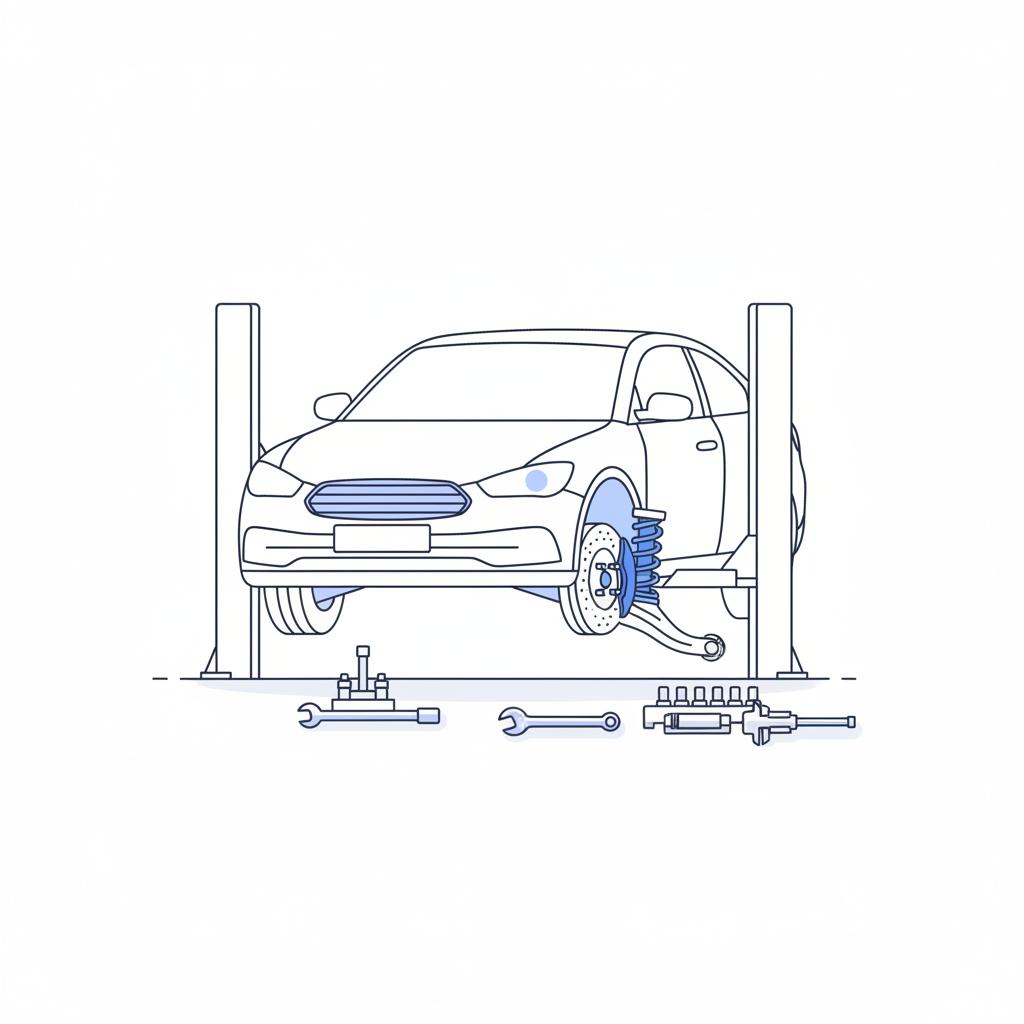
quick on-site suspension check
Use as a rapid screening tool
Inspection tips for bumps, rattles and uneven tire wear
Bring a flashlight and look for leaking struts, uneven tire wear and visibly loose components; during a short drive, note whether noise changes with steering angle or speed, which can point to wheel bearings or control-arm issues Edmunds Q50 review.
If you find signs of wear or the service history is incomplete, a professional suspension inspection helps identify whether bushings, bearings or struts are near the end of their service life.
When a professional inspection is warranted
Request a mechanic's inspection when you see clunks, ongoing vibration or evidence of uneven tire wear, or if the seller cannot produce detailed service records for recent suspension work.
A written inspection report can be used to negotiate or to decide whether the car is a good candidate for purchase given local repair options and pricing context.
Pre-purchase checklist: recalls, TSBs, VIN and vehicle history report checks
How to check NHTSA recalls and official remedies
Always check NHTSA recall pages for the exact model year and VIN to verify if any open recalls or documented dealer remedies apply to the vehicle you are considering NHTSA recall pages.
Also search for manufacturer TSBs that describe dealer service procedures, which can explain common fixes such as steering module updates or transmission reprogramming.
What to look for in a VIN or vehicle history report
Run a vehicle history report to confirm title status, ownership history, reported service events and any reported damage or insurance activity, and match those entries to the service records the seller provides Run CarFax Report or use our VIN report page VIN report.
Pay attention to repeated entries for steering or transmission work and to whether repairs were done at a dealer, as that can affect how confidently you interpret the history.
How service records and TSBs change buying risk
Documented dealer repairs for steering, transmission or engine issues lower uncertainty compared with undocumented repairs, while missing records increase the value of a professional inspection and careful pricing adjustments RepairPal Q50 overview.
Use recalls and TSB findings together with a VIN report to assess whether a listed price fairly reflects the car's repair history and remaining risk.
Test drive checklist focused on steering, transmission and electronics
Drive route and maneuvers to reveal issues
Plan a test drive that includes low-speed maneuvers, a highway stretch and a patch of uneven pavement to surface steering feel issues, shift quality and suspension noises RepairPal Q50 overview.
Start with a short walk-around, check tire pressures and then drive at city speeds, make a firm acceleration, and finally use a highway merge to evaluate transmission behavior under steady load.
Questions to ask while testing
Ask the seller when steering or transmission symptoms first appeared, whether the work was handled by a dealer and whether any software updates were performed; request written records for any described repairs NHTSA recall pages.
Note the timing and conditions of any symptom you find, and do not sign paperwork until you have time to review documentation and, if needed, schedule a mechanic's inspection.
When to end the test drive and request a mechanic check
End the test drive and ask for a mechanic inspection if you encounter steering that loses feedback, repeated harsh shifts, persistent engine misfires, or multiple unexplained warning lights.
A professional diagnostic can separate software issues from mechanical faults and provide a written estimate you can use in negotiations.
Interpreting vehicle history reports and pricing insights for value assessment
How history reports interact with price analysis labels
Vehicle history reports confirm title status and reported service events, while price analysis labels provide local market context to judge whether a listing accounts for documented repairs and mileage RepairPal Q50 overview.
Use both sources together to compare similar listings and to set a realistic offer that reflects any outstanding risk documented in the history report.
Red flags that affect comparative pricing
Red flags include missing service records, open recalls, or multiple entries for the same major repair without clear completion notes, and these items tend to push fair-market price lower relative to comparable clean-history listings NHTSA recall pages.
Balance a reported repair against the listing price: a documented, dealer-performed repair is less risky than an undocumented claim of work, but both should factor into your offer calculation.
How to weigh a reported repair against pricing context
If a history report shows a steering or transmission repair, confirm whether it was dealer-serviced and whether any follow-up entries exist; use pricing insights to decide if the reported repair is reflected in the asking price Run CarFax Report.
When repairs are documented, you can often treat them as known costs; when they are not, factor in a contingency and a stronger negotiation posture.
Decision criteria: when the documented risk makes a Q50 a poor candidate
Service history thresholds that reduce risk
Positive indicators include consistent service records, evidence of completed dealer repairs for steering or transmission faults, and no open recalls, all of which lower uncertainty about future repair needs RepairPal Q50 overview.
Also prefer listings with single-owner history and regular oil and maintenance entries, as those data points correlate with lower immediate repair risk.
Combinations of issues that raise concern
Combinations that tend to raise concern include unresolved steering complaints together with new transmission symptoms and limited service documentation, a pattern that signals elevated short-term repair risk Edmunds Q50 review.
If you see multiple system complaints without supporting dealer records, consider walking away or revising your offer to reflect the added risk and inspection cost.
Owner profile and mileage considerations
High mileage and frequent ownership transfers increase the importance of recent service records and a thorough inspection, while a single-owner car with detailed maintenance entries usually presents lower uncertainty.
Always match the car's mileage and ownership history against comparable local listings to understand whether the asking price accounts for the vehicle's condition.
Budgeting and typical repair expectations for likely Q50 issues
How to build a contingency budget
Build a contingency that reflects the systems most often mentioned by owners: steering and transmission should be prioritized, electronics and minor engine work next, and suspension or wear items after that RepairPal Q50 overview.
Decide what level of out-of-pocket repair risk you can accept and subtract that from the initial offer to keep room for unexpected work.
Repair types that tend to be cheaper versus costlier
Software updates and module reflashes tend to be cheaper than mechanical repairs, while persistent transmission mechanical work and engine cleaning or repairs can be costlier in practice according to aggregated repair sources RepairPal Q50 overview.
When a listing indicates only software updates in the service history, confirm those entries and ask whether the updates resolved the issue completely.
When to get a professional estimate before purchase
Obtain written repair estimates when the test drive shows steering inconsistency, repeated transmission faults, or evidence of engine oil consumption; a professional quote helps set a fair offer or decide to walk away.
Use the estimate along with vehicle history and pricing context to determine whether the car fits your budget and risk tolerance.
Seller red flags and the right questions to ask
Listing language and missing documents that should raise caution
Be wary of vague listings that omit service records, use evasive language about repairs, or show unclear ownership history, as these features reduce the reliability of the listing's condition claims NHTSA recall pages.
Missing or incomplete service records are one of the clearest red flags and warrant a stronger inspection requirement or a lower offer.
Direct questions to ask a dealer or private seller about repairs
Ask exact questions such as: When did steering symptoms start? Was transmission work performed at a dealer? Are there any open recalls on this VIN? Request service invoices and dates for any reported repairs RepairPal Q50 overview.
Insist on written confirmation for any repair claims and verify them against the VIN-based history report before proceeding.
How to confirm answers using records and inspections
Confirm seller statements by matching service invoices, dealer stamps and VIN history entries; if a seller claims a software update fixed a problem, verify the update entry and the subsequent absence of related repair notes.
If documentation is inconsistent, require a pre-purchase inspection and factor the inspection findings into your offer decision.
Putting it together: step by step plan for buying a used Q50
Ordered checklist from listing to purchase
Start by running a vehicle history report and checking NHTSA recall pages for the VIN, then request full service records and look for any steering, transmission or engine repairs before scheduling a test drive Run CarFax Report and follow our guide how-to guide.
During the process, use pricing insights to compare listings, get a mechanic inspection when you find symptoms or missing records, and ask for written estimates to inform your offer.
When to pause and get a mechanic involved
Pause and request a mechanic inspection if you find steering feedback issues, repeated transmission faults, engine misfires or multiple unexplained system warnings during the test drive.
Stop the purchase sequence and reassess if inspection findings indicate imminent major repairs or if the seller cannot produce clear documentation for reported fixes.
How to use pricing context to set an offer
Let documented repairs, open recalls and the mechanic's estimate guide your offer adjustments; if repairs are documented and dealer-performed, the car may justify a higher offer than an otherwise similar vehicle with undocumented issues.
Always keep a contingency buffer to account for the chance of additional issues revealed after purchase.
Common mistakes buyers make and how to avoid them
Rushing the test drive or skipping records
Skipping VIN checks or a thorough test drive increases risk because many Q50 issues are revealed only during varied driving conditions or in the service history entries RepairPal Q50 overview.
Take time to confirm service records and run a VIN report before committing to an offer.
Misinterpreting software fixes as full repairs
Do not assume a software reset eliminates underlying mechanical problems; if symptoms recur after a software update, get a mechanic's diagnosis to determine whether hardware work is needed CarComplaints Q50 page.
Persistent or recurring faults merit written diagnostics and an estimate for any needed parts or labor.
Ignoring combinations of minor issues
Treat combinations of minor complaints, such as mild steering oddities plus intermittent transmission hesitation, as more significant than isolated minor notes, and require documentation or inspection in such cases.
When multiple systems show intermittent faults, a professional evaluation is the safest way to separate inexpensive fixes from signs of deeper issues.
Final takeaways and next steps for confident shopping
Three quick actions to reduce buying risk
Run a VIN-based vehicle history report, confirm NHTSA recalls for the VIN, and request complete service records that document any steering or transmission work NHTSA recall pages.
These three steps address the most commonly reported Q50 issues and let you compare listings with clearer context.
How to prioritize inspections for the Q50
Prioritize steering and transmission checks during the test drive, verify electronic functions, and inspect suspension and tire wear during the walk-around to spot likely repairs.
If any primary system shows symptoms, schedule a mechanic's inspection and get a written estimate before finalizing an offer.
Parting guidance on using history reports and pricing context
Vehicle history reports and pricing insights are decision support tools that help you compare listings, but they do not guarantee future reliability; use them to set expectations, negotiate fairly and plan a contingency budget Run CarFax Report and read related posts on our blog.
When records show dealer-performed repairs for the main problem areas, the documented history reduces uncertainty compared with undocumented claims, so weigh that evidence when you make an offer.
Owners and reliability summaries most frequently note steering (Direct Adaptive Steering on early models), transmission hesitation or shudder, engine performance issues on some V6s, electronics or infotainment faults, and suspension or wheel bearing wear.
Yes. A VIN-based vehicle history report helps verify title status, ownership history and reported service events, which reduces uncertainty before you request a test drive or inspection.
Get a mechanic inspection if you find steering inconsistency, repeated transmission faults, engine misfires, multiple warning lights, or if service records are missing or incomplete.
Use the ordered checklist in this guide to move from listing review to offer with more confidence. Running a VIN-based vehicle history report and confirming any recall or dealer service entries are high-impact steps before you commit to a price.
When in doubt, get a mechanic's inspection and a written estimate to decide whether to proceed, negotiate, or walk away based on documented risk and local pricing context.


 Blog
Blog