Are R34 Skylines hard to find?, Practical guide to searching and verifying
The nissan skyline r34 for sale remains a relatively rare sight in North America because most R34s were produced for the Japan domestic market and import rules limited early availability. Eligibility under the 25-year exemption began to open for 1999 models in 2024, which increased legal import activity but did not instantly create large supply. This guide explains where genuine R34s typically appear, how to verify listings with a vehicle history report and paperwork checks, and what extra costs to budget for.
This guide explains which tacoma trucks for sale show the strongest reliability and safety signals to watch out for, and why mid-2010s and many pre-2016 Tacomas appear most often in complaint and recall records. The article shows how to use vehicle history reports, recall checks, and a focused inspection to reduce risk when evaluating a used Tacoma.
This article helps buyers searching tacoma trucks for sale understand which Tacoma engine tends to be most reliable. It summarizes reliability ratings, owner-complaint clusters, and maintenance-cost differences between the 2.7L I4 and the 3.5L V6, and gives actionable checks to reduce engine-related risk.
Audi reliability varies significantly by model, model year and powertrain, so the most reliable Audi for one buyer is not the same for another. This guide shows research-oriented used car buyers how to compare models using industry dependability studies, owner-reported trends, and per-VIN vehicle history reports. It focuses on checklists, inspection priorities and scenario-based recommendations to reduce risk when shopping a used Audi.
Many buyers ask whether R34 Skylines are easy to find. Short answer: they are relatively rare in North America because most were produced for the Japan domestic market and import rules limited earlier availability.
This guide explains what changed when certain model years became eligible for import, where genuine cars usually show up for sale, and the verification steps you should follow before making a decision. It is written for research-first buyers who want practical, non-hype guidance.
R34 Skylines are rare in North America because most were Japan-market models and import rules limited earlier availability.
1999 R34 models became widely eligible for U.S. import in 2024 under the 25-year exemption, which increased legal import activity but not immediate supply.
Verify any listing with a VIN vehicle history report, import paperwork, and a professional pre-purchase inspection to reduce risk.
Short answer: are R34 Skylines hard to find?
Quick verdict
Short answer: yes, R34 Skylines remain relatively rare in North America. Most were built for the Japan domestic market, and federal safety and emissions rules limited earlier legal importation without compliance work or the 25-year exemption.
The limited original supply and the administrative cost of lawful import tend to keep the number of legitimately documented cars small compared with mass-market models. This affects how often you will see verified listings described as nissan skyline r34 for sale.
R34 Skylines remain relatively rare because most were built for the Japan domestic market and federal safety and emissions rules limited early legal imports; the 25-year exemption opened eligibility for some model years but did not instantly create large supply.
What this article will cover
This article summarizes why R34s are scarce, how the 25-year exemption and customs paperwork work in practice, where genuine cars tend to appear, how values vary, and a step-by-step verification checklist you can follow before contacting a seller. It also flags common paperwork pitfalls and gives a decision framework so you can judge whether pursuing an R34 fits your budget and tolerance for import complexity.
Read on for practical steps, inspection priorities, and suggested next actions that reduce risk when evaluating a niche import listing.
Why R34 Skylines stayed rare in North America
Japan-only model history
The R34 generation was largely produced for the Japan domestic market, so relatively few left Japan under normal dealer export channels. That limited initial supply for North American buyers and created a long period where most R34s were not legally registerable in the U.S. without special procedures.
Federal safety and emissions constraints
Imported vehicles that did not originally meet U.S. Federal Motor Vehicle Safety Standards and EPA emissions rules must either be modified to comply or qualify under the 25-year exemption; this regulatory framework made imports more complex and costly for many prospective R34 buyers, which reduced the number of cars that appear in verified, documented listings NHTSA importing vehicles guide.
Even after a car becomes eligible based on age, buyers often face paperwork, conversion, and registration steps that add time and expense before a car appears as a clean, documented listing for sale.
How the 25-year rule and import paperwork actually work
25-year exemption basics
The 25-year exemption means a vehicle that is 25 years old or older can be imported without meeting contemporary FMVSS or EPA emission standards, which opened access to certain R34 model years beginning in 2024; for example, 1999 models became broadly eligible as that anniversary arrived MotorTrend on 1999 R34 eligibility.
Eligibility under the exemption increases legal import activity, but it does not instantly create many well-documented cars for sale because owners and importers must still complete customs filings, transport, and state registration procedures before a vehicle is market-ready. (see detailed discussion at MotoIQ)
Import logistics: customs and registration
When you or a broker bring a car into the U.S., expect Customs filing and declarations with U.S. Customs and Border Protection, plus any paperwork needed for state registration; these steps document title status and import declarations and are part of the landed cost that affects a listing's final price CBP guidance on importing vehicles.
Buyers should also factor in state DMV requirements, which vary by state and can include additional inspections, converted compliance proof, or nonstandard fees that affect whether the car can be titled and registered locally.
Where buyers typically find genuine R34 Skylines for sale
Specialist JDM importers and brokers
Most genuine R34s for sale appear through specialist JDM importers and brokers who handle import logistics, or through small dealers that focus on curated import stock. These channels tend to present better documentation than mass-market classifieds because they rely on provenance and paperwork to complete sales.
Enthusiast auction platforms and curated dealers
Enthusiast auction platforms and curated specialty dealers are common places where well-documented R34s trade, and auction records can help you set pricing expectations and spot unusually low or high offers Bring a Trailer R34 search results.
Why general marketplaces often show fewer verified examples
General mass-market marketplaces can list many cars, but they often show fewer verified R34 examples because sellers there may lack full import paperwork or proven provenance. For research-first buyers, focusing on channels that provide clear title status and service history typically reduces the risk of surprises later.
How much do R34 Skylines cost and what drives price variation
Auction signals and valuation services
Specialist auction results and valuation analyses indicate that well-documented R34 GT-R examples regularly command six-figure prices at auction, with wide price variation based on condition and provenance; these market signals help explain why asking prices for the most desirable cars can be substantially higher than generic listings Hagerty market analysis on R34 values.
Condition, provenance, and documented history
Price differences are driven by trim (for example GT-R versus non-GT-R), originality, mileage checks, accident and service history, and clear import/title documentation. A well-documented service history and verifiable ownership trail tend to preserve value, while inconsistent records and evidence of major repairs usually reduce market worth.
When you evaluate a listing, compare pricing context across similar auctions and dealer records to set a realistic budget and to spot outliers that may signal undisclosed problems.
Step-by-step verification checklist before you contact a seller
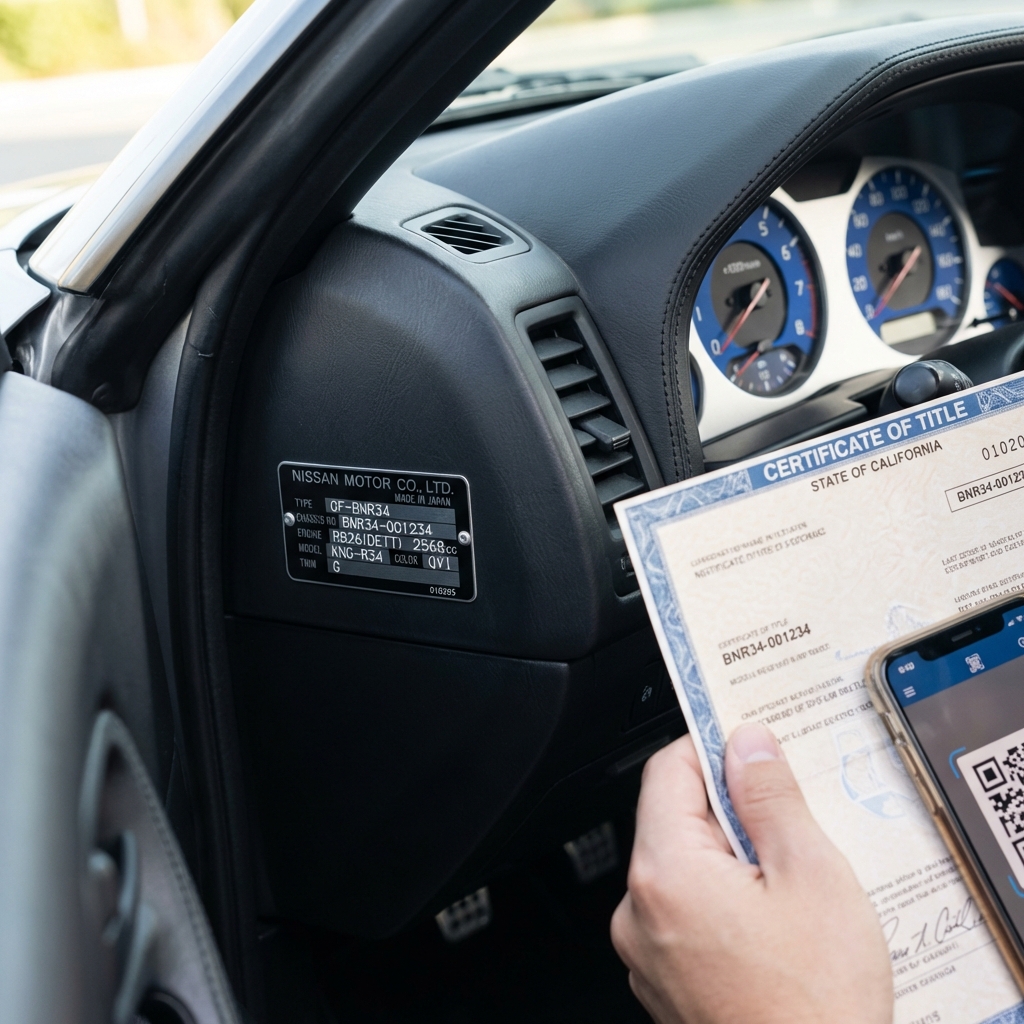
Confirm that import declarations, CBP entry forms, and state title paperwork are present and consistent. Look for matching VINs on import paperwork and title records and verify any reported conversions or compliance work through documented invoices.
Order a VIN vehicle history report and verify essential documents
Use the exact VIN shown on the listing
When to arrange a pre-purchase inspection
Arrange a professional pre-purchase inspection when the VIN and paperwork look consistent and the seller allows an independent review. An inspector familiar with JDM imports can check for repair evidence, odometer consistency, and whether any compliance conversion was done correctly, which are items not always visible in photos or reports Hagerty on provenance and inspection importance.
Document all findings and ask the seller for supporting invoices and the names of any shops that performed conversion or compliance work.
Paperwork and registration pitfalls to watch for
Common title and import paperwork issues
Common paperwork problems include missing CBP filings, unclear title status, or inconsistent ownership records that can delay or block registration. Verify that the title status matches the import declaration and that the VIN is consistent across all documents before proceeding with a deposit.
State registration hurdles and fees
State DMVs handle registration and titling differently; some require additional inspections, emissions testing, or fees for imported or converted vehicles. These variations can materially affect the time and cost to put an R34 on the road.
Run a vehicle history report on the Run Vehicle History Report flow
Check CBP entry records and consult your state DMV early to understand registration steps and possible fees for an imported or converted vehicle.
Before you commit funds, confirm with the relevant state agency whether the car will qualify for a standard title and what evidence they require to complete registration.
Pre-purchase inspection checklist for R34 Skylines
Structural and accident repair checks
Have an inspector examine frame rails, suspension mounts, and inner fender areas for signs of repair or welding that indicate structural damage. Photos can miss subtle frame alignment issues that will show during a hands-on inspection.
Odometer and mechanical inspection points
Check odometer consistency across service records and the VIN history report. Inspect engine and transmission for obvious leaks, abnormal noises, or repair signs. A compression test and a drivetrain road test are standard steps an inspector will recommend for a high-value import.
Signs of illicit modification or incorrect compliance work
Look for mismatched wiring, nonstandard emissions equipment, or aftermarket filler panels that can signal incomplete compliance work. If the vehicle was modified to meet U.S. requirements, request invoices and mechanic names so you can verify the quality of the conversion.
Common scams, misrepresentations, and red flags in R34 listings
Photos and cloning issues
Missing or inconsistent VINs in photos, or images that appear to be recycled from other ads, are red flags. VIN cloning, where a stolen or problematic VIN is applied to a different car, is a documented risk in niche imports; cross-check the VIN with a vehicle history report and with paperwork before moving forward Bring a Trailer listings show how provenance affects outcomes.
Vague or missing import documentation
Listings that lack clear import paperwork, CBP entry, or state title details require extra skepticism. Ask for scanned copies of the CBP entry, bill of lading, and the state title, and verify that VINs match on all documents.
Too-good-to-be-true pricing
Pricing well below comparable auction results or recent validated sales often indicates undisclosed damage, incomplete paperwork, or other issues that will add cost later. Use auction records and pricing analyses to benchmark offers before assuming a low price is a genuine opportunity Hagerty on valuation variance.
Budgeting: total cost to own an imported R34
Purchase price versus total landed cost
Estimate landed cost by adding purchase price, shipping, customs paperwork, import duties where applicable, and any local registration fees. Customs and CBP filings plus transportation can add materially to the out-the-door price and should be included early in your budget planning NHTSA importing procedures and considerations.
Contingency budgeting for repairs and compliance
Set aside a contingency for inspection-revealed repairs, emissions or safety compliance work if needed, and any dealer or broker fees. For many buyers, a realistic contingency allows them to handle surprise mechanical issues without derailing the purchase.
Decision framework: is buying an R34 right for you?
Checklist for buyer readiness
Use a short readiness checklist: confirm you have budget for total landed cost, access to inspection resources, willingness to manage paperwork, and a plan for long-term ownership or storage. If you cannot satisfy these points, an imported specialty car may add more risk than enjoyment.
When to consider alternatives
If the paperwork or inspection timeline is unacceptable, consider alternatives with stronger local support or easier registration. For many buyers, a similar performance car with local parts support and simpler paperwork may be more practical for daily use or a first import project.
Practical examples and buyer scenarios
Collector seeking a highly original GT-R
A collector prioritizes provenance and originality. Top priorities are original matching-numbers documentation, a documented service history, and auction records that support provenance. Budget planning should assume higher acquisition costs for low-mileage, well-documented GT-R examples.
Enthusiast wanting a driver R34 with known history
An enthusiast focused on driving may accept modest wear if the VIN, title status, and service history are consistent, and if the inspection reveals no major structural issues. For this buyer, documented repairs and routine maintenance records are high priorities.
First-time buyer considering an R34 as a long-term project
A first-time buyer should prioritize clear paperwork, a full VIN history report, and an inspector familiar with JDM imports. Expect to allocate more contingency funds and time for registration and repairs than for a similar domestic model.
Conclusion: next steps if you want to find and evaluate an R34
Practical next actions
Begin with a VIN vehicle history report, review import and title paperwork carefully, and arrange an independent pre-purchase inspection once documents appear consistent. These steps reduce the most common risks associated with specialty imports.
Resources to check first
Consult NHTSA and CBP guidance on importing vehicles, and check state DMV rules for registration steps that affect your ability to title the car locally NHTSA importing vehicles guide.
Yes, if the car meets compliance rules or qualifies under the 25-year exemption; importers must complete CBP filings and follow NHTSA and EPA guidance, and state-level registration can add additional steps.
Start with a VIN vehicle history report, confirm matching import and title paperwork, review service history, and arrange a pre-purchase inspection by someone experienced with JDM imports.
GT-R trims generally command higher prices due to desirability and provenance, but final value depends on condition, documented history, and completeness of title and import records.
If you decide to pursue an R34, start with document checks and independent verification before sending funds or traveling to inspect a car. Use a VIN vehicle history report, confirm CBP and state paperwork, and arrange a pre-purchase inspection to reduce common risks.
Careful research and a realistic budget for total landed cost make it possible to buy with more confidence, even in a niche import market.

 Blog
Blog