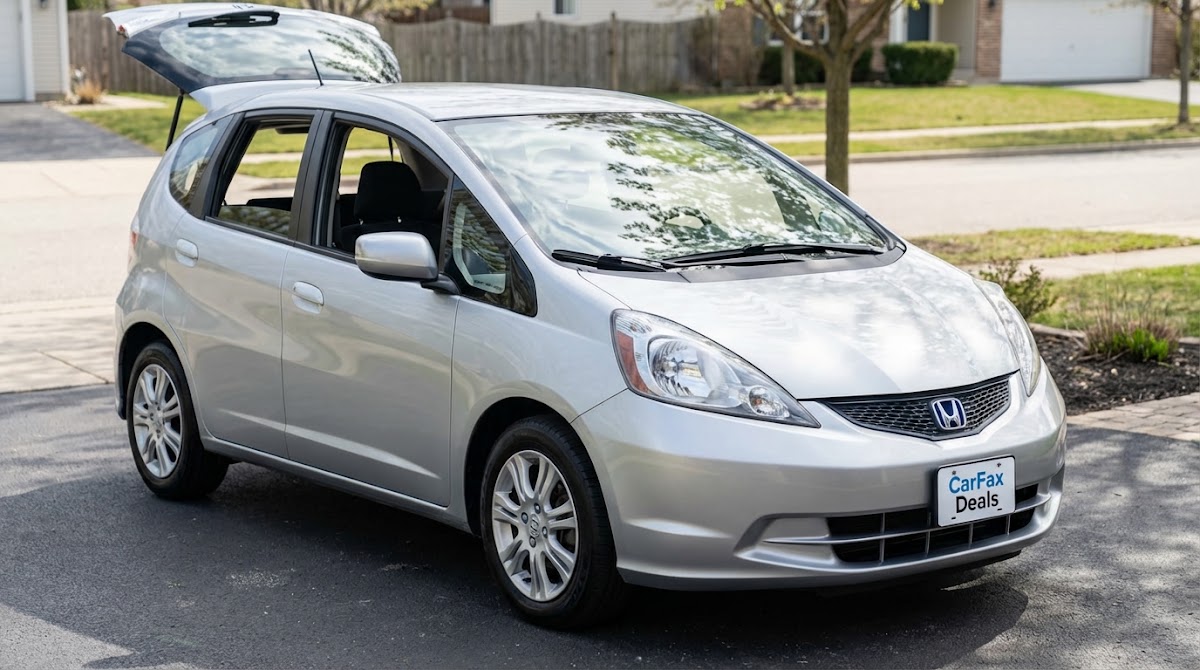
A used Honda Fit for sale can be a practical choice for buyers who prioritize low operating cost and flexible cargo space, but the right decision depends on model year, verified service history, and outstanding recalls. Run a VIN-level vehicle history report and compare local pricing context to spot red flags before you make an offer. Use authoritative safety and recall sources to check the exact candidate VIN.
A step-by-step workflow for estimating a truck's market value that centers on comparing consumer valuation tools, adjusting for mileage and condition, and checking wholesale market signals. The guide explains private-party, trade-in and dealer retail values and shows how a vehicle history report and pricing insights can change an asking price.
This guide helps research oriented buyers evaluate suv used cars for sale under $25,000 by combining safety ratings, reliability data, local pricing context, and vehicle history checks. It outlines a simple framework, a pre visit checklist, and a decision scoring worksheet so you can compare finalists before contacting a dealer. Use the steps here to narrow candidates and confirm risk signals with a vehicle history report and a pre purchase inspection.
When searching suv used cars for sale, prioritize model year, trim and powertrain before choosing a make or model. This guide explains how safety ratings, dependability studies and local pricing insights combine to produce a short list you can verify with a vehicle history report. It also provides a stepwise checklist you can use before contacting a dealer.
Used Honda Fit models remain common on the market and often appeal to buyers who want a compact car with flexible cargo space and modest running costs. This guide helps research-oriented shoppers evaluate a specific used Honda Fit for sale by focusing on safety, reliability signals, price context, and VIN-level verification.
You will get step-by-step checks to run before you visit a dealer, a practical buying checklist to follow at the viewing, and clear red flags that justify walking away. Where relevant, the guide points to authoritative sources for safety and recall checks and suggests how to use pricing tools to set a target offer.
The Fit can offer good utility and low running costs, but decisions depend on model year and verified service records.
Always run a VIN-level vehicle history report and check authoritative recall databases for the exact VIN.
Use KBB and Edmunds as starting points, then adjust price expectations using recent local listings.
Short answer: Should you consider a used Honda Fit?
The short, conditional answer is yes: a used Honda Fit for sale can be a pragmatic small-car option when you want low operating cost and useful cargo flexibility, provided you verify model-year reliability, service history, and open recalls before buying. Consumer-facing reliability research generally shows many Fit years perform above average, but outcomes depend on generation and powertrain choices, so treat each listing as an individual decision supported by facts Consumer Reports guide.
Quick verdict, in one line: the Fit often makes sense for commuters, small families, and first-time buyers who value fuel economy and interior versatility, but prioritize VIN-level checks and local price comparisons before committing.
Who the Fit often suits: buyers needing compact cargo utility and low running costs, urban drivers who value easy parking, and anyone seeking a budget-friendly small hatchback.
Key buyer caveats: check ownership and service history, confirm no unresolved recalls, and compare the asking price to local market values.
Run a vehicle history report for this VIN
Order a VIN-level vehicle history report and compare local price labels before scheduling a test drive.
What the Honda Fit is and which model years you’ll commonly find used
The Honda Fit is a small subcompact hatchback known for a roomy cabin relative to its footprint and flexible cargo arrangements. Common trims vary by generation and often include basic economy trims up to better-equipped Sport or EX variants; trim determines features such as infotainment, safety options, and wheel size, and can affect resale value.
New sales of the Fit in the U.S. ended after certain model years, so most available units are earlier years and this affects spare-part availability, trim features, and pricing context. For every listing, check the exact model year and trim rather than relying on the nameplate alone. When comparing listings, confirm the engine and transmission type because powertrain differences influence ownership cost and reliability perceptions.
Safety and recalls: what to check and where
Start safety checks with authoritative databases. NHTSA maintains recalls and complaint records that apply to specific model years and is the primary place to confirm outstanding recalls for a candidate VIN NHTSA vehicle page. You can also search the NHTSA recalls index directly for make and model at NHTSA recalls.
Use IIHS for crashworthiness and available ratings where the model year was tested; these ratings help you compare structural performance across model years and trims IIHS ratings.
A used Honda Fit for sale can be a practical, economical small-car choice if you verify the exact model year, check the VIN-level vehicle history for title and accident records, confirm no unresolved recalls, and use local price comparisons plus a pre-purchase inspection to set your offer.
After checking those databases, run a VIN-level vehicle history report to see if recalls were repaired for this specific car and to reveal title and accident history entries. Treat open recalls as a red flag until the seller provides verifiable proof of remedy, and remember both recalls and owner complaints matter for your risk assessment.
Reliability overview: what Consumer Reports and owner data say
Consumer Reports and aggregated owner-data sources report generally above-average reliability for many Fit model years, but reliability varies by generation and by specific powertrain or transmission configuration. Use those aggregated signals to prioritize which model years to search for and which to approach cautiously Consumer Reports guide.
Owner-reported databases add practical detail, noting that certain issues emerge more often on higher-mileage or older Fits. Treat reliability signals as guidance, not certainty, and use them to set a maintenance budget and inspection priorities before purchase.
Common problems and routine wear items to expect
On older Fits, the most commonly reported mechanical problems are related to powertrain and transmission repairs; these events become more likely with age and mileage according to aggregated repair data. Look carefully for transmission slipping, delayed engagement, or persistent check-engine codes during a test drive and inspection RepairPal reliability overview. You can also check RepairPal recalls for reported campaigns on the Fit RepairPal recalls.
Routine wear items that commonly drive near-term ownership cost include brakes, tires, suspension bushings, and belts or hoses. These items are normal maintenance but affect bargaining and immediate post-purchase expenses.
Quick tracker for recent service and transmission symptoms
Use during pre-purchase review
When you see service entries in the vehicle history report for transmission work or major services, cross-check dates and mileages against the odometer and the seller's documents to spot inconsistencies. (If helpful, confirm VIN decoding details with a VIN decoder: VIN decoder.)
How to set a realistic price range for a used Fit
Start with market-value services to build a baseline. Kelley Blue Book and Edmunds provide used-price ranges and total-cost-to-own estimates that are useful starting points; use those ranges to define a fair market window and then adjust to local listings and condition Kelley Blue Book values.
Major price drivers are mileage, trim level, regional demand, cosmetic and mechanical condition, and title status. Branded titles such as salvage or rebuilt materially reduce market value and increase ownership risk, so factor those into your walk-away calculation.
To set an initial target price window, gather three local comps in similar trim and mileage, average their asking prices, then set your opening offer below that average with a walk-away price that reflects repair needs or title issues. Use price analysis labels on listing platforms as a comparative signal, but validate them with local comps and vehicle specifics.
Step-by-step buying checklist for any used honda fit for sale
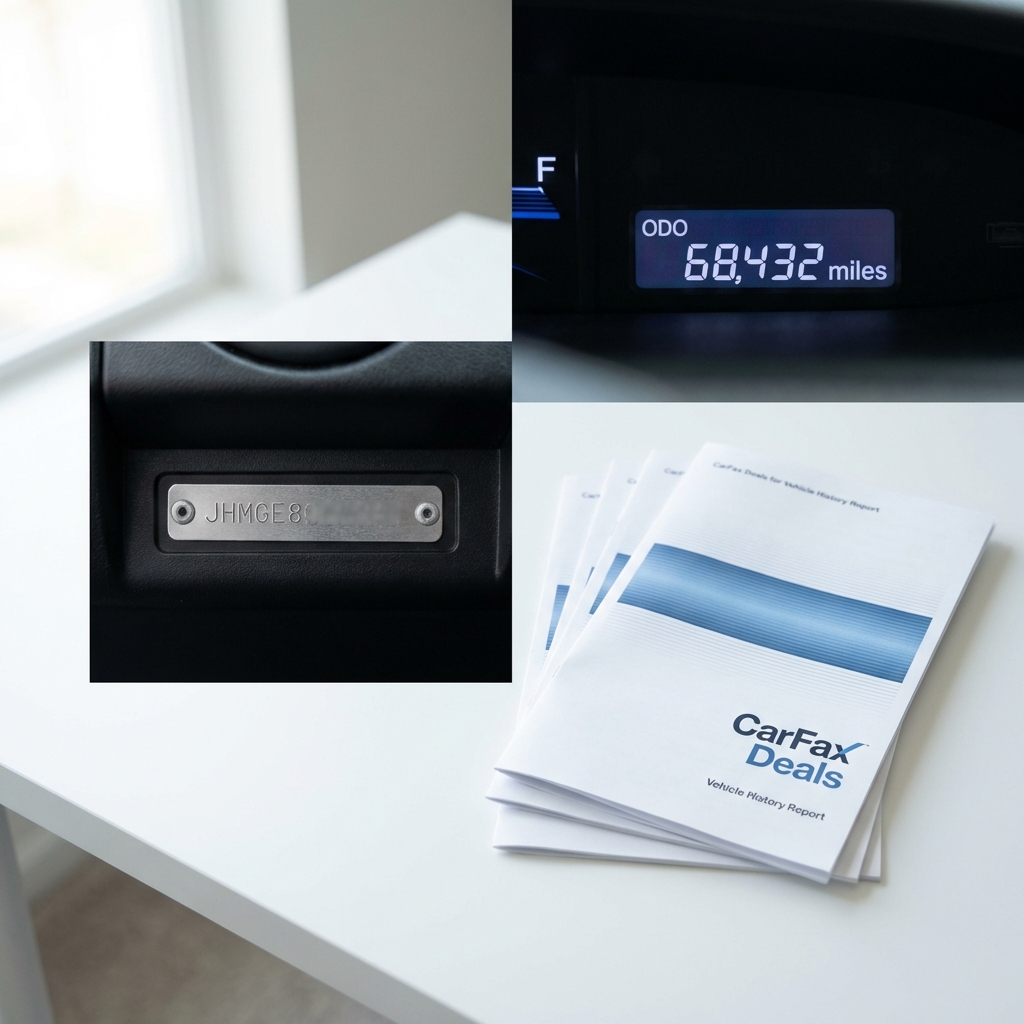
Pre-listing research tasks first: copy the VIN and run a vehicle history report to check title status, accident history, ownership history, and service history. Use the VIN report to screen out salvage or branded titles and to find any reported odometer issues or open recalls. For a VIN-level report see our VIN report page CarFax Deals VIN report.
Compare the VIN report findings against price-analysis labels and three recent local listings to set a target and walk-away price. Check NHTSA for unresolved recalls for that model year and confirm whether recall remedies appear in the history report. See our guide on how to use local comps and price signals how to use local comps.
On-site checks and test drive: inspect body panels, look for paint overspray or mismatched panels, check tire wear patterns, and listen for transmission noise during acceleration. Confirm the odometer reading matches service entry mileages on the VIN report. If anything is unclear, schedule a pre-purchase inspection with a trusted mechanic who can access underbody and engine details.
Post-inspection steps: obtain written estimates for any needed repairs, verify clean title transfer requirements in your state, and collect all sale paperwork including a bill of sale and signed title. Before final payment, confirm financing and insurance conditions and ensure the dealer transparency signals-like dealer reviews and profile information-align with your comfort level.
How to read and interpret a vehicle history report (VIN report)
Key fields to review are title status, reported accidents, service records, and ownership history. A VIN report often shows if a car has a branded title such as salvage or rebuilt, which typically lowers value and increases insurance complications. Treat a branded title as a major risk factor unless you can verify repairs and legal title transfer Edmunds buying guide.
Interpreting accident history: a minor report may mean cosmetic repair, while structural damage entries or repeated major events should be treated as red flags. Service record coverage varies by provider; absence of records does not prove good maintenance, so ask the seller for original receipts and confirm with a pre-purchase inspection.
When to walk away: red flags that should stop the purchase
High-severity red flags include a salvage or branded title, unrepaired major accident history, and unresolved safety recalls listed for the exact VIN. These items materially change value and should prompt a walk-away or very deep discount unless the seller proves legitimate repairs and clear title transfer Consumer Reports guide. You can also cross-check current recall listings on third-party research pages such as Cars.com Cars.com recalls.
Other warning signs that require deeper verification include inconsistent ownership or service records, odometer discrepancies, and evidence of long-term neglect such as heavy interior wear or repeated minor damage. Use the VIN report and a mechanic's inspection to confirm or dismiss these issues before you negotiate.
How the Fit compares to nearby segment alternatives for decision-making
Compare the Fit to similar small hatchbacks using a few consistent criteria: total cost to own, safety rating for the model year, cargo utility, and estimated reliability. Use market-value services to compare estimated ownership costs across models so you can weigh trade-offs between purchase price and expected running costs KBB ownership context.
Remember safety and reliability are model-year and trim dependent. Always compare like-for-like: similar mileage, trim, and regional price context. Cargo utility and interior layout are subjective but often favor the Fit because of its flexible seating and hatchback layout.
Understanding price-analysis labels and negotiation levers
Price-analysis labels such as Great Deal, Good Deal, or Fair Deal are comparative signals based on local comps, mileage, and condition. Treat them as starting information and always corroborate with three local listings in the same trim and mileage band. Labels should not replace a VIN report or inspection Edmunds guidance.
The strongest negotiation levers are title brand, accident history, service gaps, and mechanical issues noted in a pre-purchase inspection. Use documented discrepancies from the VIN report and inspection estimates to justify lower offers or to set a firm walk-away price.
Real-world inspection checklist and sample questions to ask the dealer
Exterior checks: examine panel gaps, look for paint overspray, check tire wear for uneven patterns, and inspect under the vehicle for fluid leaks. Interior checks: test seat adjustments, check for water staining in the trunk or footwells, and confirm electronics function.
Test-drive and mechanical checks: listen for transmission hesitation or slipping, verify smooth shifts in automatic models, and note any persistent warning lights. Essential questions to ask the seller or dealer include: can you show service records, why are you selling the car, and how long have you owned it? Compare their answers to the VIN report and request time to schedule an independent inspection RepairPal notes.
Example buyer scenarios: a first-time buyer and a family commuter
Scenario 1, first-time buyer: priorities include low purchase price, verified maintenance, and minimal immediate repairs. Aim for later-generation Fits with clear ownership history and recent service entries for brakes and fluids. Confirm mileage consistency and budget for expected wear items.
Scenario 2, family commuter: prioritize safety rating for the model year, documented service history, and enough cargo room for errands. A cleaner title and recent major services matter more here than a few cosmetic issues. Use total cost-to-own estimates to compare how the Fit stacks against slightly larger alternatives before deciding Consumer Reports guide.
Common mistakes buyers make and how to avoid them
Common errors include relying only on photos and seller claims, skipping the VIN report, and declining a pre-purchase inspection. Photos can hide structural or mechanical issues and seller statements may be incomplete; verify claims with documents and independent checks.
Practical safeguards: always run a vehicle history report, schedule a pre-purchase inspection, and compare the asking price against recent local comps. If service history is missing, treat that as a negotiation point or require inspection evidence of recent major maintenance Edmunds checklist.
Conclusion and next steps: how to act on a listing you like
Three immediate next steps: order a VIN-level vehicle history report for the listing, confirm no open recalls for the VIN, and book a pre-purchase inspection. Use the VIN report to screen title brands and accident entries and treat unresolved recalls or branded titles as strong reasons to pause.
Keep a checklist during the viewing: bring VIN printout, service questions, and a way to record odometer and body details. Use price-analysis labels and local comps to set reasonable offers. CarFax Deals can serve as a verification layer that surfaces vehicle history context and price signals to help you compare listings faster, but always confirm details with original documents and inspections.
The first step is to run a VIN-level vehicle history report to confirm title status, accident history, ownership and service entries before scheduling a test drive.
Many Fit model years report above-average reliability, but outcomes vary by generation and powertrain; use aggregated reliability reports and owner data to prioritize model years.
Primary walk-away signs are branded or salvage titles, unrepaired major accident history, unresolved recalls for the VIN, odometer inconsistencies, and large service gaps.
If a listing looks promising, prioritize ordering the VIN report, checking for open recalls, and booking a pre-purchase inspection. Keep documentation of seller answers and inspection findings when you negotiate.
CarFax Deals can help surface history and pricing context for listings, but final decisions should rest on the VIN report, inspection, and local price validation.

 Blog
Blog