A used mercedes for sale can offer luxury features and higher comfort, but typically brings higher expected maintenance and repair costs than mainstream used cars. This guide explains what to check, how to use a vehicle history report and a pre-purchase inspection, and which buyer profiles are most likely to benefit. Follow the stepwise framework to compare total cost to own and to reduce risk before contacting a dealer.
A step-by-step workflow for estimating a truck's market value that centers on comparing consumer valuation tools, adjusting for mileage and condition, and checking wholesale market signals. The guide explains private-party, trade-in and dealer retail values and shows how a vehicle history report and pricing insights can change an asking price.
This guide helps research oriented buyers evaluate suv used cars for sale under $25,000 by combining safety ratings, reliability data, local pricing context, and vehicle history checks. It outlines a simple framework, a pre visit checklist, and a decision scoring worksheet so you can compare finalists before contacting a dealer. Use the steps here to narrow candidates and confirm risk signals with a vehicle history report and a pre purchase inspection.
When searching suv used cars for sale, prioritize model year, trim and powertrain before choosing a make or model. This guide explains how safety ratings, dependability studies and local pricing insights combine to produce a short list you can verify with a vehicle history report. It also provides a stepwise checklist you can use before contacting a dealer.
If you are considering a used mercedes for sale, the decision often comes down to balancing luxury features with predictable running costs. Mercedes models keep many comfort and technology advantages after several years, but industry and owner reports suggest maintenance and repair costs tend to be higher than for typical mainstream cars.
This guide helps research-oriented buyers and families evaluate seven-year-old Mercedes examples. It explains the common costly repair areas to watch, how to use a vehicle history report and a professional pre-purchase inspection, and a simple decision framework to estimate total cost to own before contacting a dealer.
A seven-year-old Mercedes can offer luxury value but often comes with higher expected maintenance than mainstream models.
Run a VIN-level recall check and get a professional pre-purchase inspection before committing.
Selecting well-documented model years and trims with strong reliability signals reduces ownership risk.
Quick answer: is a seven-year-old Mercedes worth it for you?
Who this guide is for, used mercedes for sale
Short answer, in plain terms: a seven-year-old Mercedes often makes sense for research oriented buyers who value luxury features and can budget for higher maintenance and repair costs. Use a vehicle history report and a VIN recall check early in your research to reduce uncertainty.
For many shoppers the attraction is the comfort, technology, and refinement that Mercedes models keep after several years, but those benefits come with ownership costs that tend to be higher than comparable mainstream models. Industry dependability studies and owner reports show higher average repair and maintenance costs for the brand, though results vary by model and year, so choose carefully J.D. Power vehicle dependability study.
A seven-year-old Mercedes can be sensible for buyers who prioritize luxury features and can budget for higher maintenance and repair costs; confirm the VIN recall history, review service records, and order a professional pre-purchase inspection to reduce risk.
A short, conditional verdict: if you are prepared to budget for periodic expensive items, prefer a documented service history, and will order a professional pre-purchase inspection, a seven-year-old Mercedes can be a reasonable choice; if low predictable weekend ownership cost is your priority, mainstream alternatives may often be cheaper to run. A VIN-level recall check and a PPI should be high-priority next steps.
What makes a seven-year-old Mercedes different from mainstream used cars
Depreciation and luxury-segment pricing behavior
Mercedes vehicles typically follow luxury-segment depreciation patterns, which means they may lose a larger share of new-car price early, then retain some value relative to their size and features at the seven-year point. That retained value can make some well-maintained examples attractive, but it does not erase the higher costs for replacement parts and service that many owners report. Expect tradeoffs between purchase price and future maintenance needs depending on the specific model year and trim Kelley Blue Book ownership cost guide.
How model, trim, and powertrain change risk
Not all Mercedes are the same. The model, trim, and powertrain are major determinants of both reliability and service needs. Simple rear-wheel sedans and well-documented diesel or turbocharged four cylinder engines tend to be less expensive to maintain than high-performance AMG trims or complex hybrids and EVs. Hybrid or electric powertrains in older vehicles raise open questions about battery life and high-voltage component costs, which require model-specific inspection and service estimates before purchase.
Industry dependability ratings vary across model lines and model years, so selecting a year and trim with stronger ratings reduces risk. Consumer reliability signals and owner feedback can help you avoid high-complexity powertrains or known problem years Consumer Reports Mercedes reliability overview.
Common costly repairs at the seven-year mark and what to inspect
Owner-reported databases and repair guides commonly highlight suspension, complex electronics, and transmission components as frequent and potentially expensive repair areas around year seven. Symptoms to watch for in listings and during a test drive include uneven tire wear that suggests suspension alignment or control arm wear, warning lights or intermittent electrical faults, and delayed or harsh shifting during acceleration or deceleration RepairPal Mercedes reliability and common problems. You can also review RepairPal's recalls and safety notes for more recall-specific details RepairPal recalls.
Mileage and service history shape the probability of these repairs. For example, a seven-year-old Mercedes with higher than average mileage is more likely to need suspension refreshes and transmission service sooner than a lower-mileage example. Documented, regular maintenance reduces the odds that deferred care will lead to costly repairs.
quick PPI and VIN report checklist for seven-year-old Mercedes
Use with a VIN vehicle history report
Mileage thresholds and service items to watch
Practical mileage thresholds help prioritize inspections. Around and above 60,000 to 80,000 miles many Mercedes begin to show wear in suspension bushings, control arms, and some transmission components, though exact thresholds depend on model and driving history. High-tech features such as adaptive suspension and advanced driver assistance systems can cost more to repair than basic components, so confirm proper function on test drives.
When reviewing listings, request service history that shows regular oil changes, transmission service when applicable, and documented suspension or steering repairs. If the seller cannot provide records, treat that as increased risk and insist on a PPI that focuses on the common failure categories.
How to evaluate a used Mercedes listing: vehicle history and inspections
Using a vehicle history report and what it reveals
A vehicle history report commonly includes title status, ownership history, accident or damage records, mileage checks, and sometimes service entries. Running a VIN-level recall search is also essential because open recalls or service bulletins can affect safety and required repairs. Checking those items early can change whether a listing remains worth pursuing NHTSA Mercedes recall listings or via the Mercedes-Benz recall lookup Mercedes-Benz recall site.
Use the vehicle history report to confirm clean title status and to flag inconsistent mileage or ownership patterns. If the report shows salvage, rebuilt, or other title brands, or if there are gaps in service history, treat the listing as higher risk and require additional inspection and documentation.
What a professional pre-purchase inspection (PPI) should cover
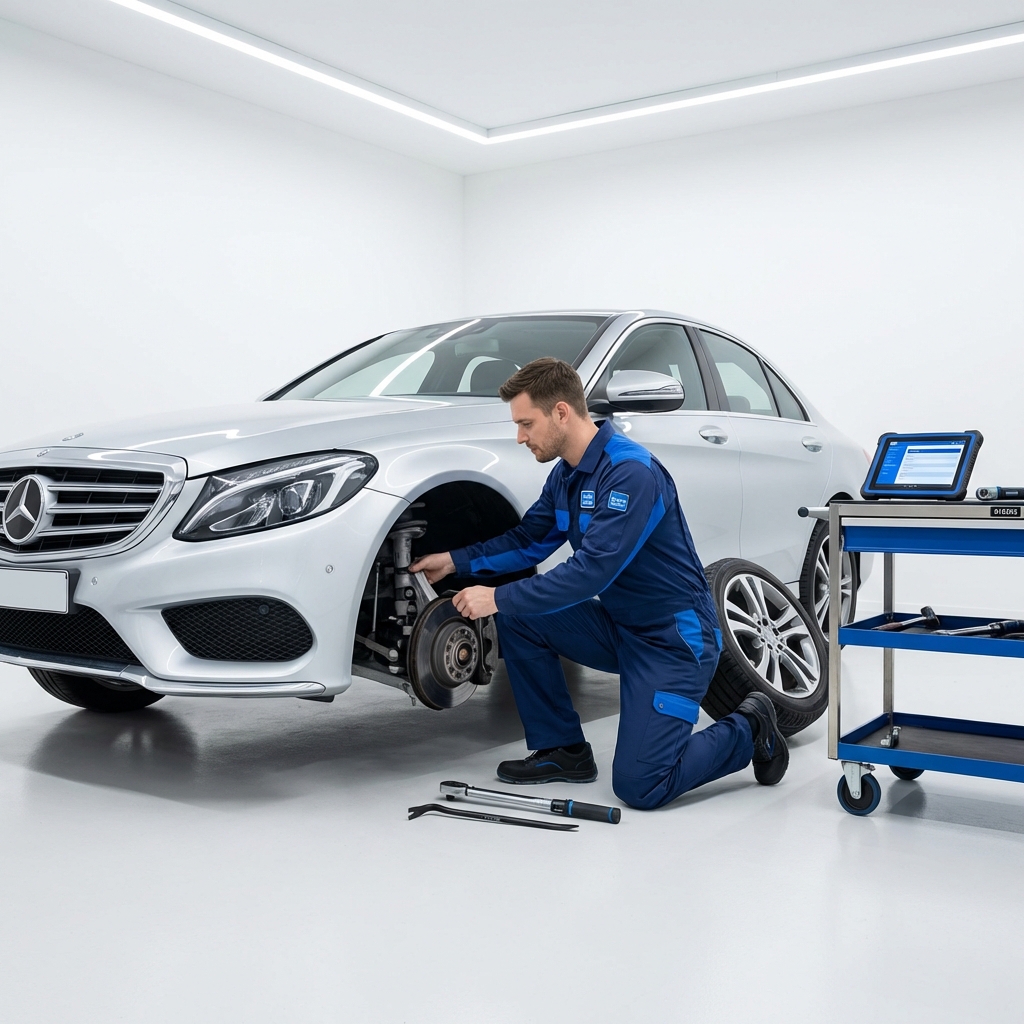
A professional PPI should include a mechanical check of engine and transmission operation, a hands-on suspension and steering inspection, a scan for stored fault codes in vehicle electronics, and a road test that reproduces the conditions where faults might appear. Ask the inspector to examine subframe mounting points and adaptive ride components when present, and to test any active safety features if possible.
Combining a vehicle history report with a PPI significantly increases the chance of detecting title issues, prior damage, and deferred maintenance before purchase. A VIN-based report and a thorough PPI together give a clearer picture of service needs and likely short-term costs Edmunds used car inspection checklist. For a quick way to generate a report online, run a report with the service tool at CarFax Deals run report.
Prioritize asking sellers for these documents before you arrange a test drive: recent service receipts, date-stamped oil change records, any transmission or major repair invoices, and proof of any extended warranty transfer if offered. If those documents are missing, you can still proceed but budget more for inspection and potential repairs.
A simple decision framework: when to buy a seven-year-old Mercedes
Budgeting for repairs and insurance
Start by estimating your total cost to own for the first three years after purchase. Include anticipated maintenance, likely repairs tied to the model and mileage, and insurance differences compared with mainstream counterparts. For many seven-year-old Mercedes examples, expected repairs and service raise the ownership estimate above similar mainstream sedans, though exact costs depend on model and local service pricing Kelley Blue Book ownership cost guide.
Create a reserve fund for likely events, such as suspension work, electronics troubleshooting, and potential transmission service. If that reserve is outside your budget, consider a different model year, a less complex trim, or a comparable mainstream vehicle.
Pick the right model year, trim, and maintenance proof
Follow a short checklist before you decide: first, confirm there are no major open recalls for the VIN; second, verify a documented service history that shows scheduled maintenance; third, check reliability ratings for the specific model year and trim; fourth, order a professional PPI and use the results to refine your cost estimate. Selecting model years with stronger reliability signals and complete service records reduces risk and can change the total cost picture Consumer Reports Mercedes reliability overview.
Run a vehicle history report and schedule a PPI
If your inspection and pricing insights line up, schedule a PPI and compare the vehicle history report against maintenance records; CarFax Deals can act as a verification layer to surface title and service entries before you visit the seller.
Overlooking recall history or incomplete service records
A common mistake is to assume the dealer or seller has addressed recalls without independent verification. Open recalls and service bulletins are frequent enough with Mercedes that a VIN check should be standard practice before you invest time or money in a test drive. If a recall affects critical systems, factor that work into your buying decision and timeline NHTSA Mercedes recall listings. You can also consult the federal VIN FAQ and lookup guidance at SaferCar SaferCar VIN FAQ.
Another frequent error is trusting verbal statements about service without invoices. Always request dated service receipts and verify them against the vehicle history report; if documentation is incomplete, treat the listing as higher risk and use the PPI to fill gaps.
Underestimating long-term maintenance and unexpected repairs
Buyers sometimes focus only on the purchase price and neglect expected maintenance over the next few years. Mercedes ownership often involves higher-cost categories such as suspension and electronics. Estimate expected repairs and include them when comparing listings, instead of treating them as one-off surprises RepairPal Mercedes reliability and common problems.
Remedies: insist on a recent PPI, request that the seller perform or document routine services, and get clear written answers about any open issues. If the seller resists inspection or documentation requests, consider walking away.
Practical scenarios: three real-world buyer examples
Family sedan with documented service history
Scenario one, a family buyer finds a seven-year-old Mercedes sedan with complete service records, moderate mileage, and no open recalls on the VIN. The documented maintenance reduces the probability of deferred issues, and a PPI confirms suspension and electronics are in good order. In this case the buyer can weigh the higher purchase price against expected comfort and retained value, while keeping a repair reserve for routine items Edmunds used car inspection checklist.
Higher-end performance trim with complex powertrain
Scenario two involves a higher-performance trim or AMG model. These cars often carry more complex engines and drivetrains, which increases the chance of expensive repairs at and after year seven. If the model has known problem years or the vehicle lacks strong service documentation, be more cautious and increase the projected repair reserve. A thorough PPI and targeted diagnostics become essential before making an offer.
High-mileage bargain vs low-mileage well-maintained example
Scenario three compares a low-price, high-mileage listing to a higher-priced, low-mileage but well-documented example. The lower price can be tempting, but expected maintenance and near-term repairs may make the cheaper car more expensive over three years. Calculate total cost to own, include likely repairs flagged by seller history and PPI findings, and prefer the better-documented vehicle if the numbers align in your favor Kelley Blue Book ownership cost guide.
Recap checklist: run a VIN vehicle history report, confirm title status and ownership history, perform a VIN recall check, order a professional pre-purchase inspection focused on suspension, electronics, and transmission, and estimate total cost to own for your market before making an offer.
How to prioritize your next actions
Prioritize documentation and inspection early. Favor model years and listings with complete service histories and stronger reliability signals, and keep a clear reserve for likely repairs. Use pricing insights to compare similar listings in your area and to set realistic expectations before contacting a dealer.
On average, Mercedes vehicles tend to have higher maintenance and repair costs than mainstream brands, though costs vary by model, trim, and service history. Use a vehicle history report and a PPI to check specifics for the VIN.
Start with a VIN-level vehicle history report and a recall check, then request service records. If those look acceptable, order a professional pre-purchase inspection focused on suspension, electronics, and transmission.
Not always. Low purchase price can be offset by near-term repairs and maintenance. Compare total cost to own and use a PPI to reveal likely short-term service needs before deciding.
Deciding if a seven-year-old Mercedes is worth buying requires documented facts and careful budgeting. Use VIN-based reports, order a thorough PPI, and compare pricing insights for similar listings in your area to make an informed choice.
When you have a VIN, run a vehicle history report and use inspection findings to refine your cost estimate before you finalize any offer.

 Blog
Blog