vin lookup kbb explained: KBB accepts VINs in some tools to decode model, trim and powertrain for valuation, but it is not a full vehicle-history provider. Use KBB for pricing and spec confirmation, run free government VIN checks, and buy a vehicle-history report when risk signals appear.
A step-by-step workflow for estimating a truck's market value that centers on comparing consumer valuation tools, adjusting for mileage and condition, and checking wholesale market signals. The guide explains private-party, trade-in and dealer retail values and shows how a vehicle history report and pricing insights can change an asking price.
This guide helps research oriented buyers evaluate suv used cars for sale under $25,000 by combining safety ratings, reliability data, local pricing context, and vehicle history checks. It outlines a simple framework, a pre visit checklist, and a decision scoring worksheet so you can compare finalists before contacting a dealer. Use the steps here to narrow candidates and confirm risk signals with a vehicle history report and a pre purchase inspection.
When searching suv used cars for sale, prioritize model year, trim and powertrain before choosing a make or model. This guide explains how safety ratings, dependability studies and local pricing insights combine to produce a short list you can verify with a vehicle history report. It also provides a stepwise checklist you can use before contacting a dealer.
KBB accepts VINs in some of its valuation tools, which helps confirm model, trim and powertrain for more accurate pricing. This article explains what that VIN input does and does not do, and it maps a practical workflow for buyers who want to reduce risk.
You will learn where to enter a VIN on KBB, which free government VIN checks to run afterward, and clear signals that justify purchasing a paid vehicle-history report or asking a dealer for documents.
KBB accepts VINs in valuation tools to improve spec and pricing accuracy but does not aggregate accident or title histories.
Run NHTSA and NICB free checks after KBB to screen for manufacturer-encoded flags and reported theft or salvage.
Buy a paid vehicle-history report when free checks or price signals suggest potential risk.
Quick answer: Does KBB do VIN checks? - vin lookup kbb
KBB accepts VIN input in some tools but is not a comprehensive vehicle-history provider. Use KBB to refine valuation and confirm exact model, and then run dedicated checks for ownership and incident history.
Specifically, KBB’s Instant Cash Offer and some vehicle-detail pages accept VINs to decode year, trim and powertrain for pricing accuracy, which helps narrow value but does not replace a vehicle-history report KBB Instant Cash Offer page.
Short summary
The short summary is: KBB does accept VINs in specific valuation tools, but it does not provide the aggregated accident, service, or title histories that paid vehicle-history reports offer.
How this article will help you
This article shows what KBB’s VIN inputs do, what they do not do, and a practical workflow for combining KBB, free government VIN checks, and paid history reports to reduce risk when buying a used car.
What KBB can do with a VIN in 2026
When you enter a VIN into KBB where allowed, the system can decode manufacturer-encoded fields to confirm model year, trim and powertrain, which refines valuation calculations.
For example, KBB’s Instant Cash Offer takes a VIN to reduce guesswork about a car’s exact configuration and to produce a more precise offer or trade-in estimate KBB Instant Cash Offer page.
Run a vehicle history report from the VIN entry flow
Before you order any paid report, enter the VIN on KBB to confirm the exact model and trim so you buy the correct comparison and valuation.
VIN decoding also helps avoid common value errors, such as confusing a base model with a higher trim that carries added features and higher market value. That matters for price negotiation and for deciding whether a deeper history check is cost effective.
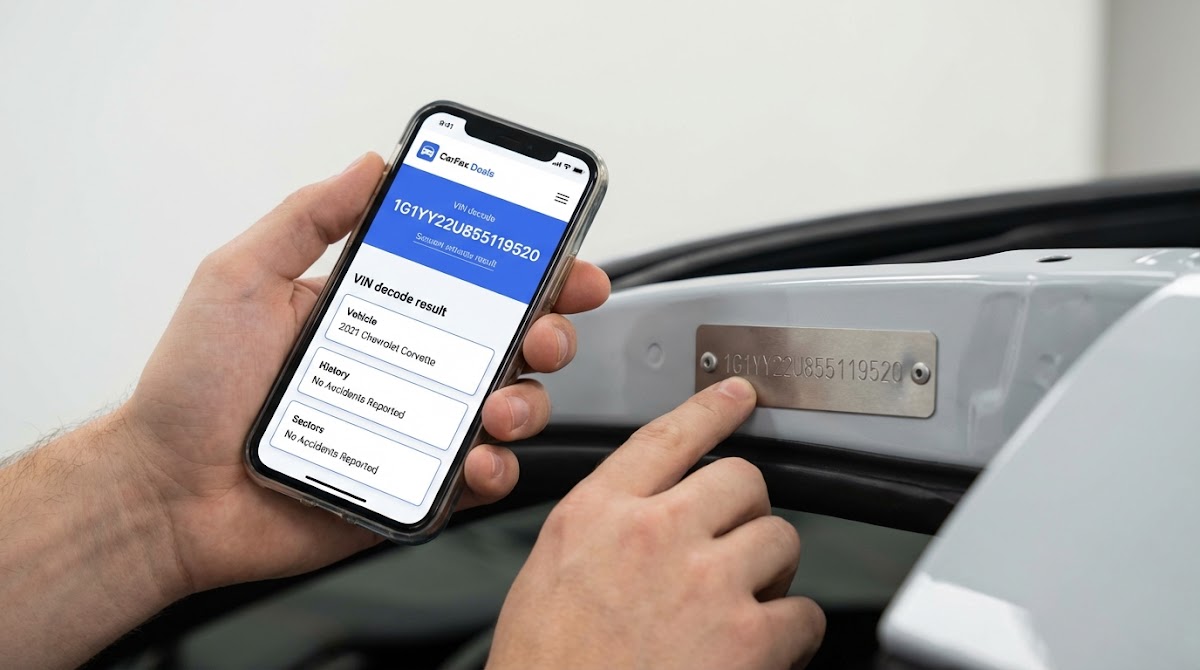
On KBB you can usually enter the VIN on Instant Cash Offer pages or vehicle-detail screens. Expect the results to list the confirmed model year and trim and show adjusted pricing or a cash offer based on that configuration KBB VIN guide. See KBB's VIN decoder guide VIN Decoder: The Essentials Explained.
Where KBB accepts a VIN
KBB accepts VIN input in valuation-focused tools, notably the Instant Cash Offer and some vehicle-detail or trade-in flows. These inputs feed the valuation engine rather than a history aggregation service KBB Instant Cash Offer page.
How VIN input improves valuation and spec accuracy
Decoding the VIN confirms powertrain and factory options that change value, so the same model line can have materially different pricing based on the VIN-derived spec.
Using the VIN on KBB tends to reduce valuation error from misidentified trims, which helps you decide whether a listing’s price fits local market context.
What KBB does not provide: the limits of VIN-based valuation
KBB is focused on valuation and vehicle specifications, not on aggregating accident or full service histories, or on systematically reporting title-brand data from DMV or insurance sources KBB VIN guide.
That means a KBB valuation can be accurate for model and trim but still miss risks that appear only in history data, such as unreported collision repairs or private-service-only records.
KBB accepts VINs in valuation and spec tools to improve accuracy, but it does not provide a comprehensive vehicle-history report; use KBB for valuation, run NHTSA and NICB checks, then buy a paid report when needed.
Examples of gaps: KBB does not typically show third-party service bay logs, insurer claims detail, or title brand entries that a paid history report or state title search would surface.
Practically, a normal valuation on KBB can exist alongside undisclosed incidents. When you see inconsistencies or a price that looks unusually low, plan follow-up checks rather than relying solely on a VIN-based valuation.
History gaps KBB does not fill
Items KBB usually will not surface include unreported accidents, dealer-only service entries, branded titles such as salvage or rebuilt, and possible odometer discrepancies.
Because these items often come from DMV, insurer, or independent service records, they are most effectively found by a full history report or by asking the seller for documentation.
Why valuation tools may miss risk signals
Valuation tools use market data, encoded vehicle specs and pricing models. They do not systematically ingest all claims and title-brand updates from every state or insurer, so gaps remain unless supplemented by dedicated history services.
If you need incident-level detail, an offer or price estimate from KBB should be the starting point, not the final check.
Practical 2026 workflow: Use KBB first, then verify with government checks and history reports
Step 1: Use KBB to confirm model, trim and pricing context. Enter the VIN where allowed to get the most accurate valuation and to ensure you compare like-for-like listings KBB Instant Cash Offer page.
Step 2: Run free government VIN checks such as the NHTSA VIN decoder and the NICB VINCheck to look for manufacturer-encoded flags and reported theft or salvage records.
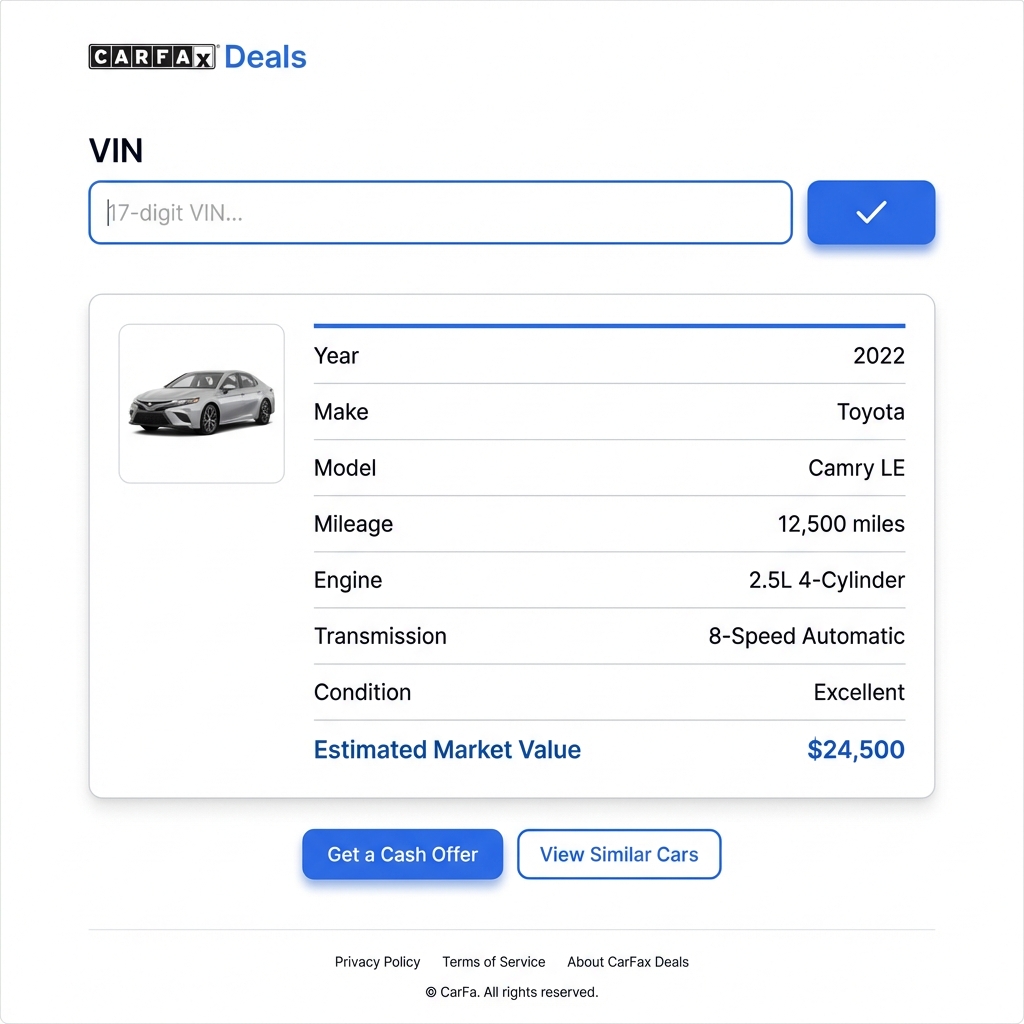
Step 3: If any risk signals appear, purchase a paid vehicle-history report or request dealer maintenance records to confirm incident details before you schedule a test drive or make an offer NHTSA vPIC VIN decoder. See our VIN report page CarFax Deals VIN report.
This order helps reduce wasted spending on paid reports. Use KBB first to limit reports to vehicles where the VIN or price raises questions. See our how-to guide how to use.
Step 1: Use KBB for valuation and spec confirmation
Enter the VIN on KBB to confirm exact trim and options. A correct spec reduces the chance you buy an incorrectly described car or pay for an unexpected option level that changes value.
KBB’s VIN-based valuation can point out when a car’s listed features do not match the decoded configuration, prompting a closer look at the listing.
Step 2: Run NHTSA and NICB free checks
Run the NHTSA VIN decoder to confirm manufacturer-encoded data and run NICB VINCheck to check for reported theft or salvage entries; both are no-cost, authoritative first checks NICB VINCheck page. Use the vPIC decoder for manufacturer-encoded fields vPIC VIN decoder.
Step 3: Buy or request a full vehicle-history report
If free checks or KBB valuation raise concerns, buy a paid history report or ask the dealer for service records and title documentation. Paid reports aggregate DMV and insurer sources that KBB does not systematically include Edmunds guide to VIN checks. Check pricing before you buy pricing.
When you order a report, check for title brand language, accident or damage entries, mileage inconsistencies, and prior reported location changes that might affect history.
If a dealer offers maintenance records, compare them with the paid report. Discrepancies between dealer documents and a paid history report are a reason to ask for clarification or a mechanical inspection.
Step 1: Use KBB for valuation and spec confirmation
Enter the VIN on KBB to confirm exact trim and options. A correct spec reduces the chance you buy an incorrectly described car or pay for an unexpected option level that changes value.
KBB’s VIN-based valuation can point out when a car’s listed features do not match the decoded configuration, prompting a closer look at the listing.
Step 2: Run NHTSA and NICB free checks
Run the NHTSA VIN decoder to confirm manufacturer-encoded data and run NICB VINCheck to check for reported theft or salvage entries; both are no-cost, authoritative first checks NICB VINCheck page.
Step 3: Buy or request a full vehicle-history report
If free checks or KBB valuation raise concerns, buy a paid history report or ask the dealer for service records and title documentation. Paid reports aggregate DMV and insurer sources that KBB does not systematically include Edmunds guide to VIN checks.
When you order a report, check for title brand language, accident or damage entries, mileage inconsistencies, and prior reported location changes that might affect history.
If a dealer offers maintenance records, compare them with the paid report. Discrepancies between dealer documents and a paid history report are a reason to ask for clarification or a mechanical inspection.
When you order a report, check for title brand language, accident or damage entries, mileage inconsistencies, and prior reported location changes that might affect history.
What paid reports aggregate
Paid reports typically compile DMV title data, reported insurance claims, and available service-bay logs, which together provide a more complete history than valuation-only tools.
These reports can surface repeated issues, previously branded titles, or series of ownership transfers that suggest higher risk, and they form the core of a pre-purchase verification step.
When the extra cost is justified
The extra cost is often justified when the price is low for the spec, a government check returns a flag, or the ownership and maintenance record is unclear or incomplete.
Purchasing a report is a calculated step to reduce uncertainty when indicators suggest the vehicle may have more history than the listing shows.
Decision criteria and red flags to watch when the VIN or report raises questions
Top red flags include branded titles, salvage or theft flags, inconsistent odometer readings, multiple owners in a short period, and major accident entries in a history report Edmunds guide to VIN checks.
When you see one of these flags, increase verification: obtain the full paid report, request dealer or seller maintenance records, and consider a professional mechanical inspection before buying.
Weigh price versus documented history by factoring in likely repair costs and resale uncertainty. A lower price can reflect hidden costs that a history report will reveal.
Combine price analysis labels or market context with history signals: if the valuation looks very favorable but the history shows a red flag, treat the listing as higher risk and proceed cautiously.
Top red flags that should change your next step
Branded title entries, salvage reports, theft flags and large mileage discrepancies are immediate reasons to pause and dig deeper rather than proceed on price alone.
Smaller issues, such as one minor accident with full repair documentation and clear service history, may be acceptable depending on the buyer’s tolerance and intended use.
How to weigh price versus documented history
Match the likely repair and ownership costs inferred from the history report against the price advantage. If the cost to restore or verify is higher than the discount, walk away or negotiate a lower price contingent on repairs and inspection.
When in doubt, use a trusted mechanic and insist on written records before committing to a purchase.
Common mistakes buyers make when relying on VIN checks and valuation tools
A frequent mistake is over-relying on a single source such as a valuation tool or a basic VIN decode and assuming no news is good news; that can miss private repairs or title issues that do not show up in those tools KBB VIN guide.
Another common error is misreading trim or option codes and assuming a decoded VIN means full history coverage. Decoding helps with specs but not with service or claim histories.
Practical fixes: run the free government checks, buy a paid report when logic suggests risk, ask for maintenance records, and have a pre-purchase inspection with a mechanic who can look for evidence of past collisions.
Over-relying on one source
Relying only on KBB valuation can lead to missed red flags because valuation sources focus on price and specs, not incident aggregation.
Always corroborate with at least one history source and a mechanical inspection for higher-risk buys.
Misreading decoded VIN data
Decoded VIN entries can be misinterpreted if you do not understand trim codes or factory option language; ask for clarification when a listing’s description does not match decoded specs.
When listings and decoded data conflict, request seller documentation and run a paid history report before assuming a simple explanation.
Three short buyer scenarios that show the workflow in action
Scenario A: Low-priced local listing. A buyer uses KBB to confirm trim and options via VIN, runs NICB and NHTSA checks, and finds a salvage indicator on NICB; they buy a paid report and then decide whether to move forward based on the documented damage and repair history NICB VINCheck page.
Scenario B: Clean KBB price but NICB flag. A listing shows a fair KBB valuation but NICB returns a theft or salvage flag. The buyer requests dealer maintenance records and a paid report to reconcile the discrepancy before scheduling a test drive.
Scenario C: Seller-provided maintenance records versus report. A buyer compares seller-supplied records with a paid history report; if the report shows gaps or conflicting entries, the buyer requests an independent inspection and clarifies the title status before offering.
Scenario A: Low-priced local listing
Use KBB first to confirm the spec, then run government checks; a NICB or NHTSA flag should trigger a paid report before you invest time or money in inspection.
When the paid report confirms salvage or major repairs, adjust your offer or walk away depending on repair cost and resale considerations.
Scenario B: Clean KBB price but NICB flag
A government flag after a clean KBB valuation warrants asking the seller for documentation and buying a paid report to see the full record before proceeding.
If the dealer provides consistent, dated maintenance records that align with the report, the buyer may decide to inspect and negotiate. If not, the safe choice is further verification or walking away.
Scenario C: Seller-provided maintenance records versus report
Compare the dates, mileage and items listed in seller documents with the paid report. Any mismatch in mileage or missing entries should prompt deeper questions and a mechanic inspection.
Keep records of communications and ask the dealer to certify any records they provide so you can rely on them during negotiation or for future recourse.
Wrap up: how to use KBB and when to go further
KBB is a useful VIN-based valuation and spec confirmation tool, but it is not a substitute for full history reports when you need accident, service or title-brand detail KBB VIN guide.
Next steps checklist: use KBB for valuation, run NHTSA and NICB free checks, purchase a paid vehicle-history report if any risk signals appear, request dealer maintenance records, and get a pre-purchase inspection before buying.
One-paragraph summary
Use KBB early to confirm what you are actually buying; use government VIN checks to catch encoded or insurer-reported flags; buy a paid report or request records whenever the combined signals suggest risk.
Next steps checklist
1. Enter VIN in KBB for spec confirmation. 2. Run NHTSA and NICB checks. 3. Buy a paid report if anything looks off. 4. Request dealer records and inspect the car.
No, KBB accepts VINs in some tools to improve valuation and confirm specs, but it does not provide the aggregated accident, service, and title history that paid vehicle-history reports deliver.
Run the NHTSA vPIC VIN decoder to confirm manufacturer-encoded details and the NICB VINCheck to look for reported theft or salvage flags before buying a paid report.
Buy a paid report when KBB, NHTSA, or NICB flags look concerning, when the price seems unusually low for the confirmed spec, or when ownership and service records are unclear.
Use KBB first to confirm what you are buying, then use free government checks to screen for encoded or insurer-reported flags. Purchase a paid vehicle-history report when any risk signals appear, and always request maintenance records and a pre-purchase inspection before finalizing a purchase.
Taking these steps helps you reduce uncertainty and make a more informed decision without relying on a single source of truth.

 Blog
Blog