This guide covers what each free tool returns, the hard limit on each one, how to read the 17 characters of a VIN without any tool at all, and the exact conditions that make a paid vehicle history report worth buying.
The six free VIN lookups, compared
Every free VIN lookup does one of three jobs: it decodes what the car was built as, it checks for an open safety recall, or it checks for theft and insurer total loss. No free tool does all three, and no free tool covers accident or title history.
| Tool | Run by | Cost and limit | What it returns | What it will not show |
|---|
| vPIC VIN decoder | NHTSA (federal) | Free, no daily cap | Make, model, model year, body class, engine, assembly plant, GVWR class, restraint systems | Anything that happened after the car left the factory |
| Recall lookup | NHTSA (federal) | Free, up to 100 VINs per search | Open, unrepaired safety recalls attached to the VIN | Completed recalls, campaigns older than 15 years, small-volume manufacturers |
| VINCheck | National Insurance Crime Bureau | Free, 5 searches per IP address per 24 hours | Reported stolen and not recovered, insurer-declared salvage, flood, or total loss | Anything from an insurer that is not an NICB member, plus all accident and title data |
| KBB VIN lookup | Kelley Blue Book (Cox Automotive) | Free | Decoded trim and factory options, plus trade-in, private party, and dealer retail value ranges | Accidents, title brands, odometer history |
| Manufacturer owner portal | The automaker | Free, account sometimes required | Recall status, open factory campaigns, sometimes remaining warranty | Records from any other brand, anything outside the factory relationship |
| Free preview from a paid provider | Commercial providers | Free | A record count or a single yes/no flag | The records themselves, which sit behind the paywall |
What the KBB VIN lookup shows
The KBB VIN lookup is a valuation tool with a decoder attached. You enter the 17-character VIN at kbb.com, confirm mileage, pick a condition tier, and add a ZIP code. Kelley Blue Book returns the decoded year, make, model, trim, and factory equipment, then prices that exact configuration for your local market.
The three value ranges it returns
KBB splits the answer by how you plan to dispose of the car: a trade-in range for what a dealer will give you, a private party value for a person-to-person sale, and a dealer retail figure for what a lot would ask. The ranges reflect local conditions across more than 100 US geographic regions and are refreshed weekly against transaction and auction data.
Why the number assumes a clean car
KBB prices the condition you selected. It does not check the VIN against title records, so a car with a rebuilt title, a rollback odometer, or a repaired collision returns the same Blue Book value as an identical car with a clean record. That gap is the single most expensive misreading of a KBB VIN lookup: the valuation is a market benchmark, not a verification.
KBB's own history report is an AutoCheck
Kelley Blue Book does not run a history database. It sells AutoCheck reports from Experian through kbb.com, and its free vehicle search returns only the number of records in the full AutoCheck report, not the records. That count is a genuinely useful free signal: a late-model car with a dozen records on file is worth a second look before you pay for anything. For the pricing and coverage detail on that specific product, see our breakdown of whether the Kelley Blue Book VIN check is free.
NHTSA vPIC: the only unlimited free factory decode
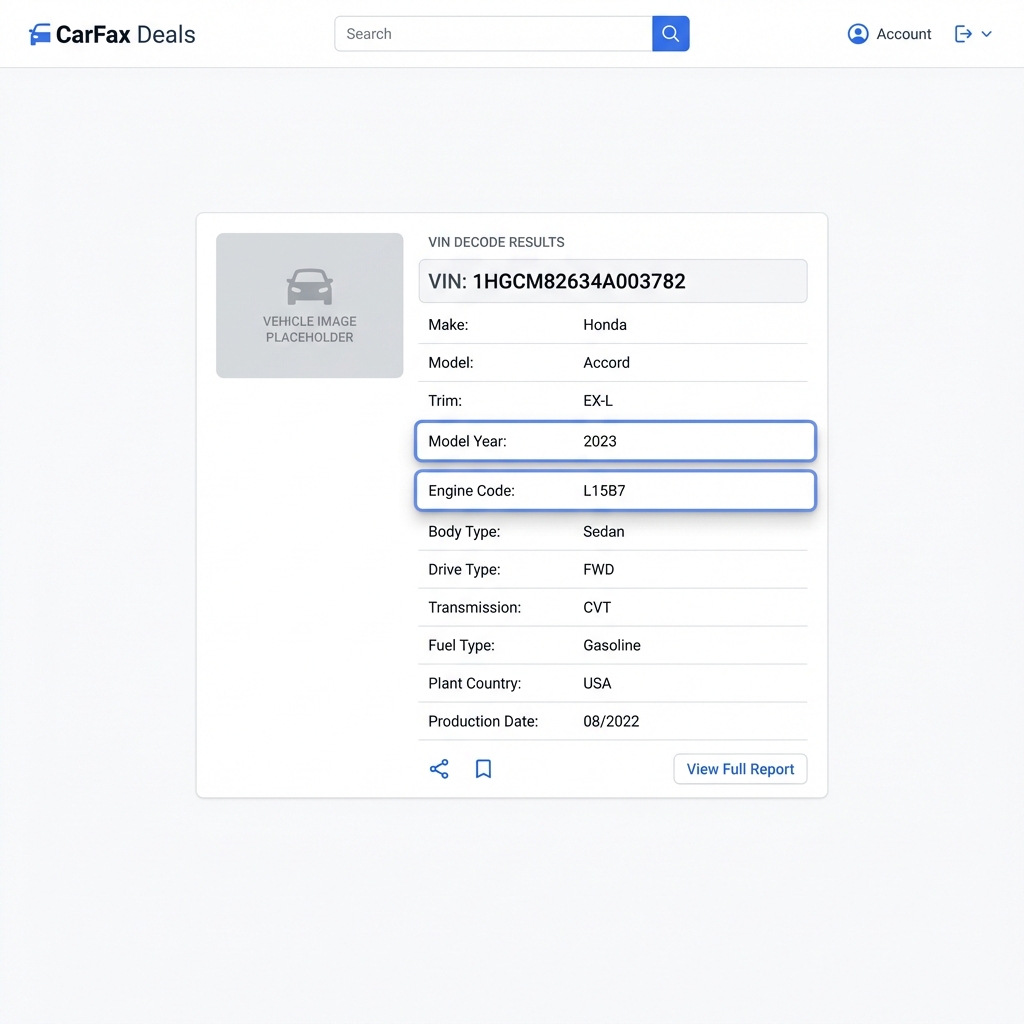
The vPIC decoder at vpic.nhtsa.dot.gov is the federal government's own VIN decoder, and it has no daily search cap. It reads the manufacturer-encoded fields and returns make, model, model year, body class, engine displacement and cylinder count, assembly plant, GVWR class, and the restraint systems the car was built with.
Use it as the first check on any listing, because it settles the cheapest question to answer: is this car what the seller says it is? A listing that claims a V6 on a VIN that decodes to a four-cylinder is either a copy-paste error or a deliberate one, and either answer changes what you do next.
NHTSA recall lookup: open campaigns only
The recall tool at nhtsa.gov/recalls returns safety recalls that are still unrepaired on that specific VIN. Recalls attach to the vehicle rather than the owner, so an open campaign a previous owner ignored transfers to you, and the repair stays free at any franchised dealer for that brand.
Four things it will not show:
- Recalls that have already been completed on the car
- Campaigns more than 15 years old, unless the manufacturer voluntarily extends coverage
- Very recent recalls where the manufacturer has not yet published the affected VIN list
- Recalls from small-volume manufacturers, including some ultra-luxury and specialty brands
An empty result on a 2005 car therefore means much less than an empty result on a 2022 car. You can also paste up to 100 VINs into a single search, which is the fastest free way to screen a shortlist.
NICB VINCheck: theft and total loss, five a day
NICB VINCheck is run by the National Insurance Crime Bureau and searches records contributed by participating member insurance companies. It answers two questions: has this vehicle been reported stolen and not recovered, and has a participating insurer declared it a salvage, flood, or total loss. It also covers some motorcycles and watercraft.
The limit is five searches per IP address per 24 hours, applied to stop commercial bulk scraping. If you are working a shortlist of listings, spend those five searches on the cars you would actually put money on.
The coverage gap matters as much as the daily cap. A car totaled by an insurer that is not an NICB member, or written off outside insurance entirely, comes back clean. Treat a clean VINCheck as the absence of a specific red flag, not as evidence of a clean history.
How to read a VIN before you run any tool
A 17-character VIN has been mandatory on vehicles built for the US market since the 1981 model year, and the character positions are standardized. You can verify the basics from the number itself in about 30 seconds.
| Position | Name | What it encodes |
|---|
| 1 to 3 | World Manufacturer Identifier | Country of origin, manufacturer, vehicle type or division |
| 4 to 8 | Vehicle Descriptor Section | Model, body style, engine family, series, restraint system |
| 9 | Check digit | A calculated 0 to 9 or X that validates the other 16 characters |
| 10 | Model year | A letter or digit on a repeating cycle |
| 11 | Assembly plant | The specific plant that built the vehicle |
| 12 to 17 | Serial number | The build sequence for that plant |
Three checks you can do by eye
- The letters I, O, and Q never appear in a VIN. They are excluded because they are too easily confused with 1 and 0. A VIN containing any of them is a transcription error or a fabrication.
- Position 10 gives the model year. R is 2024, S is 2025, T is 2026, V is 2027. The cycle repeats every 30 years, so on a passenger car use position 7 to break the tie: a digit there means model year 1980 to 2009, a letter means 2010 to 2039.
- Position 9 is a check digit. It is derived arithmetically from the other characters, which is why an altered or invented VIN usually fails validation in any decoder.
What no free VIN lookup will tell you
The free tools cover identity, recalls, theft, and total loss. Seven categories sit outside all of them:
- Reported accidents and the severity of the damage
- Dealer and independent service records
- Number of previous owners and how long each held the car
- Odometer readings captured at each title transfer
- Title brands recorded across all 50 state DMVs
- Open liens against the vehicle
- Use history such as rental, fleet, taxi, or lease
Title brands are the one people expect to find free. They sit in NMVTIS, the federal title database operated by the US Department of Justice, and NMVTIS is not a free consumer lookup. You buy access through an approved provider listed at vehiclehistory.gov, and every provider on that list receives the same federal title and odometer data.
When to stop using free tools and buy a report
Use the free sequence to eliminate cars. Buy a report on the one you are about to pay for. These conditions each justify the spend on their own:
- If the decoded trim, engine, or model year does not match the listing and the seller cannot produce a door jamb sticker photo, buy the report.
- If NICB returns a theft flag, do not buy a report. Walk away and notify local police rather than the seller.
- If the asking price sits well below comparable local listings with no explanation, buy the report.
- If you are buying out of state and cannot inspect the car in person, buy the report.
- If the car has had several owners in a short window, buy the report.
- If the car is worth a few thousand dollars, every free check is clean, and you can inspect it yourself, put the money toward a mechanic's pre-purchase inspection instead.
What the paid tier costs
| Report | Single report price | Strongest data |
|---|
| CarfaxDeals | $7.99, down to $3.00 per report on the 100-pack | Full Carfax vehicle history at a discount |
| Carfax direct | $44.99 | Franchise dealer service records |
| AutoCheck (Experian) | About $25 to $30 | Auction history and the AutoCheck Score |
| NMVTIS-approved provider | About $5 to $15 | Federal title brands and odometer records only |
Provider pricing changes, so confirm the current figure before you buy. The practical point is that the gap between the cheapest and most expensive report is mostly packaging and service-record depth, not the core title data, which every approved provider draws from the same federal source.
If you have already run the free checks and want the accident, title, and ownership timeline they cannot reach, compare CarfaxDeals report pricing or read how the report works before you buy.
A six-step free VIN check that takes about ten minutes
- Write the VIN down from the windshield base and the driver door jamb, then compare both against the title and the listing. Mismatched plates are the cheapest fraud there is to catch.
- Run the VIN through the NHTSA vPIC decoder and confirm model year, engine, and body class against what the seller claims.
- Run NICB VINCheck for theft and insurer total loss, spending your five daily searches on serious candidates only.
- Run the NHTSA recall lookup and note any open campaign, remembering that a clean result on a pre-2011 car proves less than on a recent one.
- Enter the VIN at KBB with honest mileage and condition, then compare the value ranges against the asking price.
- If any step returns a mismatch or a flag, or the car is worth more than a few thousand dollars, run a full vehicle history report before you hand over money.
Frequently asked questions
Is there a completely free VIN lookup?
Yes. The NHTSA vPIC decoder, the NHTSA recall lookup, NICB VINCheck, and the KBB VIN lookup are all free with no payment or subscription. Together they cover factory specification, open safety recalls, theft and insurer total loss, and market value. They do not cover accidents, service history, or ownership records.
Does KBB do a free VIN lookup?
Yes. Kelley Blue Book accepts a VIN to identify exact trim and factory options and returns trade-in, private party, and dealer retail value ranges at no cost. KBB also offers a free vehicle search that shows how many records exist in the full AutoCheck report, though the records themselves are a paid product.
Does a free VIN check show accidents?
No. No free VIN lookup returns reported accidents or damage severity. NICB VINCheck shows insurer-declared total losses, which is a narrower signal: a car can be in a significant collision, be repaired, and never appear as a total loss anywhere.
How many times can I use NICB VINCheck?
Five searches per IP address in any 24-hour window. The cap exists to prevent commercial bulk lookups. If you hit it, the sixth VIN has to wait until the window resets.
What does the 10th character of a VIN mean?
It encodes the model year. R is 2024, S is 2025, T is 2026, and V is 2027. Because the code cycles every 30 years, check position 7 on a passenger car: a digit there points to model years 1980 to 2009, a letter to 2010 to 2039.
Is a clean free VIN check enough to buy the car?
Not on its own. A clean result means the car is not in the specific databases you searched, which is different from a clean history. Pair the free checks with a physical title inspection, a mechanic's pre-purchase inspection, and a full history report on any car where the price makes the report cost trivial.
How much does a full vehicle history report cost?
Carfax lists a single report at $44.99, AutoCheck runs roughly $25 to $30, and NMVTIS-approved providers sell title and odometer reports for about $5 to $15. CarfaxDeals sells a full Carfax report for $7.99, dropping to $3.00 per report on the 100-report pack.
References


 Blog
Blog