Is the auto market crashing? — Is the auto market crashing?
The evidence does not support a single, abrupt auto market crash. New car sales in 2025 returned near long-run norms while dealer inventories rose and incentives expanded, which eased price pressure. Used-vehicle values cooled from pandemic peaks and showed signs of stabilization in late 2025, though outcomes vary by region and model.
A rav4 used for sale can be a sensible pick for many research-oriented buyers because reliability aggregators rate the model above average and safety ratings are generally strong. This guide explains how to vet listings, what model years tend to be better, and a step-by-step checklist to reduce risk before you buy.
This guide explains how to estimate the cost of buying an R34 Skyline, with attention to import rules, condition-driven price tiers and landed cost. It shows which factors move value, how to verify history and paperwork, and offers a checklist you can follow when you search for a nissan skyline r34 for sale.
This guide helps buyers set realistic expectations for tacoma trucks for sale by explaining the main price drivers and a repeatable method to build conservative, typical, and ambitious offer ranges. It shows how the 2024 redesign, valuation guides, and vehicle history reports interact to change asking prices and reduce purchase risk.
The phrase "auto market crash" is alarming, but the evidence through late 2025 does not support a single, nationwide collapse. Instead, the market shows a mixed picture: new car sales moved back toward long-run norms, inventories rose, incentives expanded, and used values cooled and then stabilized in many segments.
This article walks through the indicators that would confirm a crash, explains how recent sales and inventory data fit together, and gives a practical framework you can use to decide whether to buy now, wait, or shift to a different segment. It focuses on measurable signals and on steps buyers can take to reduce risk.
Data through late 2025 shows normalization rather than a uniform market crash.
Higher inventories and larger incentives in 2024-2025 eased upward price pressure for many models.
Used-vehicle wholesale indices cooled from pandemic peaks and showed late-2025 stabilization in many segments.
Quick answer: Is the auto market crashing?
Short summary for busy buyers
Short answer, the available data do not show a single, abrupt market crash. Instead, markets cooled in ways that look like a return toward normalcy for many segments, with uneven pockets of weakness by region and model.
U.S. light-vehicle retail sales in 2025 were close to long-run normalized levels rather than collapsing, a central reason experts describe the period as stabilization rather than a crash S&P Global Mobility sales outlook. For a recent discussion of monthly sales trends see S&P Global's auto sales blog.
Dealer inventories increased in 2024 and 2025 and manufacturers expanded incentive programs, which relieved upward price pressure on some new cars and improved buyer negotiation leverage in many markets Cox Automotive market report. Cox's 2026 outlook offers additional context Cox Automotive 2026 outlook.
This article assesses the measurable signs that would indicate a true crash and explains how recent sales, inventory, and wholesale trends fit together. It does not predict a specific price outcome for a particular model or guarantee future market moves.
Used-vehicle wholesale indices fell sharply from pandemic peaks into 2024 but showed signs of stabilization in late 2025, so retail used prices cooled in many segments without a uniform collapse Manheim used-vehicle value index.
What a true 'crash' would look like: indicators to watch
Sales, inventories and transaction prices
A rapid market collapse would show deep, persistent declines in retail sales, collapsing transaction prices at dealerships, and a simultaneous spike in dealer inventories. Those three moving together over several quarters is the clearest mechanical sign of a crash.
Retail sales volumes and transaction prices can move in opposite directions depending on inventory. If inventories keep rising while incentives jump and transaction prices fall for many models, that pattern would support a crash diagnosis.
Wholesale indices and auction trends
Wholesale indices track auction outcomes and often lead retail prices. A sudden, broad decline in auction prices across makes and model years would be an early warning signal because dealers rely on auction values to set retail offers Manheim used-vehicle value index.
Credit conditions and unemployment as stress tests
Credit spreads, underwriting standards, and unemployment act as stress tests for demand. A sharp deterioration in consumer credit availability or a meaningful rise in unemployment would reduce buyer capacity and could convert ordinary cooling into a rapid collapse Federal Reserve policy summary.
How recent data fits together: sales, inventories, and incentives
2025 sales versus long-run norms
Overall, 2025 retail activity looked more like a normalization after pandemic-era disruptions than a sudden drop. Analysts point to retail sales returning close to long-run norms as evidence that demand broadly rebalanced S&P Global Mobility sales outlook.
Inventory build and dealer leverage
Dealer inventories increased through 2024 and 2025, which reduced upward price pressure and gave buyers more choices on showrooms and online listings. More cars on lots generally means dealers face longer hold times and more willingness to offer concessions NADA dealer inventories report.
Higher inventories tend to lengthen dealer hold times because turnover slows when supply nudges ahead of demand, especially for slower-selling trims or model years. That dynamic can translate into moderately lower transaction prices without implying a crash.
Run a vehicle history report to add verification before you visit a dealer
Compare local listings with pricing context to see whether dealers are posting increased incentives or longer days on lot in your area.
Manufacturers expanded incentive programs in 2024 and 2025 to stimulate purchases where inventory rose, which often reduces transaction prices for specific segments or model years Cox Automotive market report.
In practice, incentives vary by brand, region, and model. That means buyers who shop specific trims and compare local offers can sometimes find better leverage than national headlines suggest.
Used-vehicle values and wholesale indices explained
What wholesale indices measure
Wholesale indices, like the Manheim used-vehicle value index, summarize average auction prices across many vehicles and model years. They are useful because they reflect dealer-to-dealer pricing that often precedes retail adjustments Manheim used-vehicle value index.
Pandemic peak to 2025 cooling and stabilization
Indices show a clear arc: sharp gains during the pandemic, notable declines through 2024, and signs of stabilization in late 2025. That pattern indicates a reversion toward longer-term norms rather than a sudden crash for the whole market.
What stabilization means for retail used prices
Stabilization in wholesale markets typically means retail used prices stop falling rapidly and settle into banded pricing that varies by make, model, age, and regional demand. Some vehicles remained above pre-pandemic norms while others moved closer to older price ranges Edmunds market trends. For a forward-looking perspective on market trends see Edmunds insights on 2026 trends.
Macroeconomic forces: interest rates, inflation, and affordability
How higher rates change monthly payments
Higher interest rates in 2024 and 2025 increased financing costs for buyers, which raises monthly payments and reduces how much some households can comfortably borrow.
When rates rise, affordability constraints often push buyers toward longer terms, lower-priced trims, or used cars. This shift can reduce demand for new vehicles at mainstream price points Federal Reserve policy summary.
Compare monthly payment scenarios for different loan rates and prices
Use as a quick comparison
Inflation and household budgets
Persistent inflation in 2024 and 2025 reduced discretionary budgets for some buyers, compounding rate effects and encouraging delayed purchases or shifts to lower-priced segments.
Credit conditions and buyer behavior
Tighter underwriting or wider credit spreads would make financing more expensive or harder to obtain for some buyers, which is an important downside risk that could deepen market softness Federal Reserve policy summary.
Regional and segment differences: why location and model matter
How luxury, EV and mainstream segments diverged
Luxury and EV segments often showed different inventory, incentive, and resale dynamics than mainstream internal combustion compact segments. That means buying choices should be model-specific and data-driven Manheim used-vehicle value index.
Regional inventory and demand patterns
Local market conditions create real variation: some regions had more inventory pressure, others retained tighter supply. National averages can hide these patterns, so local checks matter.
Why model-level data beats headline statements
Model year, trim and powertrain influence resale and reliability more than national summaries. Using model-level listings and history can change a decision from wait to buy for a particular vehicle.
A practical decision framework: buy, wait, or switch segments
Step 1: Check availability and pricing context
Step one is to compare local listings, including price analysis labels and comparable offers, to see whether specific models show real discounts or only temporary incentives Cox Automotive market report. For tips on comparing local listing detail see our blog.
Step 2: Assess personal affordability and financing
Next, estimate monthly payments given current rates and your down payment. If payments push you beyond a comfortable budget, waiting or choosing a lower-priced segment is reasonable.
Current evidence points to mixed cooling and stabilization rather than a single, abrupt crash; monitor sales, wholesale indices, inventories, incentives, and credit conditions.
Step 3: Decide based on model-specific resale risk
Finally, compare total cost to own and vehicle history details for chosen models. If resale risk or maintenance history looks unfavorable, switching segments or waiting can reduce long-term cost uncertainty Edmunds market trends.
Common mistakes buyers make when interpreting market signals
Overgeneralizing from national headlines
Buyers often take national averages as direct advice for a local purchase. That leads to missed opportunities or unwarranted caution because local supply and demand can differ materially.
Misreading incentives as permanent price declines
Increased incentives can be temporary, tied to manufacturer cycles or dealer targets. Treat incentives as a prompt to compare offers rather than proof that prices will stay low.
Ignoring model-level reliability and history
Focusing only on price without checking vehicle history reports and reliability studies can leave buyers exposed to higher total cost to own. Always verify title status and ownership history when possible Cox Automotive market report.
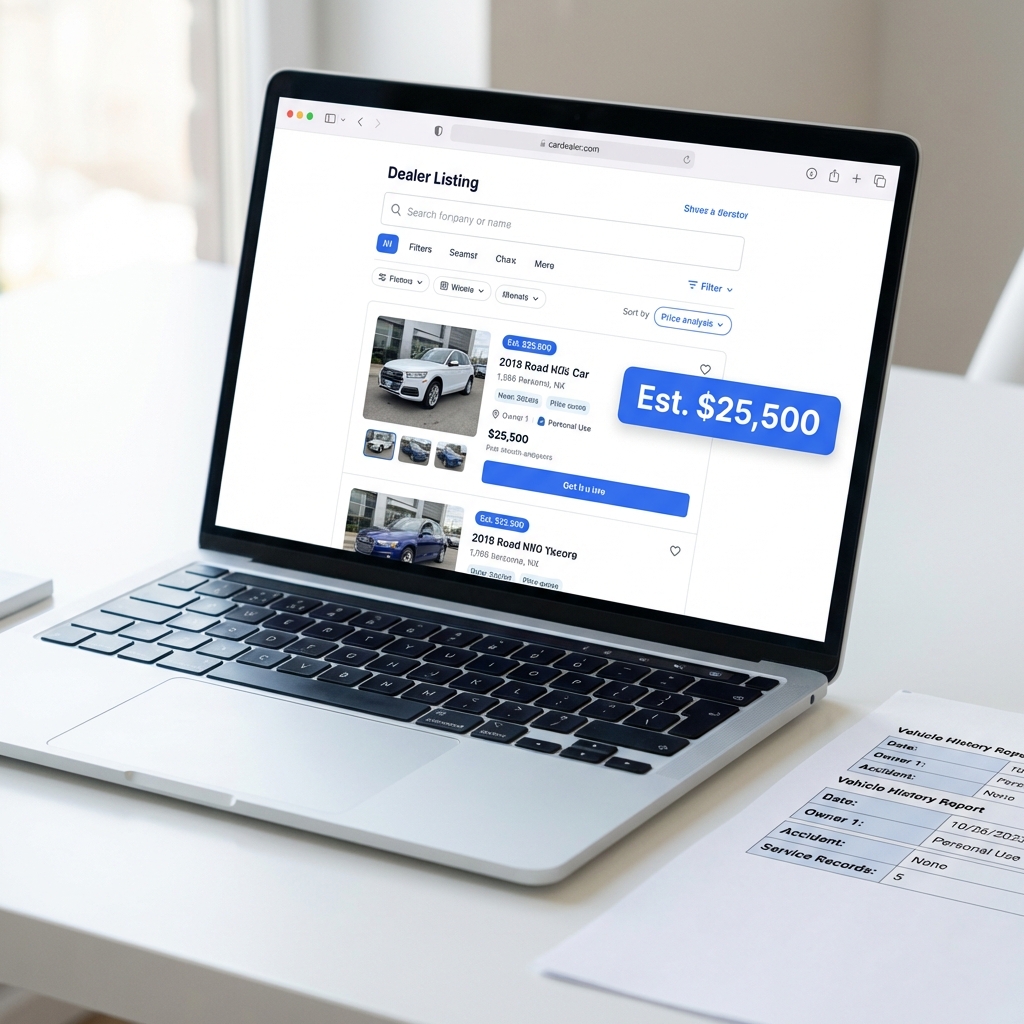
How to read a dealership listing: data points that matter
Title status, ownership history and service records
Prioritize the listing fields that confirm title status, ownership history, and service history, because these items directly affect risk and valuation for used cars.
Price analysis labels and comparable listings
Price analysis labels such as Great Deal, Good Deal, and Fair Deal are useful shorthand to compare a listing against local comparables, but confirm with similar-year and trim comparisons.
Dealer transparency signals to check
Look for dealer ratings, reviews, and a clear dealer profile. Those transparency signals can help you shortlist sellers to contact for an inspection or test drive NADA dealer inventories report.
Using vehicle history reports and pricing insights together
How history and price context reduce uncertainty
A vehicle history report helps verify title status, ownership history and reported accidents and can materially change the value you assign to a listing when paired with pricing insights.
When a history report changes the valuation
If a history report shows prior damage or inconsistent mileage, that can justify a lower offer or a decision to walk away, even when a price label indicates a Good Deal Edmunds market trends.
Limitations of reports and what to verify in person
History reports do not replace a physical inspection or professional mechanical check. Use reports to narrow choices and plan an inspection rather than as a final condition certification.
Scenario walkthroughs: examples for different buyer types
First-time buyer on a budget
A first-time buyer with tight monthly cash flow may focus on smaller, proven compact models and compare local pricing insights to find a reliable used option with lower payments.
Given higher rates in 2024 and 2025, choosing a slightly older model with strong reliability and a verified vehicle history report can be a defensible path to lower total cost to own Federal Reserve policy summary.
Family looking for reliable daily driver
For families, prioritize well maintained models with clean title and a clear service history. Compare price analysis labels across local listings and factor in expected repair costs when calculating total cost to own.
Buyer targeting EV or luxury model
Buyers targeting EVs or luxury models should pay special attention to incentives, local inventory for those segments, and model-specific resale behavior because those dynamics differed from mainstream segments in 2024 and 2025 Manheim used-vehicle value index.
What to monitor over the next 12 months
Leading indicators to re-check monthly
Check retail sales reports, the Manheim index, local inventory listings and manufacturer incentives monthly to track whether cooling stabilizes or worsens Manheim used-vehicle value index.
Signals that would change the recommendation
Key signals that would prompt revisiting the buy or wait guidance include sustained declines in retail sales, a broad fall in auction prices, or a sudden tightening of consumer credit.
How to set simple alerts and benchmarks
Set alerts for large local changes in inventory or sudden incentive announcements and establish benchmarks such as a multi-week drop in wholesale indices or a quarter-over-quarter sales decline to trigger a review.
How CarFax Deals can fit into your research workflow
Using vehicle history reports before contacting a dealer
CarFax Deals can act as a verification layer by pairing dealership listings with vehicle history reports and pricing insights to reduce uncertainty before a test drive. Access history reports at CarFax Deals VIN report.
Comparing pricing insights across local listings
Use price analysis labels and local comparables to see whether a listing is aligned with nearby offers, and treat those labels as context rather than as final valuation.
Applying dealer transparency signals to shortlist sellers
Check dealer reviews and profile information to prioritize dealers that provide clear contact information and transparent listing details, and then plan inspections or test drives.
Conclusion and quick action checklist
Key takeaways
Current evidence points to a mixed cooling and stabilization across new and used markets rather than a single market crash. New car sales returned close to long-run norms in 2025, dealer inventories rose, incentives expanded, and used values cooled before stabilizing S&P Global Mobility sales outlook.
Short checklist before you buy or wait
Checklist: verify pricing context against local comparables, run a vehicle history report, review incentives and dealer hold times, and confirm financing affordability. If multiple indicators deteriorate together, reconsider the timing of a purchase Cox Automotive market report.
No. The evidence through late 2025 points to mixed cooling and stabilization rather than a single, abrupt market crash, though risks remain if macro conditions worsen.
It depends on your personal affordability and local listings. Compare pricing context and financing costs; if incentives and inventory give you clear savings, buying may make sense, otherwise waiting is reasonable.
Compare the listing to local comparables, look for a price analysis label, and run a vehicle history report to verify title and service records before arranging an inspection.
Monitor a short list of indicators monthly and revisit your plan if multiple signals move together. Use vehicle history reports and local pricing context to make model-specific decisions rather than relying on national headlines.
Staying data-driven and checking financing options will help you act with more confidence even as markets shift.


 Blog
Blog