What is the oldest car you should buy? Practical guidance and checks
A clear, evidence-based guide to judging whether old cars for sale make sense for your needs. The article explains typical thresholds many guides use, the four main risk drivers you should check, and a step-by-step framework for commuters, budget buyers, and enthusiasts. It shows how to use a vehicle history report and pricing insights to reduce uncertainty before you bid or visit a dealer.
A rav4 used for sale can be a sensible pick for many research-oriented buyers because reliability aggregators rate the model above average and safety ratings are generally strong. This guide explains how to vet listings, what model years tend to be better, and a step-by-step checklist to reduce risk before you buy.
This guide explains how to estimate the cost of buying an R34 Skyline, with attention to import rules, condition-driven price tiers and landed cost. It shows which factors move value, how to verify history and paperwork, and offers a checklist you can follow when you search for a nissan skyline r34 for sale.
This guide helps buyers set realistic expectations for tacoma trucks for sale by explaining the main price drivers and a repeatable method to build conservative, typical, and ambitious offer ranges. It shows how the 2024 redesign, valuation guides, and vehicle history reports interact to change asking prices and reduce purchase risk.
Buying an older used car mixes practical trade-offs. Age can lower price but raise uncertainty about repairs, safety features, and parts. This guide translates common consumer thresholds into a short checklist and decision framework you can use while browsing listings.
It presents the four risk drivers that matter most, shows how to verify records and condition, and offers scenario-based guidance for commuters, budget buyers, and enthusiasts. Use these steps to reduce uncertainty before you run a report or visit a dealer.
Many guides use roughly a 10-year or up to about 100k-150k mile threshold for lower-risk daily drivers.
Confirm service history, check for corrosion, verify parts and emissions compliance, and use a vehicle history report before you inspect.
A well-documented older car can be a good buy; missing records, structural rust, or parts scarcity are the main red flags.
Quick answer: how to judge if an old car is still a sensible buy
Many consumer guides suggest a simple bottom line: for a lower-risk daily driver choose cars roughly 10 years old or newer, or examples with total mileage commonly below about 100,000 to 150,000 miles. This threshold is a practical starting point because it tends to balance remaining useful life, safety features, and parts availability when compared across typical models and commuter needs AAA guidance on buying a used car.
Beyond an age or mileage number, four risk drivers usually decide whether an older listing is acceptable: a complete service history, cumulative mileage and recent maintenance, visible corrosion or frame rust, and model-year constraints such as parts and emissions. If those four areas check out, many older cars can still be sensible buys for the right buyer; if one or more are weak, the risk and likely near-term cost rise Edmunds used car inspection advice.
Run Vehicle History Report
Run a vehicle history report on any listing you are seriously considering to check ownership and service signals before you visit.
Buyer type matters. Commuters tend to prefer the lower-risk 10-year-or-newer window with moderate mileage. Budget buyers may accept 10 to 20-plus year cars if the service history and immediate repair needs are clearly documented. Enthusiasts and restorers accept any age but must plan for parts, inspections, and higher ownership costs.
Why vehicle age matters: trade-offs between cost, safety, and reliability
Age is a convenient proxy for several underlying risks. Older model years are more likely to lack the latest crash-avoidance systems and may show more wear on consumables and mechanical components. That combination increases the probability of near-term repairs and can change expected ownership cost and resale trajectory IIHS guidance on buying a used car. See the IIHS shopping-for-safety guide IIHS shopping-for-safety.
Model-year safety improvements are documented across multiple studies and reviews. Newer vehicles often add features that reduce crash frequency or severity, so two cars of identical mileage but different model years can carry different safety profiles. That effect makes age relevant even when a specific car looks well cared for a model-year safety review. See the IIHS safe vehicles for teens list IIHS safe vehicles for teens.
On the cost side, age increases the chance that rubber, bushings, hoses, and other wear items are approaching replacement. Parts availability and labor complexity can add to repair bills for older vehicles, and some models develop known late-life failure modes that raise maintenance risk.
Still, age alone does not determine value. A well-documented, single-owner vehicle with consistent service history and moderate mileage can outperform a newer car with incomplete records. Use age as a guide, not a verdict.
A simple decision framework: the four risk drivers to check first
Apply a compact checklist when you open a listing. The four risk drivers are: verified maintenance and service history; cumulative mileage and recent major services; visible corrosion or structural rust; and parts or emissions constraints tied to the model year. Treat each as a gate: one serious failure usually raises the total risk above acceptable levels for commuting uses AAA guidance on buying a used car.
For typical daily driving, many guides suggest prioritizing cars about 10 years old or newer or with under roughly 100k-150k miles; evaluate older cars by checking service history, mileage, corrosion, and parts or emissions constraints.
Weight the drivers by buyer type. Commuters prioritize low near-term repair risk and modern safety features, so they give extra weight to service history and mileage. Budget buyers accept higher repair probability but require strong service records or evidence of recent major fixes. Enthusiasts focus on parts availability and restoration cost and may accept missing modern safety equipment.
Always verify ownership and service claims with a vehicle history report before you travel for an inspection. A verified report can confirm single-owner claims, show service entries, and flag title events you should research further Edmunds inspection checklist.
Mileage and maintenance: what records and numbers really matter
Many guides use the 100,000 to 150,000 mile band as a practical breakpoint for everyday drivers. That range does not mean a car with 120,000 miles is automatically bad, but it does mean a buyer should expect certain wear items either recently replaced or due soon. Confirming recent major services (timing belt or chain work, transmission service, recent brake or suspension work) reduces uncertainty AAA guidance on buying a used car.
Odometer reading is one signal. Service logs and receipts are stronger evidence. Look for consistent entries showing oil changes at suitable intervals, brake service, and records of larger jobs. Single-owner histories or dealer-maintained service stamps carry more weight than spotty, year-separated receipts.
Red flags in maintenance records include long gaps in service, vague descriptions (for example a single line that just says "maintenance" without dates), and a sudden cluster of major repairs that might indicate prior neglect or recent attempts to make a problematic car presentable. Ask for the original receipts and digital images when possible, and cross-check mileage progression with the vehicle history report.
Before you bid or offer, request a fresh vehicle history report and ask whether recent maintenance was performed by a certified shop or dealer. If a major item like timing belt replacement or transmission overhaul is unverified, budget for inspection or a potential immediate repair.
Rust, corrosion and prior structural damage: inspection and walk-away signals
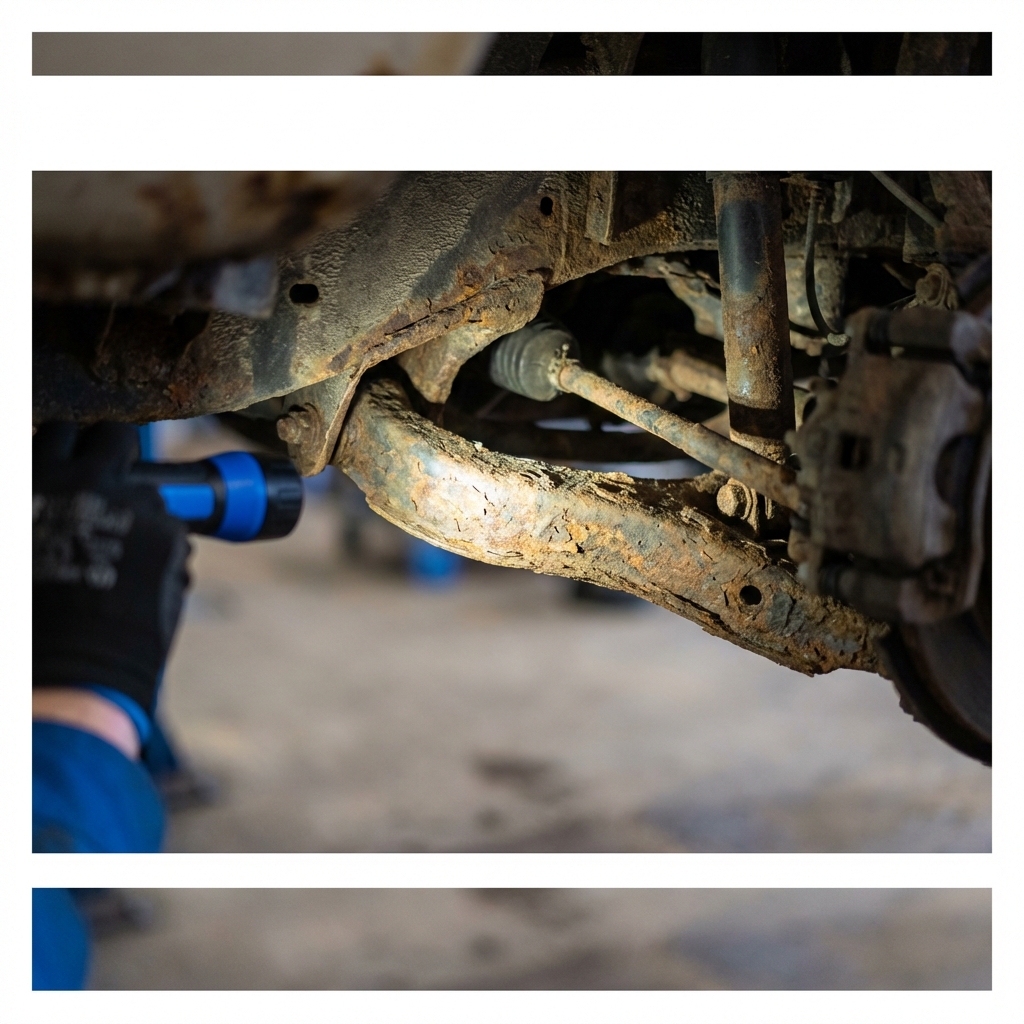
Rust is one of the clearest failure modes that can convert a low-cost purchase into a costly one. Look for frame rust, rust-through at suspension mounting points, general underbody pitting, and bubble-shaped paint blistering that indicates rot beneath the surface. Where structure, mounts, or unibody components show significant corrosion, guides commonly recommend walking away or getting a thorough professional inspection IIHS guidance on buying a used car.
Minor surface rust on panels is common and often repairable at modest cost. Structural corrosion, visible holes, or rust that changes the fit of panels and doors are much more serious. If the seller cannot answer where recent rust repairs were done or provide a mechanic report, treat this as a high-risk sign.
Visual checks have limits. Hidden frame damage from prior accidents or long-term exposure is not always visible in photos. For any listing with visible corrosion or a history of collision repairs, insist on a professional pre-purchase inspection that includes a lift check of the underbody.
Document what you see. Take dated photos, note locations and descriptions, and use those points to negotiate or to decide to walk away. In many cases, severe corrosion materially increases both repair cost and safety risk.
Safety features and model-year updates: what older cars are likely to lack
Model-year updates often include crash-avoidance systems, stronger occupant structures, or additional airbags. Older model years are more likely to miss features such as automatic emergency braking, lane departure mitigation, or advanced airbag systems. Where safety is a priority, favor more recent model years where those systems became standard on the model or trim IIHS guidance on used car safety. See Consumer Reports coverage Consumer Reports.
Confirm the equipment list for the specific model year and trim rather than assuming all examples have the same options. Manufacturer brochures, dealer spec sheets, and many vehicle history reports or online spec tools can show whether a particular VIN includes a given safety feature.
Remember that the presence of certain safety systems changes the relative risk for crash outcomes, but does not replace the need for a mechanical inspection. Safety equipment reduces some risks but cannot compensate for severe structural damage or poor maintenance.
Parts availability, emissions rules and regional constraints to check
With increasing age, parts scarcity and regional inspection rules become real constraints. Some engines or niche powertrains move into limited parts channels, and certain older model years can fail local emissions or safety inspection requirements without modification. Check local regulations and parts supply before you commit to a purchase NHTSA buying used vehicle tips.
Search parts catalogues, local salvage listings, and OEM dealer inventories for the specific engine and major assemblies. For rare powertrains or early hybrid systems, verify whether major components are still listed and how long typical lead times are. If parts are scarce, the effective ownership cost increases, and repair timelines can be long.
Local parts and inspection readiness lookup
Start with your VIN and model year
Emissions and inspection windows vary by state and country. A car that passes in one jurisdiction may require adjustments or fail in another. Confirm local inspection rules before making an offer, and factor any required changes into your cost estimate.
How to use a vehicle history report and pricing labels to reduce uncertainty
Vehicle history reports commonly include ownership history, accident and title events, and sometimes service entries or mileage checks. Use the report to confirm single-owner claims, spot title brands, and note service events that match the receipts the seller provides AAA advice on verifying history.
Pricing context labels on listings, such as Great Deal or Good Deal, indicate local market position but do not replace inspection or verification. Use pricing insights to compare similar listings and to identify outliers that may be underpriced because of hidden issues or overpriced despite poor records Edmunds pricing and inspection guidance.
Prioritize listings that combine reasonable pricing context, a clean title status on the report, and documented service history. Those three signals together reduce uncertainty and increase the chance the car is a sensible short-list candidate.
If a listing lacks a report or has conflicting service claims, either request that the seller provide verifiable records or run your own VIN check before scheduling an in-person inspection.
A buyer-oriented age-miles matrix: what to aim for by buyer type
Translate the general guidance into three pragmatic rows. Commuters: aim for cars roughly 10 years old or newer and under approximately 150,000 miles, with a verified service history and no serious corrosion. Budget buyers: acceptable range often expands to 10 to 20-plus years if the car has consistent service records, recent major repairs, or demonstrably low immediate repair needs. Enthusiasts: any age can be acceptable, but parts availability, restoration cost, and inspection become the dominant concerns Edmunds inspection guidance.
Condition can move a car between categories. A 15-year-old vehicle with a full service history, recent major components replaced, and no rust may be acceptable for commuters in some cases. Conversely, a 6-year-old car with incomplete records and frame corrosion can be a poor choice for a daily driver.
Use a simple rule-of-thumb: if at least two of the core signals (service history, mileage, corrosion, emissions/parts) are weak, class that car as higher risk for commuting needs. If all four read well, an older car may be reasonable even if its year is outside the typical commuter window.
Pre-bid inspection checklist: what to do before you place an offer
Documents to request: a vehicle history report, all available service records, and clear title documentation showing title status and ownership history. Verify that mileage progression on receipts matches the report and photos. If the seller cannot provide records, treat that as increased uncertainty AAA guidance on documentation.
Walk-around checklist: look for visible rust at wheel wells and undercarriage, fluid leaks, uneven tire wear, and signs of patch paint or mismatched panels. Test-drive priorities: listen for abnormal engine noises, check shifting behavior under load, evaluate steering and brake response, and confirm electronics and climate functions operate normally.
Bring simple test items: a flashlight for underbody checks and a phone to record photos and video. If anything seems amiss, schedule a professional pre-purchase inspection before you place a firm offer. A mechanic can check for structural issues, suspension wear, and hidden leak sources.
When negotiating, use documented issues and the lack of verified service history as points to adjust offers or to request that certain fixes be completed before sale.
Common mistakes and pitfalls buyers make with older cars
A frequent error is relying solely on photos. Images can hide corrosion, oil leaks, and drivetrain issues that appear only under lift or during a test drive. Another mistake is assuming cosmetic fixes mean the mechanical work is done. Paint and body repairs do not guarantee structural integrity IIHS advice on inspecting used cars.
Underestimating long-term ownership costs is common. Budget buyers may focus on initial purchase price and neglect parts rarity, upcoming service needs, or known model-specific failures. Always estimate near-term maintenance and include a contingency for unseen repairs.
Avoid trusting vague service claims. Ask for dated receipts and cross-check them against the vehicle history report. If receipts are missing, a report can sometimes show service mileage entries and title events that help corroborate seller statements.
Finally, do not assume an older car has the same safety capability as a newer model year. If safety is important, prioritize model years and trims that introduced the specific crash-avoidance features you value.
Three practical buyer scenarios: applying the framework in real cases
Scenario A, commuter on a budget: acceptable target is a 7 to 12-year-old compact with under 120k miles, a clear vehicle history report showing single-owner or consistent service entries, and no visible frame corrosion. Non-negotiables: documented timing belt or equivalent major service if applicable, no title brands, and a clean underbody inspection. If these fail, walk away or require a professional inspection AAA guidance on commuter choices.
Scenario B, family needing reliability: favor a car under 8 years old with moderate mileage, complete service history, and modern safety options such as electronic stability control and additional airbags. Verify safety equipment for the specific VIN and prioritize listings with clear pricing insights that match local market comparables Edmunds on family-oriented checks.
Scenario C, enthusiast restoring an older model: acceptable age is wide but plan for parts sourcing and restoration cost. Verify parts availability early, confirm whether common replacement components are still produced, and check salvage and specialty retailers. For niche powertrains, confirm service manuals and specialist support before you buy.
For all scenarios, the decision steps are similar: screen by age and mileage, request a vehicle history report and service records, inspect or hire a professional, and then use pricing context to shape a fair offer.
How age affects price and what fair pricing looks like
Price generally declines with age and higher mileage, but condition and service history adjust that pattern. A well-documented older car can command a premium over a poorly documented newer example because verified maintenance lowers perceived near-term risk. Use local pricing context and price analysis labels to compare similar listings before assuming an asking price is fair Edmunds pricing context.
Spot outliers: a very low price with missing history or visible corrosion is rarely a bargain once inspection costs and parts issues are included. Conversely, an asking price slightly above market may be reasonable if the car has verifiable major services and a clean vehicle history report.
Conclusion: short decision checklist and next steps
Compact checklist: verify service history with a vehicle history report, check cumulative mileage against your needs, inspect for rust or structural damage, and confirm parts and emissions compliance for the model year. If two or more of these signals are weak, treat the car as higher risk for daily driving and budget accordingly AAA decision guidance.
For most commuters, guides usually recommend cars roughly 10 years old or newer with moderate mileage and a verified service history; exceptions exist when documentation and condition are strong.
Yes, if it has a complete service history, low immediate repair needs, no structural rust, and you confirm parts availability and emissions compliance for your region.
A vehicle history report combined with original service records offers the clearest single view into ownership, service, and title signals you should verify before inspection.
If a listing looks promising, order a vehicle history report and request service records before you travel. Use the checklist in this guide during the walk-around and test drive, and consider a professional pre-purchase inspection when corrosion or complex mechanical work is likely.
These steps help you compare listings with clearer context, but they do not guarantee a problem-free ownership experience. Treat them as risk-reduction measures that inform a more confident decision.


 Blog
Blog